
By Mohammed Moinuddin
Technology & Market Analyst, VeritaLogic

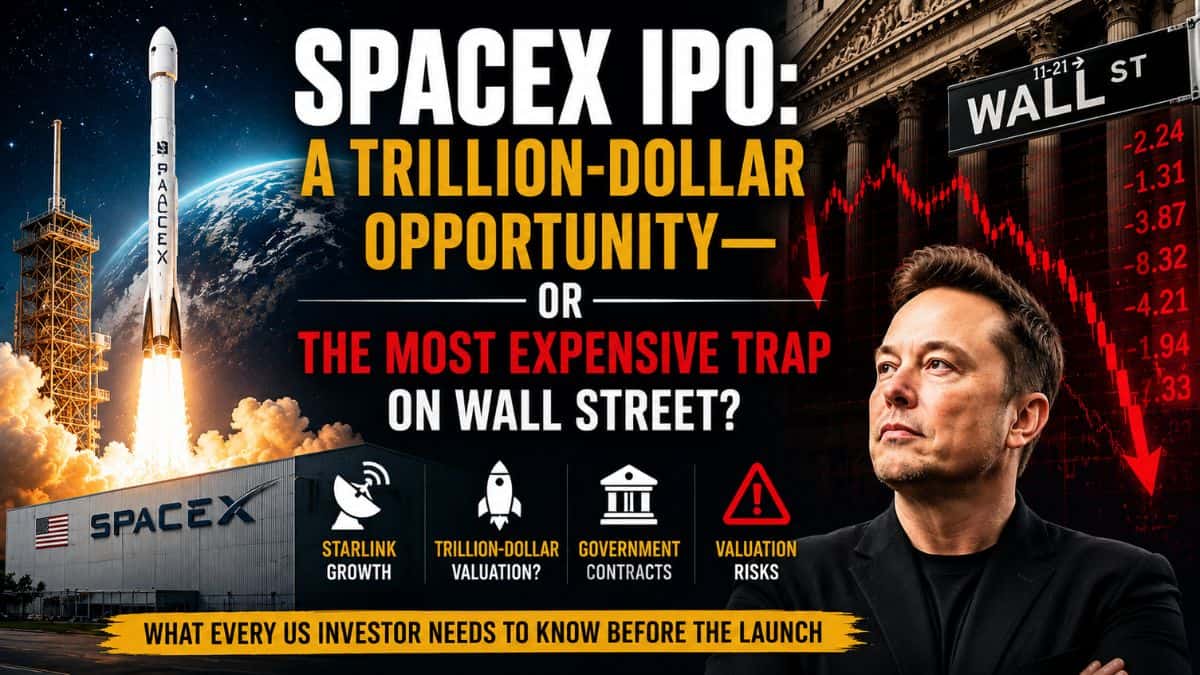
Could SpaceX become Wall Street’s next trillion-dollar company, or are investors underestimating the risks?
For years, investors have watched SpaceX from the sidelines while private shareholders enjoyed one of the most extraordinary value-creation stories in modern business history. Now, the conversation is changing.
Wall Street is increasingly focused on a question that could reshape both the aerospace industry and technology investing: If SpaceX eventually goes public, will it become the investment opportunity of a generation-or the most expensive stock retail investors have ever chased?
That distinction matters because history is full of companies that changed the world while simultaneously delivering disappointing returns to investors who bought at the wrong price. SpaceX may be the latest test of that reality.
🇺🇸 Why This Matters to You
Even if you never plan to buy a SpaceX share directly, chances are the company will eventually appear in your financial life through retirement portfolios, growth-focused ETFs, or index funds. The moment SpaceX becomes publicly accessible, millions of Americans may gain exposure without fully understanding the underlying risks.
The Golden Rule of Wealth Preservation: A great company does not automatically become a great investment.
🚀 The Business Behind the Hype: A Strategic Powerhouse

Reusable rockets have helped SpaceX secure a leading position in the global launch market.
SpaceX is no longer simply a rocket company. It has quietly evolved into one of the world’s most strategically important infrastructure businesses. Its revenue streams span multiple key sectors:
- Commercial Launch Services: Dominating the global satellite market with highly efficient, reusable Falcon rockets.
- Government & Defense Contracts: Serving critical, multi-billion dollar payload deliveries for NASA and the U.S. Department of Defense.
- Starlink Broadband: The fastest-growing, consumer-facing satellite communications platform globally.
- Future Space Infrastructure: Heavy projects like Starship and deep-space logistics representing massive long-term upside.
This diversification is what makes SpaceX fundamentally different from many high-growth technology firms. It isn’t dependent on a single product cycle.
📡 What Most People Are Missing: The Starlink Factor
 Reusable rockets have helped SpaceX secure a leading position in the global launch market.
Related Reading: How Dell, Snowflake & Ford Are Turning AI Into Real Business Growth
While the mainstream media focuses heavily on fiery rocket launches, Wall Street is looking directly at Starlink. The real investment story here may not be aerospace at all; it may be global telecommunications.
For decades, internet access depended on expensive terrestrial infrastructure like fiber-optic cables and cell towers. Starlink changes that entire equation by delivering high-speed internet directly from space to underserved markets. Many institutional investors now view SpaceX as a communications company that happens to launch rockets-not the other way around.
💰 The Trillion-Dollar Question: Valuation vs. Reality
Elon Musk Could Become a Trillionaire as SpaceX Eyes IPO (ABC News)
ABC News explores how a future SpaceX IPO could potentially push Elon Musk toward trillion-dollar status.
Source: ABC News via YouTube
 A trillion-dollar valuation may be possible, but investors must weigh growth expectations against execution risks.
Valuation is where psychological excitement meets raw financial reality. Some bullish projections suggest a future public valuation exceeding $1 trillion. But smart investors should pause. A company can execute its mission flawlessly and still turn out to be a poor investment if the entry price you pay is fundamentally too high.
📊 Historical Lessons: When Great Companies Were Poor Investments
| Company | Historical Period | The Structural Lesson for Investors |
|---|---|---|
| Cisco | Dot-com Boom | Its market importance grew massively, but the stock took nearly two decades to recover from its peak hype valuation. |
| Amazon | 2000 Market Collapse | Lost 90% of its market value before eventually becoming a dominant force. Entry price matters. |
| Alibaba | Record Global IPO | Massive e-commerce growth didn’t prevent long-term public stock underperformance due to macro shifts. |
| Rivian | EV Market Frenzy | High valuation expectations left zero room for execution errors, leading to heavy retail losses. |
🏛️ The Corporate Governance Question
 SpaceX sits at the intersection of technology, connectivity, and national security, making it one of the most closely watched private companies in the world.
Professional institutional investors are focusing heavily on governance. Early structural reports suggest that Elon Musk could maintain substantial, near-total voting control over the enterprise through specialized multi-class share structures.
This means you could legally own shares in the company but have zero influence over major corporate decisions. While founder control can protect long-term innovation from short-term quarterly market pressures, it also significantly reduces management accountability.
📉 The Dilution Risk Few Retail Investors Discuss
Building a Mars transportation system is incredibly capital-intensive. Unlike lean software companies, aerospace firms require massive, ongoing physical capital injections. Future fundraising could lead to consistent shareholder dilution.
Every time new equity shares are issued to raise capital, your existing ownership percentage of the total company declines. Retail investors frequently overlook this structural risk while chasing top-line revenue growth charts.
🎯 The Single Metric Investors Should Watch
Forget the media headlines. The single fundamental metric that matters most is Starlink subscriber growth.
Recurring subscription revenue natively commands much higher market valuations and multiples from Wall Street than volatile, project-based launch contracts. If Starlink continues successfully expanding into rural broadband, maritime, and aviation sectors, its long-term value proposition becomes significantly stronger.
📈 Which Public Stocks Could Feel the Impact?
A historic SpaceX IPO would immediately ripple across the commercial space sector, forcing money managers to reassess existing public alternatives. Investors should watch these specific stocks:
- Rocket Lab USA
(NASDAQ: RKLB)– SpaceX’s closest rival in payload launch infrastructure. - AST SpaceMobile
(NASDAQ: ASTS)– Expanding direct-to-cell global satellite connectivity. - Iridium Communications
(NASDAQ: IRDM)– A legacy player in mobile satellite data networks.
🏁 Final Verdict: What Investors Should Do Right Now
Who Can Get In on the SpaceX IPO? (Bloomberg Television)
Bloomberg analysts discuss who may gain access to a future SpaceX IPO and what retail investors should expect.
Source: Bloomberg Television via YouTube
Before getting caught up in the inevitable market FOMO (Fear Of Missing Out), take these practical actions:
- Review Your Personal Risk Tolerance: High-profile, generation-defining IPOs are notoriously volatile at launch.
- Study the Core Fundamentals: Look deeply at net cash flow and real subscriber growth numbers, not just social media headlines.
- Understand Your Voting Rights: Know clearly if you are buying a legitimate seat at the boardroom table or just a ticket for the ride.
- Be Patient: Historical indicators prove that patience almost always outperforms urgency in the world of investing.
SpaceX sits at a rare intersection of connectivity, global communications, and national defense security. It is a strategic corporate asset few private businesses can ever match. The challenge for you as an investor is determining whether the future public price reflects an opportunity-or assumes absolute perfection.
❓ Frequently Asked Questions (FAQ)
Is SpaceX publicly traded right now?
No. SpaceX remains a privately held company. Shares can only be traded on private secondary markets by institutional funds or accredited employees.
Why is Starlink critical to SpaceX’s valuation?
Subscription-based revenue is predictable, scalable, and generates consistent monthly cash flow, which commands much higher premiums on Wall Street than project-based rocket launches.
What is the biggest risk for retail investors?
Valuation risk-paying a massive premium at launch that already assumes flawless future execution and decades of zero competition.
Could SpaceX hit a $1 trillion valuation?
It is possible, but it requires sustained dominance in deep-space logistics and massive, unhindered global expansion of Starlink’s subscriber base.
📝 Editorial Note & Source Transparency
This analysis is based on publicly available economic indicators, historical capital market data, regulatory space registries, and commercial aerospace supply-chain reporting. The VeritaLogic Editorial Team independently reviews and synthesizes data from multi-source disclosures-including corporate filings, institutional investment banking prospectuses, and historical market performance trends-to provide balanced, objective consumer insights. The views expressed are intended strictly for informational and educational purposes and must not be construed as official financial, investment, legal, or tax advice. Retail investors must conduct independent due diligence and consult with a certified financial professional prior to executing asset allocation decisions.