

The AI Story Is No Longer Just About Nvidia
A year ago, most discussions about artificial intelligence investing revolved around a relatively small group of companies. Nvidia dominated global headlines with its AI chips, while Microsoft continued expanding its AI-powered cloud services. Investors rushed toward businesses directly involved in building large language models and the infrastructure needed to support them.
That narrative is now beginning to change.
Recent corporate earnings reports suggest that artificial intelligence is no longer confined to semiconductor manufacturers and Silicon Valley software giants. Instead, AI is steadily spreading across industries that many investors once considered traditional, slow-moving, or unrelated to advanced technology.
This shift matters because it signals a broader transformation across the economy. The companies benefiting from AI today are no longer just creating the technology. They are finding practical ways to deploy it, improve efficiency, reduce costs, and create new revenue opportunities.
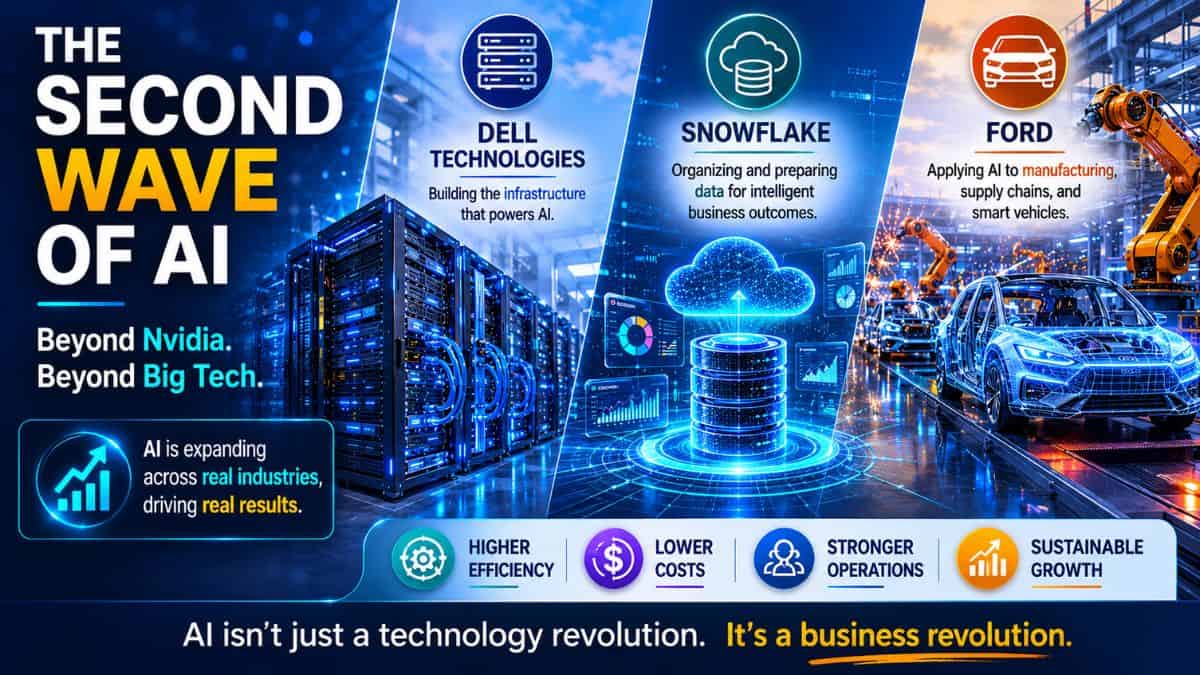
Three companies illustrate this trend particularly well: Dell Technologies, Snowflake, and Ford Motor Company. While they operate in entirely different industries, each demonstrates how AI is becoming a core part of modern business operations.
The Second Wave of AI Investing
The first wave of AI investing was relatively straightforward.
Investors focused on companies building the foundation of artificial intelligence. Semiconductor manufacturers, cloud providers, and software developers attracted most of the market’s attention because they supplied the tools required to train and run advanced AI systems.
However, technology markets eventually mature.
Today, investors are asking a more practical question:
Which companies can successfully use AI to improve real-world business performance?
This marks what many analysts describe as the second wave of AI investing.
Rather than concentrating solely on businesses that develop AI technologies, investors are increasingly evaluating companies that use AI to improve productivity, optimize supply chains, strengthen customer experiences, and generate measurable business results.
Dell, Snowflake, and Ford provide three distinct examples of how this shift is unfolding.
Dell Technologies: Building the Physical Foundation of AI

When most consumers hear the Dell name, they think of laptops, monitors, and desktop computers. Institutional investors often see something different.
Dell has become an important supplier of enterprise infrastructure needed to support modern AI workloads.
As organizations adopt AI across departments, they require increasingly powerful computing systems capable of processing large datasets, advanced analytics, and machine-learning applications. This growing demand has increased interest in enterprise-grade servers and data-center equipment.
One reason Dell has attracted renewed investor attention is the growing demand for AI-ready infrastructure. As more organizations experiment with private AI systems, spending is increasingly moving beyond software and into physical computing capacity.
Dell’s Infrastructure Solutions Group (ISG) has become a key part of that trend.
| Dell AI Infrastructure Focus | Business Impact |
|---|---|
| High-performance servers | Supports enterprise AI workloads |
| Liquid-cooled systems | Improves efficiency for intensive computing |
| Data-center solutions | Expands AI deployment capacity |
| Enterprise hardware | Supports hybrid and private AI environments |
One notable trend is the rise of private and hybrid AI environments.
Rather than relying entirely on public cloud providers, many organizations are exploring ways to deploy AI capabilities within their own infrastructure for greater security, compliance, and operational control.
This creates significant opportunities for companies like Dell that provide the physical hardware powering those environments.
In many ways, Dell serves as a reminder that every AI application ultimately depends on real-world infrastructure. Without servers, storage systems, and computing power, artificial intelligence remains little more than software code.
Snowflake: Organizing the Data That AI Depends On
Artificial intelligence is only as valuable as the data behind it.
A sophisticated AI model cannot produce meaningful insights if the underlying information is incomplete, fragmented, outdated, or poorly organized.
This challenge is exactly where Snowflake has positioned itself.
Traditionally known as a cloud data platform, Snowflake has become increasingly important in enterprise AI initiatives. Its value extends beyond simple data storage.
Organizations use Snowflake to unify information across departments, improve accessibility, maintain governance standards, and prepare datasets for AI applications.
This process is commonly known as data readiness.
AI systems often produce unreliable outputs when they rely on incomplete, outdated, or poorly structured data. For industries such as healthcare, banking, insurance, and financial services, data quality and security are critical.
Organizations cannot simply move sensitive information into unsecured environments.
Snowflake’s platform allows businesses to manage, analyze, and prepare large datasets while maintaining strict security and compliance requirements.
As enterprise AI adoption continues to grow, the importance of data infrastructure may become just as significant as the AI models themselves.
In this sense, Snowflake is helping organizations transform raw data into a strategic business asset.
Ford: Bringing AI to Manufacturing and Transportation
Perhaps the most interesting example of AI’s expansion beyond traditional technology companies is Ford Motor Company.
For more than a century, Ford was primarily viewed as a manufacturing company focused on building vehicles. Today, software and artificial intelligence are becoming increasingly important parts of its long-term strategy.
This transformation is occurring across several areas of the business.
Smarter Manufacturing
Manufacturing downtime is expensive.
Unexpected equipment failures can disrupt production schedules, increase costs, and reduce efficiency.
AI-powered predictive maintenance systems help address this challenge by identifying patterns that may indicate future equipment issues before they occur.
By detecting problems earlier, manufacturers can reduce unplanned downtime and improve productivity.
Supply Chain Optimization
Modern vehicle production relies on highly complex global supply chains.
Artificial intelligence can help analyze logistics networks, forecast demand, and identify potential disruptions more effectively than traditional methods.
These capabilities can improve planning and reduce inefficiencies throughout the production process.
Connected Vehicles and Software Services
The automotive industry is increasingly shifting toward software-enabled experiences.
Advanced driver-assistance technologies, connected services, and subscription-based features are becoming important parts of future vehicle ecosystems.
Artificial intelligence plays a growing role in supporting these systems by improving performance, safety, and personalization.
Ford’s evolving strategy demonstrates that AI is no longer limited to technology firms. It is becoming an operational tool capable of improving efficiency across traditional industries.

What Investors Can Learn From These Three Companies
Although Dell, Snowflake, and Ford operate in different sectors, they share a common theme.
Each company is applying artificial intelligence to solve practical business challenges.
Dell provides infrastructure.
Snowflake organizes data.
Ford applies intelligence to manufacturing and transportation.
Together, they represent a broader trend that may define the next stage of AI-driven economic growth.
Rather than focusing exclusively on companies building AI models, investors are increasingly examining businesses that can successfully integrate AI into everyday operations.
This shift may ultimately create more sustainable value than speculative enthusiasm alone.
Frequently Asked Questions (FAQ)
Why are investors looking beyond Nvidia for AI opportunities?
While Nvidia remains a critical player in the AI ecosystem, investors are increasingly exploring companies that help deploy artificial intelligence across industries, including infrastructure providers, enterprise software firms, and industrial manufacturers.
How does Dell benefit from AI growth?
Dell supplies enterprise-grade servers, storage systems, and infrastructure needed to support AI workloads. Increased adoption of AI can drive demand for these solutions.
Why is Snowflake important for enterprise AI?
Snowflake helps organizations organize, manage, secure, and prepare large datasets that AI systems depend on for reliable and accurate results.
How is Ford using AI?
Ford uses artificial intelligence in manufacturing, predictive maintenance, supply-chain management, and advanced driver-assistance technologies.
Is the AI opportunity limited to technology companies?
No. As AI adoption expands, industries such as manufacturing, transportation, healthcare, finance, and logistics may also benefit from AI-driven productivity improvements.
Final Verdict
One of the biggest misconceptions about artificial intelligence investing is the belief that all future winners will look exactly like Silicon Valley technology companies.
The latest corporate earnings season suggests a different reality.
Dell is helping build the infrastructure required to power AI workloads. Snowflake is enabling organizations to manage and utilize data more effectively. Ford is applying artificial intelligence to improve manufacturing efficiency and support software-driven innovation within the automotive sector.
These companies represent different stages of the same transformation: turning artificial intelligence from a promising technology into measurable business value.
The next chapter of the AI story may not be written solely by chipmakers and software giants. It may also be shaped by companies that successfully integrate artificial intelligence into real-world operations, improve productivity, and solve practical business challenges.
For investors, the key takeaway is simple: the future of AI may not belong only to the companies building the technology. It may also belong to the businesses quietly using it to become faster, smarter, and more efficient.
As AI continues to spread across the global economy, identifying these practical adopters may prove just as important as finding the next breakthrough technology provider.
Sources & References
- Dell Technologies Investor Relations – Quarterly Earnings Reports and Infrastructure Solutions Group Updates
- Snowflake Investor Relations – Earnings Presentations and Data Cloud Strategy Updates
- Ford Motor Company Investor Relations – Annual Reports and Technology Strategy Briefings
- U.S. Securities and Exchange Commission (SEC) Filings
- The Wall Street Journal – Corporate Earnings and Artificial Intelligence Coverage
Disclaimer
This article is intended for informational and educational purposes only and should not be considered financial, investment, or legal advice. Investors should conduct independent research and consult qualified financial professionals before making investment decisions.