
I’ve spent the last few days reading everything I could find about the potential SpaceX IPO.
Analyst opinions. Investor discussions. Reddit threads. Finance podcasts. YouTube comment sections that somehow turned into arguments about retirement funds, tax policy, artificial intelligence, and the future of capitalism.
The strange thing is that the more information I consume, the less confident I feel.
Usually when a major company approaches the public markets, I can at least figure out where I stand.
The Comparison Everyone Keeps Making
Part of that uncertainty comes from the comparisons people keep bringing up.
Amazon wasn’t profitable at IPO.
Neither was Tesla.
Netflix wasn’t either.
Nvidia spent years proving itself before becoming the company investors know today.
It’s a fair argument.
If investors had focused only on near-term profitability, they would have missed some of the biggest winners of the past few decades.
Still, comparisons can be dangerous.
For every Amazon, there were countless companies that never delivered on the story investors bought into.
SpaceX sits somewhere in the middle of that debate.
Unlike many growth companies, it already has real products, real customers, and real revenue.
Starlink continues to expand globally.
Launch contracts continue to grow.
Government agencies depend on its infrastructure.
That’s what makes this IPO harder to evaluate than most.
The Part That Keeps Pulling Me Back
The company itself isn’t what makes me hesitate.
It’s the structure surrounding the IPO.
The discussion around rapid index inclusion keeps coming up.
If SpaceX enters major indexes quickly, passive funds may end up buying large amounts of the stock automatically.
Some investors view that as proof of strong future demand.
Others argue that automatic buying isn’t the same thing as genuine market demand.
I’ve found myself agreeing with both sides at different times.
Then there’s the float.
A limited number of shares combined with enormous investor interest can create dramatic price movements.
That doesn’t automatically mean the valuation is justified.
Sometimes scarcity creates excitement.
Sometimes it creates distortion.
Starship Might Matter More Than Earnings
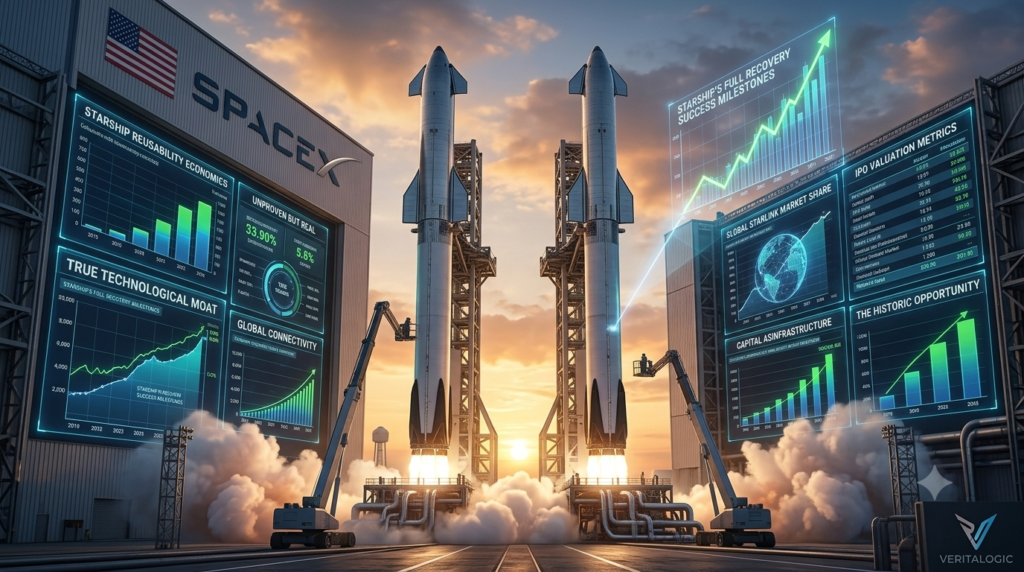
Starship’s reusability and Starlink’s dominance: The core pillars behind SpaceX’s historic valuation.
One thing I don’t see enough people discussing is how much of the long-term narrative depends on Starship.
A large portion of the future growth story assumes launch costs continue falling.
That assumption isn’t random.
It’s connected to engineering milestones that still need to be achieved consistently.
Maybe those milestones arrive sooner than expected.
Maybe they take longer.
Engineering projects rarely follow investor timelines.
And markets aren’t always patient.
What I’ve Noticed While Reading Investor Discussions
Video Source: CNBC Television
Recent reports suggest a $1.75 trillion valuation target for the upcoming IPO. Here is a breakdown of what that means for the market.
The thing that stands out most isn’t optimism.
It isn’t pessimism either.
It’s certainty.
There are people who already know SpaceX will become one of the greatest investments of the next decade.
You can read my previous in-depth analysis on this topic here: SpaceX IPO: A Trillion-Dollar Opportunity—or the Most Expensive Trap on Wall Street?। I’ve discussed the valuation and risks of the IPO in much greater detail there.
There are people who already know retail investors are about to get burned.
Both groups sound equally convinced.
That alone makes me cautious.
The market has a long history of embarrassing people who were absolutely certain they knew what would happen next.
Some days I read about Starlink’s growth and think investors may still be underestimating the business.
Other days I look at the excitement surrounding the IPO and wonder whether people are becoming attached to the story more than the numbers.
That’s probably the thought I keep returning to.