

The 0% APR balance transfer offer arrives in your inbox like clockwork.
Transfer your balance. Pay zero interest for 18 to 24 months. Stop wasting money on debt. The pitch is simple and mathematically sound. But outcomes tell a very different story.
Some people use these transfers correctly and save thousands. Others use them and end up deeper in debt than before.
The difference isn’t luck. It’s a strategy.
Why Banks Are Aggressively Pushing These Offers
Banks don’t offer 0% APR promotions out of generosity.
Research into banking behavior reveals the actual mechanism: these offers are customer acquisition tools. Banks know that borrowers with excellent credit (scores 750+) who successfully complete a balance transfer become long-term assets. The checking account they maintain. The future mortgage they might apply for. The credit cards they’ll carry later.
The math makes sense from a lender’s perspective: lose money on interest today, gain a profitable customer relationship for years.
This strategy only works, however, if the borrower completes the transfer and maintains the account relationship. If the balance remains unpaid when the promotional period expires, the economics shift dramatically in the bank’s favor.
Historical data on balance transfer outcomes shows a telling pattern: roughly 40-45% of borrowers successfully eliminate the balance before the promotional period ends. The remaining 55-60% carry a balance into the higher-rate period.
The bank isn’t losing those cases. It’s winning them.
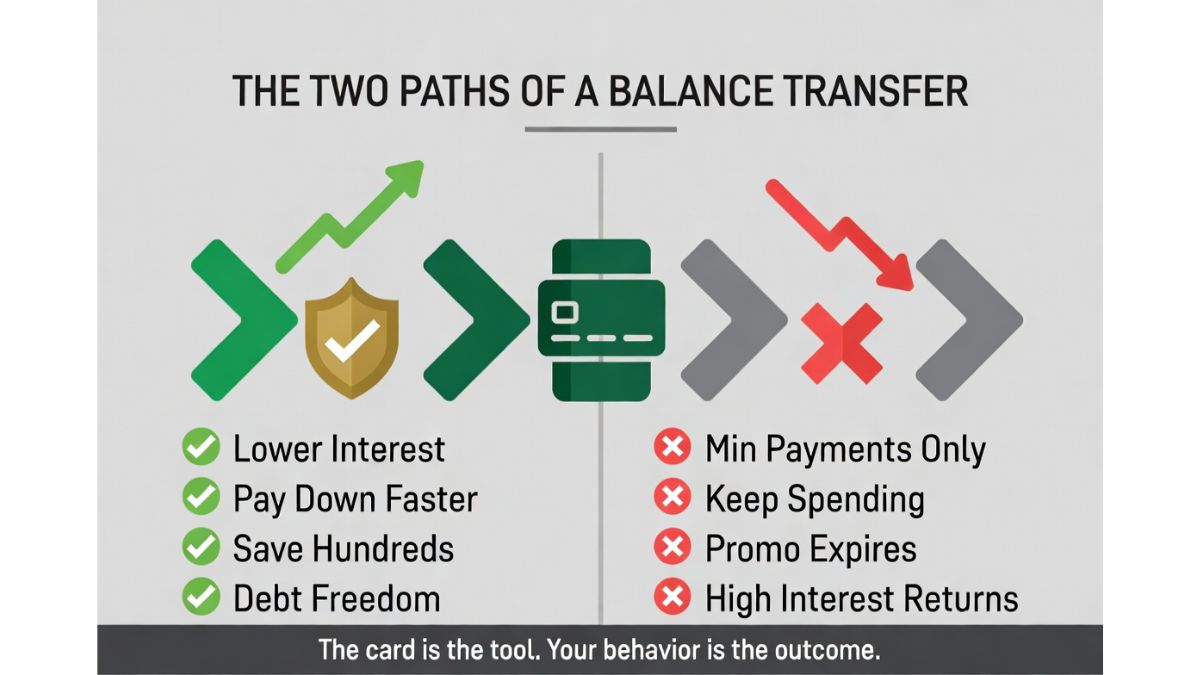
The Two Paths: Michael’s Success vs. The Alternative
Analysis of real balance transfer scenarios reveals two dramatically different outcomes.
Scenario One: The Strategic Approach
A borrower carries $9,000 on a credit card charging 23.9% APR. Minimum payments run roughly $200 monthly. Using basic interest calculations, eliminating this debt without intervention would take approximately 5-6 years and cost roughly $4,200 in interest charges.
A 21-month balance transfer offer arrives with a 3% upfront fee ($270).
The strategic response: calculate the exact monthly payment required to eliminate the balance before promotional expiration.
$9,000 ÷ 21 months = $428 per month
Set up automatic transfers. Commit to the timeline.
Twenty-one months later: balance eliminated. Interest saved: approximately $1,500. Net benefit: $1,230 after the transfer fee.
Scenario Two: The Delay Approach
Same $9,000 balance. Same transfer offer. Different executions.
The transfer feels like relief. The psychological weight lifts. Spending patterns remain unchanged. Monthly payments drop to minimums. Eighteen months have passed.
When the promotional period expires, roughly 65% of the original balance remains-approximately $5,850.
At the card’s standard APR (21%), monthly interest charges on that remaining balance now exceed $102. The cycle restarts.
The Math That Most People Never Actually Do
Research data on balance transfer decisions shows that most consumers focus entirely on the 0% headline and skip the calculation.
Here’s what the calculation actually looks like:
Current Balance: $10,000 Current APR: 24% Promotional Period: 18 months Transfer Fee: 3% ($300)
Interest Cost (Without Transfer): $3,600 Transfer Fee Cost: $300 Interest Cost (With Transfer): $0 Net Savings: $3,300
That looks compelling. Until you add a realistic variable:
Minimum Payment Scenario: $250/month Balance Reduced in 18 Months: $2,000 Actual Interest Avoided: $1,200 Transfer Fee Cost: $300 Real Net Savings: $900
Same card. Different math.
The difference between these scenarios is the payoff commitment – a detail that determines whether a balance transfer creates value or postpones a problem.
Who Benefits (And Who Gets Trapped)
Financial data analysis reveals clear patterns in successful versus unsuccessful balance transfers.
Successful Transfers Typically Include:
- Written payoff timeline (not hope-actual numbers)
- Automatic monthly payments set up
- No new spending on transferred card
- Credit score 750+ (access to best terms)
- Stable income
- Clear math done before application
Unsuccessful Transfers Typically Include:
- No specific payoff timeline
- Continued spending at previous levels
- Additional purchases on the transferred card
- Credit score 650-720 (limited options, higher fees)
- Income volatility
- Decision made emotionally, not mathematically
The product isn’t the determining factor. The approach is.
A brief breakdown explaining the mechanics of 0% APR balance transfer promotional offers.
Video Credit: The Yukon Project
Why Credit Score Access Matters More Than Most Realize
Banking data shows a clear correlation: borrowers with excellent credit (750+) receive the longest promotional periods and lowest fees. Those with good credit (650-720) receive shorter windows and higher fees. Below that threshold, access becomes extremely limited.
This matters strategically because it shapes which borrowers can even access these tools. If balance transfers are part of your debt-elimination strategy, protecting your credit score becomes part of the overall strategy.
On-time payments. Low utilization ratios. Avoiding unnecessary credit inquiries.
These behaviors determine whether future balance transfer offers will even be available.
The Single Question That Determines Success
Research into debt elimination reveals one question that separates successful outcomes from disappointing ones:
“Am I solving a debt problem or moving it to a different address?”
This distinction matters because the answer changes what this tool actually does.
A balance transfer solves a debt problem when:
- You have a specific payoff timeline
- You’ve done the math
- You’ve committed to changing behavior
- You treat it as a temporary tool
A balance transfer delays a debt problem when:
- You’re hoping the timeline will force discipline
- You haven’t changed your spending
- You use it as permission to continue borrowing
- You treat it as a permanent solution
The timeline doesn’t solve problems. Behavior does.
What Financial Data Reveals About The Expiration Date
When the promotional period ends, any remaining balance immediately converts to the card’s standard APR.
Research shows that most standard balance transfer card APRs range from 18% to 24%-sometimes higher. If $5,000 remains, monthly interest charges suddenly exceed $75-$100.
Here’s the secondary consequence that matters: using a promotional offer “burns” your access to that card’s future promotional terms. Multiple balance transfers within short timeframes get flagged as elevated risk.
You’ve essentially spent your one advantageous offer opportunity.
What The Broader Market Data Tells Us
Balance transfer activity provides insight into lending behavior. When banks aggressively promote these offers with extended periods, it typically signals confidence in borrower quality. Lenders believe prime borrowers will meet payment obligations.
Conversely, when promotional periods shrink or qualification standards tighten, it often precedes broader shifts in credit availability.
This data point matters for two audiences:
For Borrowers: These offers may become less attractive or harder to access
For Investors: Lending patterns can signal economic sentiment Sometimes the most interesting information isn’t the offer itself. It’s why the offer is being made.
Note: Promotional periods fluctuate depending on the issuer and your credit profile. Have you spotted a particularly generous offer lately? Let us know in the comments!
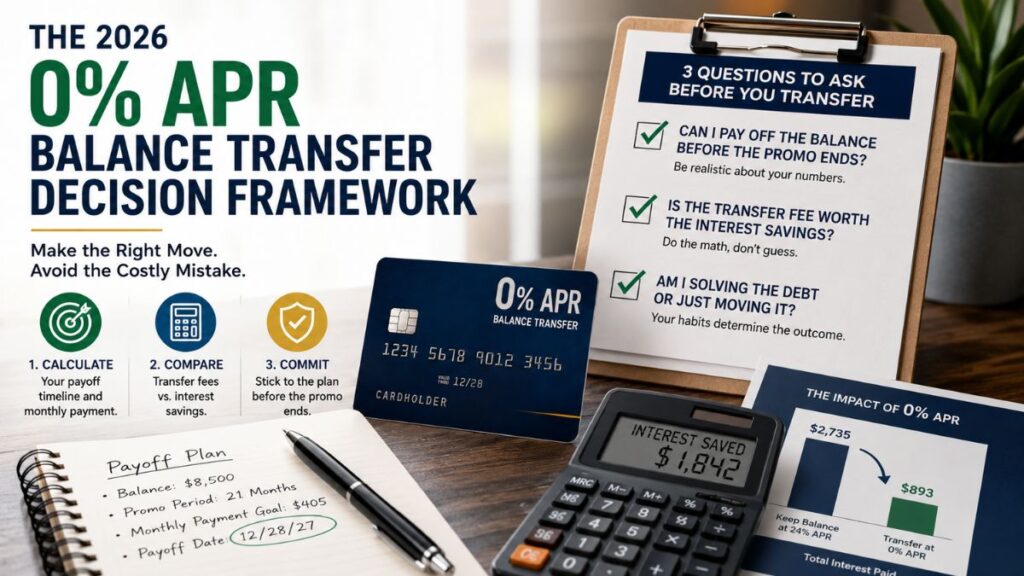
Figure: A 0% APR balance transfer decision framework to ensure you make the right move.
The Verdict
A 0% APR balance transfer can eliminate thousands of dollars in interest charges when approached with clear strategy, mathematical precision, and behavioral commitment.
Data shows these transfers work best for borrowers who:
- Calculate before committing
- Automate payments
- Eliminate new spending
- Maintain discipline
For borrowers hoping the promotional period will magically create discipline that spending patterns haven’t provided? The transfer typically becomes an expensive delay rather than a solution.
The card itself isn’t the deciding factor.
The plan behind using it is.
VeritaLogic publishes independent analysis on personal finance, investing, and consumer behavior. This article is educational content and should not be considered financial, legal, or tax advice. Consult qualified professionals before making credit decisions.
Further Reading: Balancing debt is the first step toward financial freedom. Once you have a clear plan for your debt, learn how to build your long-term wealth by mastering your Asset Allocation Strategy for Investors.