
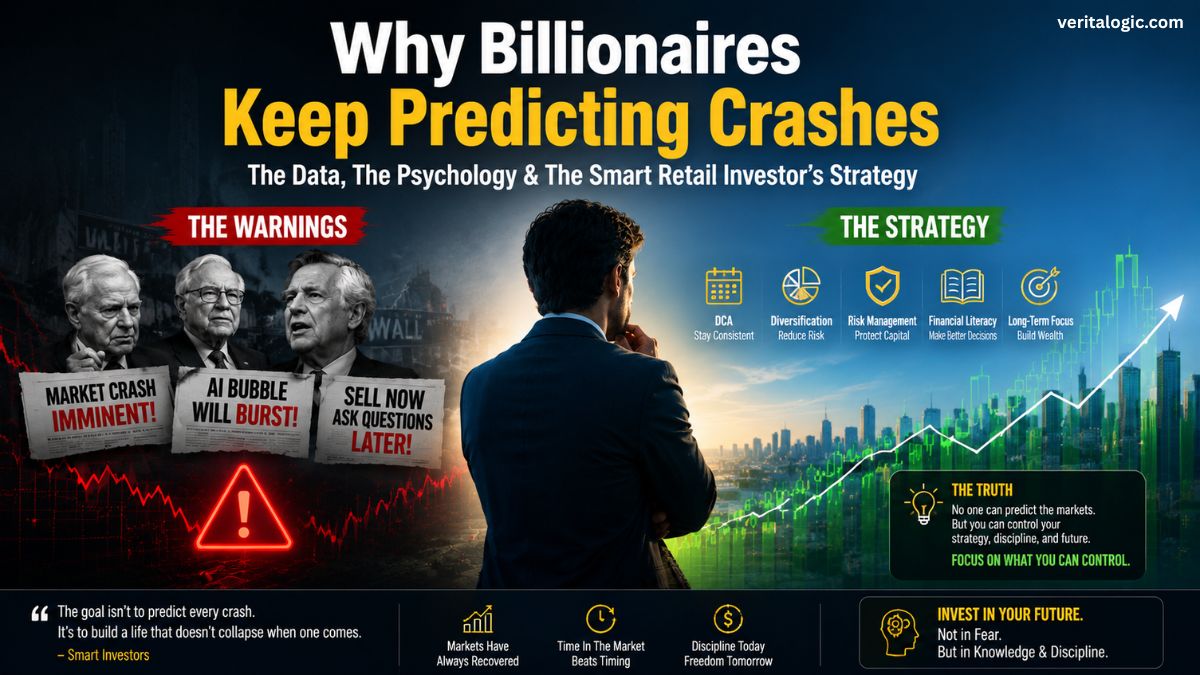
Market Crash Warnings have become a recurring theme in modern investing, with billionaire investors like Jeremy Grantham repeatedly cautioning that U.S. stocks are dangerously overvalued. Grantham has been warning about a major market correction since at least 2021, arguing that the “superbubble” never fully disappeared. His concerns intensified in early 2026 when GMO published Valuing AI: Extreme Bubble, New Golden Era, or Both?, a report suggesting that soaring AI-driven valuations could represent one of the largest speculative bubbles in financial history.
And yet, as one commenter in a popular investing forum put it recently: “Grantham said the same thing in 2021 and missed a 40% rally. Respect the man’s track record, but ‘weeks away’ has been his language for three years now. At what point does the warning become noise?”
That question deserves a straight answer.
The uncomfortable truth about market crash warnings is that they are almost always structurally correct and temporally wrong. Grantham called the dot-com bubble before it burst. He called the 2008 housing crisis before it unraveled. He has a legitimate track record of being right on major turning points – which is precisely what gives his current warnings weight, even when his timing has repeatedly slipped.
But “the market is overvalued” and “the market will crash this quarter” are two very different statements. The first can be true for years. The second requires a catalyst that nobody, including Grantham, can reliably predict.
As another commenter observed, with no small amount of frustration: “The first and most fundamental rule of the market is: nobody knows the future. If they think they do, they are delusional or trying to sell you something.”
That’s not cynicism. That’s market history.
Before diving deeper into our analysis, you can watch the original interview that inspired this discussion. Our article expands on the key ideas with additional historical context, market data, and independent editorial analysis.
Video Credit: The Diary Of A CEO
Episode: Billionaire’s WARNING: I’m SELLING. The Crash Is Already Here!
Source: Official YouTube Channel – The Diary Of A CEO
What the Data Actually Shows About These Predictions
GMO’s Ben Inker, co-head of asset allocation, predicted in early 2026 that the wave of mega IPOs – OpenAI, Anthropic, SpaceX – would pull money from the broader S&P 500, citing historical data suggesting that each 1% increase in market cap through IPOs eventually leads to approximately a 7.5% decrease in stock market prices. His firm predicted negative returns for the S&P 500 this year – a call that, as Inker acknowledged, was “well outside the consensus on Wall Street.” NAGA
By early Q2 2026, the S&P 500 had already breached 7,000 in January before pulling back in what analysts called a “February Fade.” The Nasdaq slipped into correction territory. The VIX, Wall Street’s fear gauge, was hovering around 27 – well above its long-term average of 20. That’s not a crash. But it’s not nothing, either.
Here’s the historical comparison that matters most. After the dot-com peak in 2000, investors who ignored all warnings and stayed fully invested in the Nasdaq lost 78% of their value over 30 months. After the 2008 financial crisis peak, the S&P 500 fell 57%. But investors who stayed invested through both crashes and held diversified index funds for a decade recovered everything – and then some. By contrast, investors who panic-sold during the 2022 bear market, when the Nasdaq fell 35%, locked in permanent losses while those who held diversified “defensive” portfolios in utilities and healthcare weathered the storm.
The pattern repeats with remarkable consistency: crash predictions are frequently correct about conditions, wrong about timing, and catastrophic for investors who act on them by trying to exit and re-enter the market at the right moment.
| Prediction | Predictor | Year Made | S&P 500 Performance in Following 12 Months |
|---|---|---|---|
| “Superbubble” crash imminent | Grantham | 2021 | +26% rally followed by 2022 correction |
| 50% crash, “don’t invest in US” | Grantham | 2023 | Market recovered to new highs |
| AI bubble, negative S&P returns | GMO/Inker | Early 2026 | Reached 7,000 before February pullback |
| Buffett Indicator at 232% | Various | 2026 | Ongoing; no crash confirmed as of Q2 |
Data compiled from Fortune, Yahoo Finance, IBTimes UK, and GMO research, 2023–2026.
Read More: AI Stocks, Bitcoin & Gold Investors: What’s Driving the 2026 Market Shift?
https://veritalogic.com/ai-stocks-bitcoin-gold-investors-2026/
The Real Enemy: Your Own Psychology
Ten years of crash predictions. Wyckoff cycles, real estate warnings, private equity concerns, tech bubble comparisons, de-dollarization headlines. And stocks have continued hitting all-time highs.
Why do people keep listening? Because fear is a more powerful motivator than greed, and the human brain is wired to overweight the pain of potential loss relative to the pleasure of equivalent gain. Behavioral economists call it loss aversion. In practice, it means that a billionaire saying “sell everything” registers more powerfully than a decade of compound returns.
One commenter captured this dynamic precisely: “It’s always rich people who try and scare us little people at the bottom. They say sell all your crypto, sell your stocks and shares, don’t invest in this and that, don’t buy a house – cause they want it all for themselves.”
That view oversimplifies the motives involved – Grantham and others aren’t secretly accumulating your stocks – but it identifies something real. The incentive structures around financial media are not designed to keep retail investors calm and invested. They’re designed to generate attention, and fear generates more attention than reassurance.
Grantham himself has acknowledged this structural problem: “You will never be told by major players to get your tail out of the market – it’s just not going to happen.” He argues that large financial institutions’ business models depend on keeping clients invested, which shapes public messaging. That’s a fair critique. It’s also worth noting that Grantham’s own fund has a business model built on contrarian bets, which creates its own set of incentives.
The most useful thing a retail investor can do with any crash warning is ask: what specific trigger would cause this, on what timeline, and what evidence would I need to see to confirm it? If the answer is vague – and it almost always is – the warning is useful for general risk awareness but not for specific portfolio action.
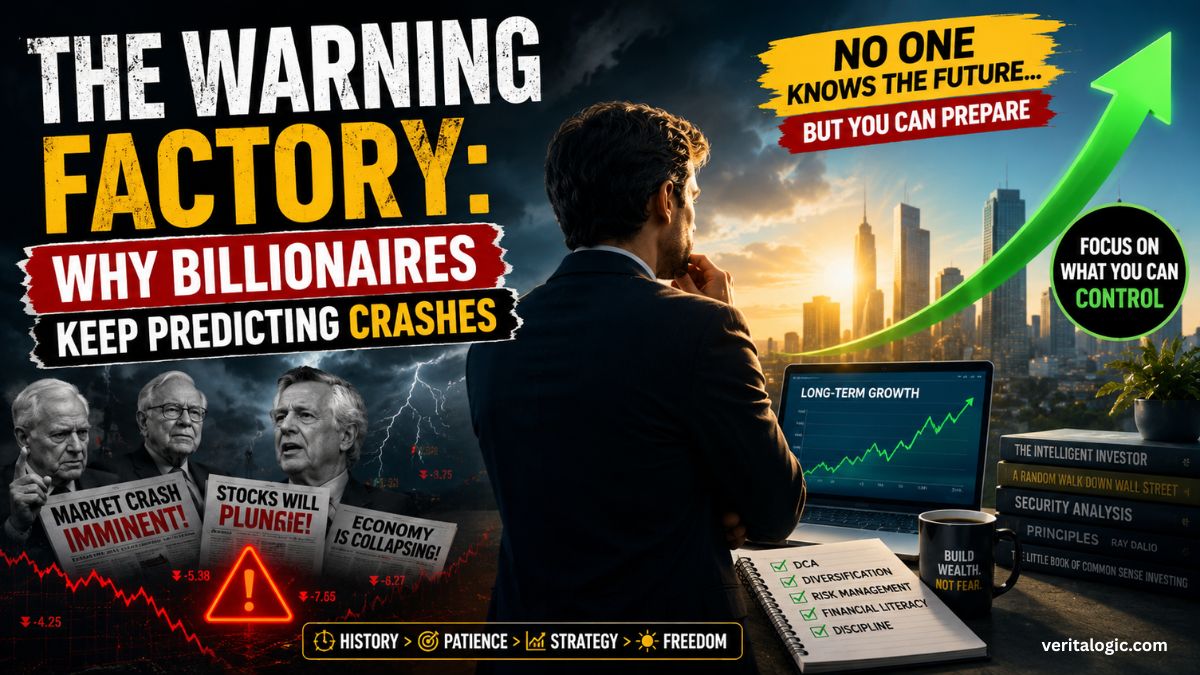
Successful investing is less about predicting the next crash and more about managing emotions, staying diversified, and following a disciplined long-term plan.
What Smart Retail Investors Are Actually Doing
The comment that resonated most in recent investor discussions wasn’t about predictions at all. It was about process.
“The goal isn’t to predict every crash. It’s to build a life that doesn’t collapse when one comes.”
That single sentence contains more useful investing wisdom than most crash warning videos combined. It shifts the question from the unanswerable (“when will the market crash?”) to the actionable (“what does my portfolio look like if it drops 40% tomorrow?”).
Smart retail investors in 2026 are doing several things that have nothing to do with billionaire predictions.
They’re checking their actual allocation. If your portfolio is 100% equities at 65 years old, a correction doesn’t just feel bad – it can permanently impair your retirement. If you’re 30 with decades of runway, a 40% drawdown is historically an opportunity.
They’re evaluating their employer-sponsored benefits. Many professionals eligible for tuition reimbursement or matching contributions are leaving money on the table while worrying about market timing.
They’re holding enough cash to sleep at night. Not as a market timing strategy, but as a psychological buffer that prevents panic selling during corrections.
DCA, Diversification, and the Boring Truth That Works
Dollar Cost Averaging – investing a fixed amount at regular intervals regardless of market conditions – is not exciting. It doesn’t make for compelling YouTube thumbnails. It won’t be featured in the next billionaire crash warning video.
It also happens to be one of the most reliably effective strategies available to retail investors across every market cycle in modern history.
The mechanics are simple. When prices are high, your fixed investment buys fewer shares. When prices fall, it buys more. Over time, your average cost per share reflects a blend of peaks and troughs, and you stop needing to predict which direction the market is going – because it genuinely doesn’t matter for your long-term outcome.
“Never time the market. Buy the dip, DCA, with a stop loss and chill” is how one investor summarized it. The language is casual, but the logic is sound. Index fund investors who DCA’d through the 2008 crisis, the 2020 pandemic crash, and the 2022 tech selloff are sitting on substantial gains today – not because they predicted anything correctly, but because they stayed in the market when it was uncomfortable to do so.
Diversification provides the structural complement to DCA. The 2022 bear market illustrated the cost of concentration: investors who were over-leveraged in single-sector tech portfolios saw significant wealth destruction, while those with diversified defensive holdings – utilities, healthcare, consumer staples – absorbed the shock with far less damage.
“If you don’t have leverage, you won’t go to zero if invested in large index funds,” one commenter noted. That observation is technically precise. Unleveraged index fund investors cannot be wiped out by a market crash, regardless of how severe – because the index itself represents the entire productive capacity of the economy, which has never permanently gone to zero in a functioning modern economy.
When Is a Warning Actually Worth Listening To?
Not all crash warnings deserve to be dismissed as noise. The productive approach is to distinguish between structural warnings and timing claims.
Structural warnings – observations about valuation, debt levels, monetary conditions, or systemic risk – carry genuine information. Grantham’s observation that the S&P 500 sits in the top 1% of historical Shiller P/E ratios, creating what he called “double jeopardy” where both profits and valuations could decline simultaneously, is a structurally meaningful data point. It doesn’t tell you when. It tells you that expected forward returns from current valuations are historically lower than average – and that’s useful information for setting realistic expectations.
Timing claims – “the crash is weeks away,” “sell everything now,” “this is the most dangerous market in history” – deserve far more skepticism, because they require predicting a specific trigger on a specific timeline, which no institutional investor in history has done consistently.
The honest summary: listen to the structural analysis, ignore the urgency language, and never make a permanent portfolio decision based on someone else’s timeline.
What History Says About Timing the Market
The data on market timing is remarkably consistent across every major study conducted over the past 40 years. Missing the 10 best trading days in any given decade typically cuts long-term returns by more than half. The problem is that the best days often cluster immediately after the worst days – meaning investors who sell during a crash frequently miss the recovery.
A J.P. Morgan Asset Management study found that a $10,000 investment in the S&P 500 from 2003 to 2022 would have grown to $64,844 if fully invested. Missing the 10 best days reduced that to $29,708. Missing the 20 best days brought it to $17,826 – barely above the original investment, across two decades.
The comment that perhaps captures this reality most honestly: “I’ve come to realize that the hardest part of investing isn’t finding opportunities – it’s knowing how to build a portfolio that can handle the inevitable mistakes along the way.”
That’s not an insight about predicting crashes. It’s an insight about the design of a portfolio that doesn’t require you to predict anything.
Read our complete analysis:
👉 Market Crash Warnings vs. Reality: What Every Retail Investor Should Know (2026)
Actionable Takeaways for 2026
Review your allocation, not the headlines. Your equity-to-bond-to-cash ratio should reflect your time horizon and actual risk tolerance – not your emotional response to the latest crash warning.
Run a drawdown test. Ask yourself what a 40% portfolio decline would actually mean for your life. If the answer involves genuine hardship, your allocation is more aggressive than your situation warrants.
Automate contributions. DCA works best when it’s not subject to your emotional state. Automated monthly investments remove the decision entirely.
Understand what you own. Broad index funds tracking the total market or S&P 500 have recovered from every historical crash. Concentrated positions in individual stocks or sectors carry risks that index funds don’t.
Keep a 3-6 month cash reserve. Not as a market timing strategy, but as an insurance policy that prevents you from being forced to sell equities at the worst possible moment.
Invest in financial literacy continuously. As one commenter observed: “We are in a transitional era from banks to personal management of our finances.” Understanding the basics of portfolio construction, tax efficiency, and compound growth is not optional – it’s the foundation that everything else sits on.
Frequently Asked Questions
Should I sell my stocks because of billionaire crash warnings?
Historically, selling based on billionaire crash predictions has cost retail investors more than staying invested. The S&P 500 has recovered from every correction and crash in modern history. Unless your personal financial situation has changed – not the market’s – selling in response to a prediction you can’t verify is almost always a mistake. Review your allocation, not the headlines.
Is the stock market going to crash in 2026?
Nobody can reliably predict market timing, including Jeremy Grantham, whose firm GMO predicted negative S&P 500 returns for 2026. The market reached 7,000 in January before a February pullback, with the VIX rising to around 27. Elevated valuations – the Shiller CAPE ratio sits in the top 1% of its historical range – suggest lower expected future returns, not an imminent crash date.
What is Jeremy Grantham predicting for 2026?
Grantham and GMO have predicted negative returns for the S&P 500 in 2026, citing the AI bubble, high valuations, and the potential impact of major tech IPOs pulling capital from the broader index. Grantham has described the AI boom as “a classic bubble” and said there is a “slim to none” chance it doesn’t eventually burst. His track record on major crashes is strong, but his timing has repeatedly been early by years.
What is dollar cost averaging and does it protect against a crash?
Dollar cost averaging means investing a fixed dollar amount at regular intervals regardless of price. During a crash, your fixed investment buys more shares at lower prices. During rallies, it buys fewer at higher prices. Over time, this produces an average cost per share below the peak price. It doesn’t prevent portfolio drawdowns, but it eliminates the need to time the market and has historically produced strong long-term outcomes through every major crash.
What is the Buffett Indicator and why does it matter in 2026?
The Buffett Indicator divides total U.S. stock market capitalization by U.S. GDP to produce a ratio indicating whether stocks are cheap or expensive relative to the underlying economy. As of 2026, it has exceeded 232% – levels that historically precede periods of lower-than-average forward returns, though not necessarily an immediate crash.
How did investors who ignored the 2021 crash warnings do?
Investors who stayed fully invested through Grantham’s 2021 superbubble warnings experienced a 40% rally before the 2022 correction, which itself lasted roughly a year before the market recovered to new highs. Those who sold in 2021 based on the warnings missed both the rally and the recovery, and would have needed to time their re-entry correctly to match a simple buy-and-hold strategy.
What should retail investors actually do during a market crash?
Continue investing according to your pre-established plan. If you have automated DCA contributions, don’t pause them – a crash is when DCA mathematically works in your favor. Don’t check your portfolio daily. Avoid selling anything you’d want to own in five years. Make sure you have enough cash outside the market to cover six months of expenses so you’re never forced to sell equities at the worst moment.
Is financial literacy really the answer to dealing with crash warnings?
It’s the foundation of everything else. Investors who understand how market cycles work, what their actual risk tolerance is, how compound returns accumulate, and why diversification matters are structurally less vulnerable to fear-driven decision-making. As the community observed: “We need to teach our children financial literacy, factual history, and critical thinking.” That’s not inspirational language – it’s a practical survival skill in a financial media environment designed to generate engagement through fear.
Final Thoughts
Here is what a decade of market crash warnings has actually taught us, stripped of the drama.
Structural warnings from credentialed investors with track records deserve attention – not as trading signals, but as context for calibrating expectations and risk tolerance. Grantham’s January 2026 paper arguing that the AI bubble is real, that valuations are stretched, and that the superbubble of 2021 was never fully resolved makes a coherent case that forward returns from current levels will be lower than the past decade delivered. That’s useful information for setting realistic expectations.
Timing claims deserve skepticism – always, from everyone, including the most credentialed voices in finance. The market has a 100-year track record of confounding the smartest predictions by the smartest people. It will continue doing so.
And the retail investors who will look back on 2026 with the least regret are not the ones who correctly predicted whether the crash came this year or next. They’re the ones who built portfolios that didn’t require them to predict anything – because their allocation matched their actual risk tolerance, their contributions were automated, their diversification was genuine, and their time horizon was long enough to survive whatever comes next.
“Regret,” as one commenter put it, “always seems to be centered around allowing others to make your decisions for you.”
That applies to billionaire crash warnings. It applies to YouTube stock pickers. And it applies to anyone -including this article – who tries to tell you what the market is going to do next.
Nobody knows. Build accordingly.
Author’s Note: This analysis is based on publicly available market data, GMO research reports, and community investor perspectives gathered through mid-2026. All market data cited reflects information available at time of publication.
Sources: Yahoo Finance / Business Insider – GMO IPO Analysis, February 2026 · WebProNews – Grantham AI Bubble Warning, January 2026 · Fortune – Jeremy Grantham Interview, April 2026 · The Wealth Advisor – Grantham Market Warning, January 2025 · IBTimes UK – Grantham Super-Bubble Warning, May 2026 · NAGA Markets – Stock Market Crash Prediction Analysis, April 2026 · J.P. Morgan Asset Management – Guide to the Markets · S&P Dow Jones Indices Historical Data NAGA
Disclaimer
This article is written for informational and educational purposes only. Nothing in this article constitutes financial, investment, legal, or tax advice. Past market performance does not guarantee future results. Investing involves risk, including the possible loss of principal. All views expressed represent editorial analysis based on publicly available information as of June 2026. VeritaLogic is an independent publication with no commercial relationship with any company, fund, or individual mentioned herein. Readers should conduct their own independent research and consult a qualified, licensed financial advisor before making any investment decision.
About the Author
The VeritaLogic Editorial Desk covers global markets, investment strategy, and economic policy for a U.S. and international audience of retail and professional investors. Drawing on analysis from Federal Reserve data, institutional research, and publicly available company filings, VeritaLogic provides independent market commentary designed to cut through headline noise and deliver practical, evidence-based financial perspective. VeritaLogic does not provide personalized investment advice.
Editorial Note: This article is an independent editorial analysis inspired by the public discussion featured in the video above. The opinions, historical comparisons, market data, and investment insights presented here are based on additional research and do not necessarily reflect the views of The Diary Of A CEO, its host, or its guests.