
Here’s a number worth sitting with for a moment.
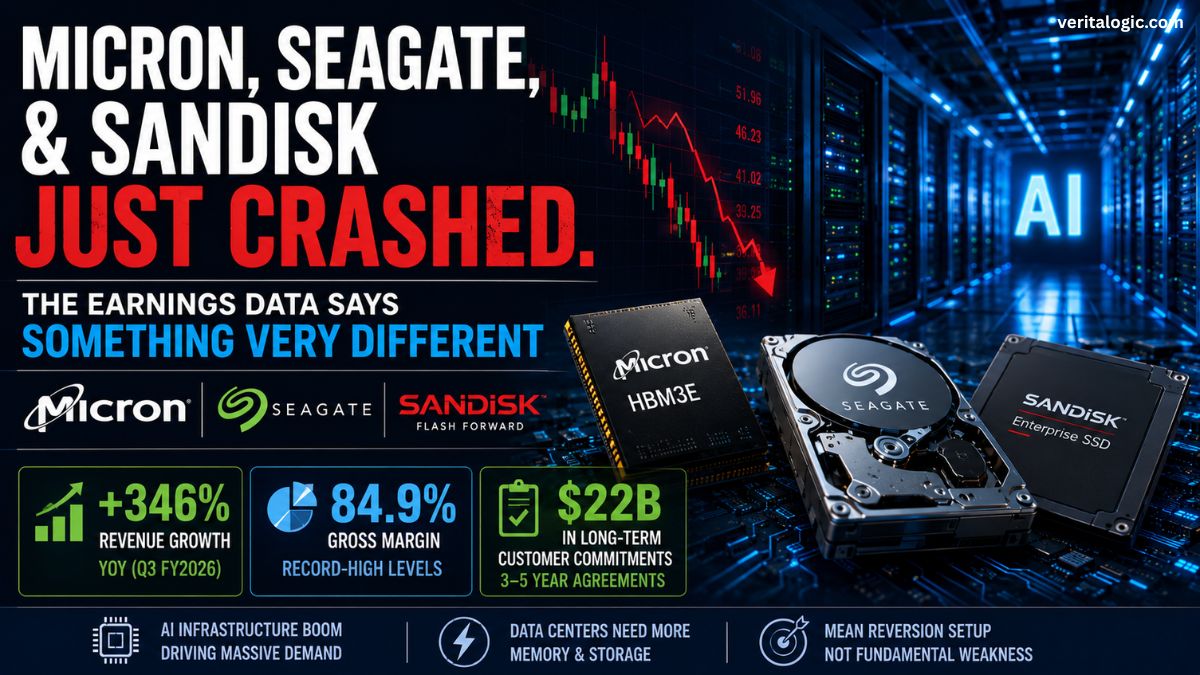
Micron Technology reported fiscal Q3 2026 revenue of $41.46 billion – up from $9.30 billion in the same quarter a year earlier. That’s not a rounding error. Revenue shot up 346% year over year, while earnings per share grew by a whopping 1,215%. The company’s gross margin expanded to 84.9% – a figure that most semiconductor companies would consider a career highlight, let alone a single quarter.
Analysts who cover Micron stock in 2026 as a buy are pointing to one thing above all else: a 346% revenue surge that the stock price has not yet reflected.
And yet, Micron has pulled back 22% from its post-earnings highs, despite a year-to-date gain of 250%.
That gap – between what the business is actually doing and what the stock price is doing right now — is the entire investment story in July 2026. Louie Navellier, founder of Navellier & Associates and one of the most respected quantitative growth investors on Wall Street, has been explicit about his view: the selloff is macro-driven noise. The fundamental demand story for AI storage hasn’t changed. Not even slightly.
His firm owns Micron, Sandisk, and Seagate in managed accounts. He and his family hold the same positions personally. This isn’t a prediction from someone watching from the sidelines.
What Just Happened – and Why the Headlines Are Misleading
The pullback in Micron, Seagate, and Sandisk happened against a macro backdrop that had nothing to do with memory chips.
Fed Chair Kevin Warsh declined to commit to a rate path at his most recent press conference, describing the upcoming FOMC debate as a “good family fight” while acknowledging that the inflation outlook has improved. Markets don’t process ambiguity well. When the Fed is uncertain, high-beta growth names typically absorb the selling pressure first – regardless of what their income statements say.
Add a stronger dollar and the flow of capital back into Treasuries as a safe-haven trade, and you have a textbook example of what Navellier calls “AI derangement syndrome”: periodic loss of confidence in the AI trade driven by macro rotation, not fundamental deterioration.
The distinction matters enormously. A stock falling because its business is weakening deserves selling. A stock falling because institutional investors temporarily rotated out of growth during a Fed policy ambiguity window – while the underlying company is printing the best quarterly numbers in its history — deserves a very different response.
What institutional investors are watching isn’t the stock price. It’s the long-term agreement pipeline.
Micron disclosed 16 long-term agreements with customers including data center operators and automakers, structured with binding volume commitments over three to five years, representing approximately $22 billion in financial commitments. CEO Sanjay Mehrotra said these agreements will eventually cover “approximately half or more” of company revenue. That kind of visibility is extraordinarily rare in semiconductor cycles, which have historically been characterized by boom-bust inventory swings.
When a company has locked-in volume commitments from the world’s largest data center operators for the next three to five years, a 22% pullback from highs looks very different than it does without that context.
Read More: Top High-Yield Investment Ideas & Dividend Stocks for 2026
The Mean Reversion Setup: Price Corrected. Fundamentals Didn’t.

The visual says it all: AI infrastructure demand continues rising while stock prices fell 22% from highs. Micron holds 16 long-term agreements covering $22 billion in commitments, with ~50%+ of future revenue locked in. Price corrected. Fundamentals didn’t. That’s the definition of a mean reversion setup. Source: Micron Technology Earnings Release, June 24, 2026.
Navellier’s analytical framework for this setup is borrowed from a principle that shows up across asset classes: mean reversion. When a stock pulls back to its long-term moving average because of external macro factors – not because its earnings story changed – prices have historically tended to revert toward the trend line.
The gold comparison makes this concrete. Gold hit its 200-day moving average and had a weak second quarter. Why? A stronger U.S. dollar, higher interest rates, and money flowing into Treasuries instead of gold. Meanwhile, the fundamental demand picture – central bank buying at multi-decade highs, mining supply constraints, safe-haven status – remained entirely intact. The price corrected. The fundamentals didn’t.
The storage stocks are running the same playbook. The macro forces that pushed Micron, Seagate, and Sandisk lower have no bearing on whether hyperscalers need more NAND and HBM chips to run their AI workloads in Q4 2026 and beyond. The structural demand story that drove Micron’s Q3 revenue to $41.5 billion hasn’t softened. The capacity constraints that allowed gross margins to expand to 84.9% haven’t eased. The long-term agreements with $22 billion in committed revenue haven’t been renegotiated.
Mean reversion doesn’t mean the story is over. It means markets often pause before the next move.
The AI Infrastructure Demand Story – By the Numbers
Understanding why the demand thesis for memory and storage stocks is structurally intact requires looking at the infrastructure buildout from the power and physical capacity angle, not just the chip angle.
Data centers are consuming natural gas – and by extension, electricity – at a rate that’s going to roughly triple by 2035 according to BloombergNEF projections, with the fastest growth concentrated in the East and South Central U.S. regions. That’s not a demand curve created by investor enthusiasm. It represents physical infrastructure with 20-year operational lives – data centers, cooling systems, power contracts, and connectivity buildouts – that require memory and storage at scale for as long as those facilities operate.
Micron has already crossed the $1 trillion market cap mark, driven by AI demand for its HBM, DRAM, and NAND products. The consensus FY2026 revenue forecast has jumped from $79.8 billion to $108.7 billion, and the EPS estimate has risen from $34.26 to $58.05 per share. For Q4 FY2026, the company guided for approximately $50 billion in revenue – versus analyst expectations of $43.58 billion. The beat wasn’t marginal.
Separately, Micron signed a multi-year AI infrastructure partnership with Anthropic, becoming Anthropic’s primary supplier of memory and storage for next-generation AI workloads, co-designing HBM and storage subsystems, and taking an equity stake through participation in Anthropic’s Series H funding round. Micron said it has signed 16 long-term agreements with customers such as data center operators and automakers that lock in sales for a period of three to five years.

45 Wall Street analysts rate Micron a Strong Buy with an average 12-month price target of $1,486 – representing approximately 50.9% upside from current levels. YTD gain of 250% followed by a 22% pullback. Macro noise caused the drop. The demand story is intact. Sources: Yahoo Finance; CNBC; Simply Wall St, July 2026.
The Bespoke AI basket data referenced in Navellier’s analysis underscores which part of the AI trade is actually generating returns. Over the past year, the AI Infrastructure basket is up approximately 150%, dramatically outperforming the AI Implementation basket – which is slightly negative – and the S&P 500 Equal Weight, which is roughly flat.
The money is not being made by companies learning to use AI. It’s being made by the companies that have to exist for AI to work at all.
| AI Sub-Sector | 12-Month Return | What It Represents |
|---|---|---|
| AI Infrastructure | ~+150% | Chips, storage, power, pipelines |
| AI Applications | ~+65% | Software, enterprise AI platforms |
| AI Implementation | Slightly negative | Late-stage adopters |
| S&P 500 Equal Weight | ~Flat | Broad market comparison |
Source: Bespoke Investment Group AI Basket Performance Data, July 2026
MPLX: The AI Infrastructure Energy Play Nobody’s Talking About
One of the more counterintuitive angles in Navellier’s current thesis is his position in midstream energy – specifically MPLX LP – a pipeline company that most retail investors associate with natural gas prices rather than AI infrastructure.
The logic is worth understanding because it’s genuinely non-consensus.
Midstream companies earn fees based on the volume of gas transported through their infrastructure, not the price of gas itself. Gas price volatility – which is what makes most energy investors nervous – doesn’t directly affect MPLX’s revenue model. What matters is volume. And volume is driven by demand.
Cold winters create heating demand. Hot summers create cooling demand. Both increase natural gas consumption, and MPLX collects fees on every cubic foot moving through its pipelines regardless of market price. But the 2026 twist is data centers. BloombergNEF projections show data center gas consumption growing toward 6+ billion cubic feet per day by 2035. That gas moves through pipelines. MPLX, with a massive, high-quality asset base concentrated in high-growth U.S. regions, is positioned directly in that demand flow.
This means the AI infrastructure buildout is quietly transforming a traditional energy infrastructure company into a partial AI infrastructure play – one that pays a growing distribution, generates strong free cash flow, and doesn’t carry semiconductor valuation risk.
For investors who want AI infrastructure exposure without the concentration risk embedded in semiconductor names trading at peak margins, MPLX offers a different risk-return profile. Lower volatility, a growing dividend, strong cash flows, and structural tailwinds from the same AI demand drivers.
Read More: AI Stocks, Bitcoin, and Gold: Strategic Moves for 2026
AppLovin at $527: What the Quantitative Grade Actually Reveals
The InvestorPlace Stock Grader showing AppLovin at $527 with a C total grade and B fundamental grade deserves careful interpretation – because the gap between those two scores reveals something important about how to think about quality stocks at high valuations.
AppLovin’s fundamental grade of B reflects a business with strong sales growth, very strong operating margin growth, very strong earnings growth, and very strong return on equity. Those aren’t weak numbers. They’re the kind of numbers that earn a buy recommendation in a less richly priced environment.
The C total grade reflects weaker momentum signals, neutral free cash flow scoring, and neutral earnings surprises – factors that Navellier’s quantitative system weighs alongside pure fundamentals. At $527, with mixed technical signals, the risk-reward doesn’t earn a buy rating from a system designed to identify asymmetric upside.
This is the discipline that separates systematic quantitative investing from momentum chasing. A B-quality business at the wrong price produces C-quality returns. Navellier’s approach is explicit about this: the entry point matters as much as the fundamental quality.
The broader lesson for investors following the AI software trade: the fundamental quality of the AI application layer is genuinely improving. But valuation multiples have expanded to levels where those improvements are already priced in. The infrastructure layer – chips, storage, power, pipelines – still offers more asymmetric entry points relative to fundamentals than the software layer does in July 2026.
July Seasonality: The 10-Year Pattern Most Investors Ignore
Perhaps the most immediately actionable data in Navellier’s recent analysis is the Russell 1000 July seasonality table – and the pattern it reveals is more systematic than most investors realize.
| Ticker | Company | Sector | Median July Gain | Positive Rate |
|---|---|---|---|---|
| LAZ | Lazard | Financials | +10.3% | 100% (10/10 years) |
| KKR | KKR & Co. | Financials | +10.2% | 100% |
| CG | Carlyle Group | Financials | +10.1% | 100% |
| ARES | Ares Management | Financials | +9.5% | 100% |
| SITE | SiteOne Landscape | Industrials | +9.5% | 100% |
| FNF | FNF Group | Financials | +7.0% | 100% |
| MS | Morgan Stanley | Financials | +6.5% | 100% |
| AAPL | Apple | Technology | +6.0% | 100% |
| AMD | Advanced Micro | Technology | +17.7% | 90% |
| BX | Blackstone Group | Financials | +11.8% | 90% |
Source: Russell 1000 historical data as presented in Navellier & Associates July 2026 market analysis
A 100% positive rate over 10 consecutive Julys across multiple names is not coincidence. It reflects systematic institutional behavior – year-end positioning, earnings pre-announcement flows, sector rotation patterns – that repeats with consistency.
The dominance of financial sector names – alternative asset managers like KKR, Carlyle, Ares, and Blackstone alongside traditional financial services – aligns with the macro backdrop of strong U.S. GDP growth. When the economy is expanding, assets under management grow, deal flow increases, and the earnings of fee-based financial businesses compound. July has historically been when institutional capital affirms those trends ahead of Q2 earnings season.
The reason this pattern holds is mechanical: alternative asset managers all report Q2 earnings in late July or August, and those reports reflect both market appreciation and deployment activity from the prior two quarters. Institutional buyers build positions ahead of the confirmation. Understanding why a seasonal pattern exists makes you a better judge of whether current conditions support it.
The U.S. Economy Backdrop – Why the Foundation Supports This Thesis
The economic context behind Navellier’s confidence in this setup isn’t just about individual company fundamentals. It’s about the macro environment that determines how durable corporate earnings can be.
Three structural drivers are supporting U.S. GDP growth in 2026 in ways that deserve more attention than they typically receive.
Higher productivity – driven by AI adoption, automation, and process efficiency improvements – means the economy is producing more output with fewer inputs. That’s sustainable growth, not the debt-fueled consumption variety that reverses when conditions change.
Record energy exports through LNG infrastructure are reducing the U.S. trade deficit and strengthening the country’s external economic position. A smaller trade deficit contributes directly to GDP accounting.
Consumer spending remains robust. Despite elevated interest rates, American consumers have continued spending at levels that would have seemed implausible under traditional rate-cycle models. Much of that resilience reflects the wealth effect from equity market gains, particularly among the 55% of American households that now own stocks either directly or through retirement accounts.
Navellier anticipates that GDP growth could reach a 5% annual pace in Q2 2026. If that GDP figure is confirmed in the advance estimate, it would validate the thesis that strong fundamentals provide a durable floor under AI infrastructure spending even when sentiment temporarily softens.
What This Means for Your Portfolio Right Now
Three things come out of Navellier’s current analysis that are actionable without requiring a specific market view.
The pullback in Micron, Seagate, and Sandisk is a mean reversion setup, not a fundamental deterioration. If you were looking for an entry point into AI storage exposure, a macro-driven selloff with no change in underlying demand is historically one of the better ones. Forty-five analysts rate Micron a Strong Buy. The average 12-month price target is $1,486 – approximately 50.9% above current levels. That consensus didn’t form based on hope. It formed based on a $41.5 billion revenue quarter and $50 billion Q4 guidance that came in $6.4 billion above expectations.
Read More: Market Crash Warnings vs. Reality: An Investor’s Guide
MPLX and midstream energy exposure makes sense for investors who want AI infrastructure upside without direct semiconductor concentration risk. The data center gas demand story is real, growing, and not widely understood by retail investors yet.
And July seasonality in financial sector stocks – particularly alternative asset managers – has a 10-year track record worth taking seriously. The macro conditions in 2026 align with the historical backdrop that has made these names reliable July performers.
None of this is a prediction. It’s a framework for thinking about where the evidence currently points.

The numbers that matter: a 22% stock pullback against a 346% revenue surge, $22 billion in locked-in customer commitments, 16 long-term agreements, and Q4 FY2026 guidance of approximately $50 billion – $6.4 billion above what analysts expected. AI demand is at an all-time high. The infrastructure driving the future isn’t slowing down. Sources: Micron Q3 FY2026 Earnings; CNBC; Yahoo Finance, July 2026.
Frequently Asked Questions
Why did Micron stock fall if earnings were so strong?
Micron pulled back 22% from post-earnings highs despite reporting $41.46 billion in Q3 revenue – up 346% year over year. The decline reflects macro-driven institutional rotation: Federal Reserve uncertainty, dollar strength, and capital moving into Treasuries. The business itself is performing better than at any point in its history. The pullback is a sentiment story, not an earnings story.
What is Micron’s Q4 FY2026 guidance?
Micron guided for approximately $50 billion in Q4 FY2026 revenue – versus analyst expectations of $43.58 billion. That $6.4 billion beat on guidance came alongside Q3 results that exceeded estimates by $5.6 billion on revenue. The company’s full-year FY2026 revenue consensus has risen to $108.7 billion.
What is HBM memory and why does it matter for AI?
High Bandwidth Memory is a specialized DRAM type that stacks chips vertically to deliver dramatically higher data throughput at lower power consumption than traditional memory. AI training and inference workloads need massive data throughput to keep accelerators running efficiently. Only three companies manufacture HBM at commercial scale: Micron, Samsung, and SK Hynix – creating a structural supply constraint that supports pricing power.
Is MPLX really an AI infrastructure play?
Indirectly, yes. MPLX earns fee-based revenue from transporting natural gas by volume, not by price. BloombergNEF projects data centers will consume 6+ billion cubic feet of natural gas per day by 2035. All of that gas moves through pipelines. MPLX’s infrastructure is positioned in the high-growth regions absorbing that demand – making it an indirect, lower-volatility beneficiary of the same AI infrastructure buildout driving semiconductor names.
What does AppLovin’s C grade mean in Navellier’s system?
A C grade reflects strong fundamentals – AppLovin scores B overall on earnings growth, operating margins, and return on equity – but weaker technical and momentum signals at the current price. The grade isn’t a commentary on business quality. It’s a commentary on risk-reward at the current entry point. Navellier’s system is explicit that entry price matters as much as fundamental quality.
What is Russell 1000 July seasonality?
It’s the historical tendency for specific stocks to outperform during July specifically. Looking back 10 years, 11 Russell 1000 companies show a 100% positive rate in July – meaning they rose every single July over the decade. Most are financial sector names: Lazard, KKR, Carlyle, Ares, Morgan Stanley, and Blackstone. The pattern reflects institutional earnings pre-positioning ahead of Q2 reporting season.
What are Micron’s long-term customer agreements?
Micron disclosed 16 long-term agreements with data center operators, automakers, and other customers, structured with binding volume purchase commitments over three to five years. These agreements represent approximately $22 billion in financial commitments. CEO Sanjay Mehrotra said they will eventually cover “approximately half or more” of total company revenue – providing demand visibility unusual in semiconductor history.
Should I buy Micron after the pullback?
This article is for educational purposes only and does not constitute investment advice. The factual context: 45 analysts rate Micron a Strong Buy with a 12-month average price target of $1,486, representing approximately 50.9% upside from current levels. The mean reversion framework suggests the pullback reflects macro rotation rather than fundamental deterioration. Any decision should be made with a qualified financial advisor considering your personal situation and risk tolerance.
Sources: Micron Technology Q3 FY2026 Earnings Release, June 24, 2026 – investors.micron.com; CNBC Micron Q3 2026 – cnbc.com; Yahoo Finance MU – finance.yahoo.com; The Motley Fool Micron Analysis – fool.com; Simply Wall St – simplywall.st; BloombergNEF Data Center Gas Consumption; Bespoke Investment Group AI Basket Data; Navellier & Associates Market Analysis, July 2026
⚠️Disclaimer
This article is written for educational and informational purposes only. Nothing in this article constitutes financial, investment, legal, or tax advice. All earnings figures, analyst price targets, and market data are sourced from publicly available company filings, earnings releases, and third-party research as of July 2026.
Louie Navellier and Navellier & Associates own positions in Micron, Sandisk, and Seagate in managed accounts, as disclosed in the firm’s published materials. VeritaLogic has no commercial relationship with Navellier & Associates, InvestorPlace, Micron Technology, MPLX, or any company referenced in this article.
Investing involves risk including the possible loss of principal. Past performance does not guarantee future results. Memory semiconductor stocks and individual equities are subject to significant price volatility. Always consult a qualified licensed financial advisor before making any investment decision.