
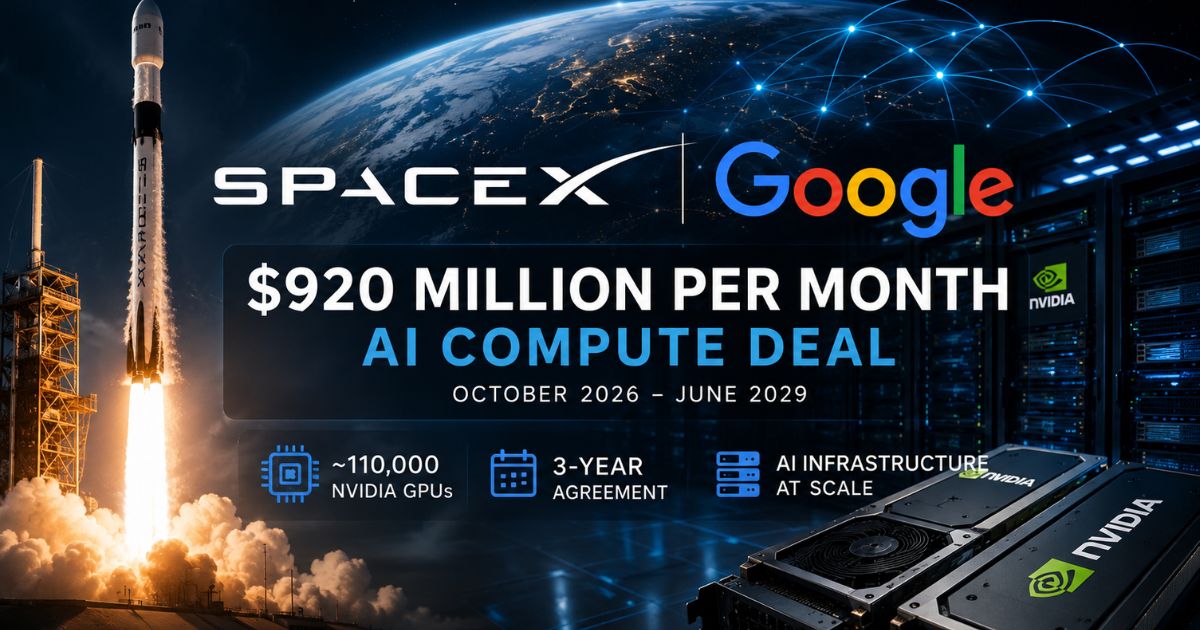
Google commits to $920 million per month for SpaceX AI infrastructure beginning October 2026. The SpaceX Google Deal signals a fundamental shift in how AI companies are competing for computational resources.
Here’s a number most SpaceX investors are ignoring.
$920 million per month.
According to Reuters, Google committed to purchasing computing infrastructure from SpaceX beginning October 2026 through June 2029. The reported agreement includes approximately 110,000 NVIDIA GPUs, plus CPUs, memory, and related computing resources.
That’s not an IPO story. That’s an infrastructure story.
And it may reveal something fundamental about what actually constrains artificial intelligence development.
Why The SpaceX Google Deal More Than The IPO Debate
The SpaceX conversation typically centers on one question: at what valuation will the company eventually go public?
That’s natural. A future IPO would rank among the largest technology offerings ever.
But focusing solely on IPO potential misses something more immediate: SpaceX is building a business that may have nothing to do with rockets.
The Google agreement suggests SpaceX is becoming an infrastructure provider. That’s a different market entirely-one with different unit economics, different customer relationships, and different long-term value.
To understand why, consider how each type of business works:
Launch Services: Project-based revenue. Client pays for a specific mission. Recurring but episodic.
Infrastructure Services: Recurring contracts. Long-term customer commitments. Predictable cash flows. Higher margins.
Markets typically assign higher valuations to recurring revenue businesses than to project-based services. That distinction could matter significantly if SpaceX infrastructure becomes a meaningful revenue contributor.
While I’ve previously discussed why SpaceX’s $1.75 trillion valuation keeps me up at night, the Google deal adds a new layer to the valuation debate.
The Physical Infrastructure Problem Behind AI Hype
Most AI discussions focus on breakthroughs: better models, new architectures, novel training approaches.
That emphasis makes sense for technological innovation. But it misses what’s increasingly becoming the real bottleneck.
Physical infrastructure.
Every AI system ultimately depends on:
- GPU computing capacity
- Reliable electricity supply
- Data center space
- Cooling systems
- Networking infrastructure
These aren’t problems software engineers solve. They’re problems that require capital, time, land, and energy.
According to industry analysts cited by technology publications, GPU demand has outpaced supply throughout 2025 and into 2026. Power generation capacity in suitable geographic regions remains constrained. Data center construction requires 24-48 months from regulatory approval to operation.
The result: major technology companies are running into physical limits, not algorithmic ones.
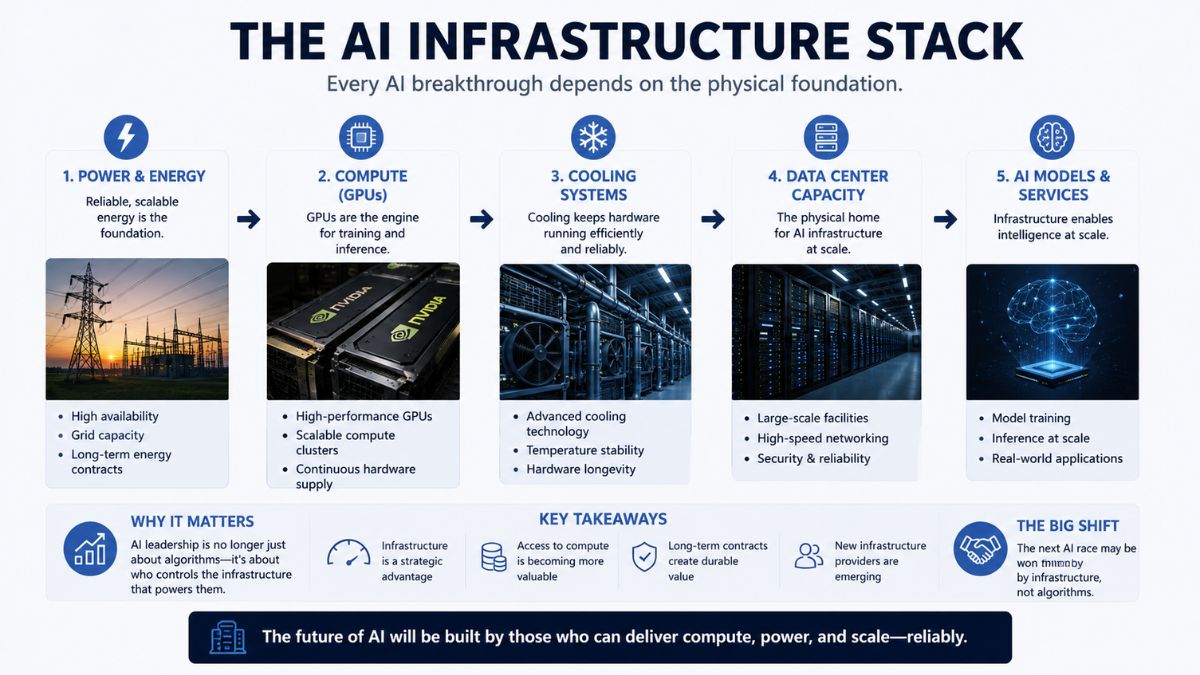
Every AI system depends on physical layers: power, GPUs, cooling, data centers, and AI models. Infrastructure is the foundation that algorithms depend on.
Why Google Needs External Capacity
The intuitive response to Google’s arrangement is straightforward: Google operates some of the world’s largest data center networks. Why outsource?
The practical answer: speed.
Building new large-scale computing infrastructure requires time. Even for Google’s scale:
- Regulatory approvals: 6-12 months
- Land acquisition and permitting: 3-6 months
- Construction: 12-24 months
- Hardware procurement and integration: 6-12 months
- Total timeline: 27-54 months minimum
If AI demand is growing faster than new infrastructure can be deployed, renting existing capacity becomes the faster option-regardless of cost premium. That’s not desperation. It’s optimization.
| Key Figure | Source | Significance |
| $920M/month | Reuters; SEC disclosures | ~$11B annual commitment |
| 110,000 GPUs | Regulatory filings | Estimated 15-20% of enterprise GPU supply* |
| 3-year duration | Contract terms | Indicates confidence in sustained demand |
| Oct 2026 start | SEC filings | Upcoming deployment deadline |
*Supply estimates derived from industry analyst reports; comprehensive market totals remain proprietary.
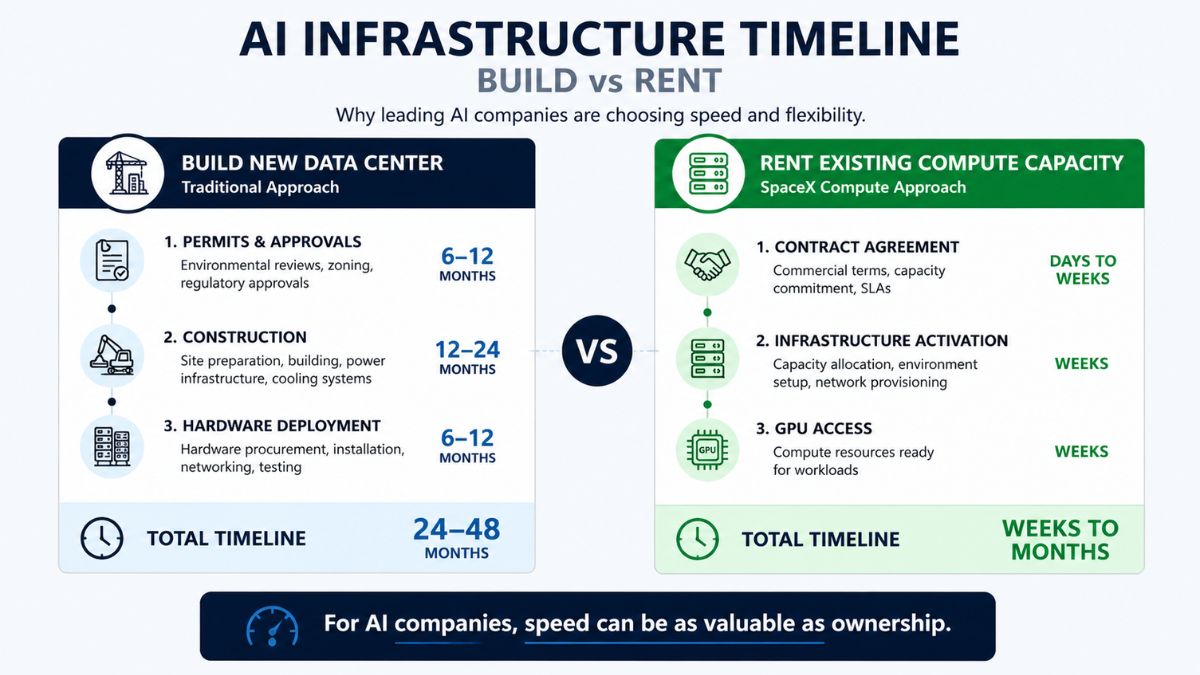
Building new data center infrastructure takes 24-48 months. Renting existing capacity takes weeks. For AI companies racing to deploy models, speed determines competitive advantage.
What This Reveals (And What It Doesn’t)
Based on reported facts, several conclusions are reasonable:
Google appears willing to commit significant capital to securing long-term computing resources. That’s factual and notable.
SpaceX has developed infrastructure capabilities that large enterprise customers value commercially. Also factual.
AI infrastructure is increasingly becoming a business category in its own right, not merely a support function. Supported by observable trends.
Anything beyond those observations requires interpretation-and interpretation deserves scrutiny.
Is this a temporary response to current supply constraints? Is it evidence of structural, long-term infrastructure scarcity? Is it strategic positioning by Google ahead of competitors? Or is it simply efficient capital deployment given Google’s unique circumstances?
Reasonable analysts could interpret the same contract differently.
The Execution Question (Which Matters Most)
Large contracts generate headlines. Actually delivering infrastructure at scale is where the real work begins.
The agreement includes provisions allowing Google to walk away if SpaceX fails to meet capacity commitments. That’s important because it means the revenue is conditional on execution.
Delivering 110,000 GPUs of consistent computing capacity requires:
- Reliable power supply at massive scale
- Hardware supply chain coordination
- Data center operational expertise
- Security infrastructure meeting enterprise standards
- Redundancy and disaster recovery systems
- Support and maintenance capabilities
Each represents complex operational challenges. Contract value only materializes if execution succeeds.
SpaceX has demonstrated capability in capital-intensive infrastructure projects. Whether that translates to data center operations at this scale remains genuinely uncertain.
What Investors Should Actually Monitor
The significance of this agreement will depend on developments that haven’t happened yet. Three indicators matter most:
Similar Agreements Do other major AI companies (Amazon, Microsoft, OpenAI) negotiate comparable infrastructure partnerships? If yes, it validates broader supply pressures. If not, this may be unique to Google’s circumstances.
Computing Capacity Economics Do GPU rental rates remain elevated through 2029, indicating sustained scarcity? Or do they decline, suggesting supply catches up? Pricing reveals whether constraints are structural or cyclical.
Infrastructure Revenue Contribution Once SpaceX discloses financial results, how much does this contract contribute to total revenue? What margins does infrastructure generate compared to launch services? Can the business scale profitably?
These observable metrics matter more than announcement excitement. They’ll either validate or challenge whatever narrative people construct today.
For more context on the infrastructure market, check out this discussion on the SpaceX-Google compute partnership via Bloomberg Podcasts.
The Real Question
Here’s what deserves honest consideration: Does this contract signal structural change in how AI gets built? Or is it a rational economic response to current scarcity that may not persist?
The data available today doesn’t answer that definitively.
What it does suggest is that computing capacity, energy availability, and infrastructure ownership are becoming more important variables in the AI economy than many investors previously assumed.
The SpaceX IPO will eventually happen, and markets will assign it a valuation. That headline will attract attention.
But this infrastructure contract may ultimately prove more consequential to long-term value creation-if execution succeeds and demand persists.
That’s a bigger “if” than most headlines acknowledge.
As AI models become more integrated into daily hardware-much like the upcoming Siri 3.0 and AI-powered apps predicted for Apple’s 2026 ecosystem the demand for physical compute infrastructure will only continue to rise.
VeritaLogic publishes independent analysis on technology and markets based on publicly available information. This article represents interpretation of reported developments and should not be considered investment advice. Consult qualified professionals before making investment decisions.
If you found this analysis helpful, explore more of my thoughts on tech markets here
Sources & Further Reading
- Reuters: SpaceX signs cloud deal with Google
- Other industry reporting and public disclosures