
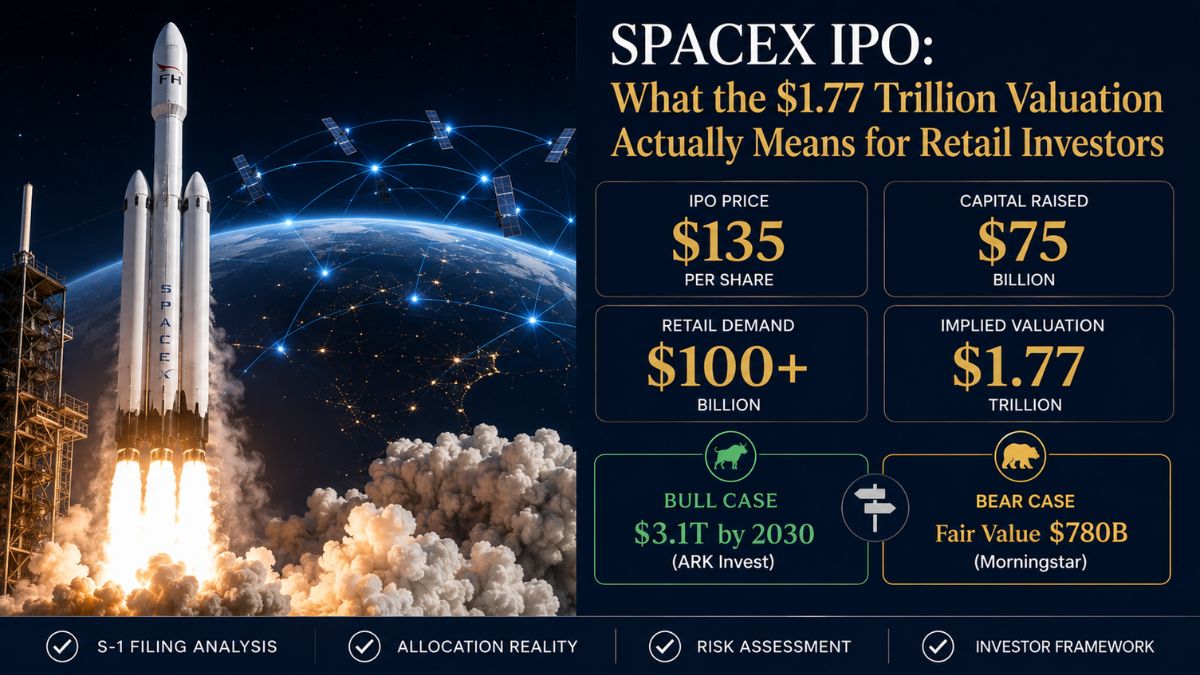
SpaceX IPO at a glance: $135 per share, $75 billion raised, and a $1.77 trillion implied valuation – with analyst projections ranging from $780 billion (Morningstar) to $3.1 trillion by 2030 (ARK Invest). Source: SpaceX S-1 Filing, June 2026.
There is a moment in every major IPO cycle when logic starts losing ground to excitement.
You have probably seen it before – the breathless headlines, the social media posts, the coworker who says he is putting his entire savings into it. The SpaceX IPO has produced all of these things, and then some.
On June 12, 2026, SpaceX began trading on the Nasdaq under the ticker SPCX, priced at $135 per share. The company offered 555.6 million shares at a fixed take-it-or-leave-it price, raising roughly $75 billion – the largest amount ever raised in a single IPO by capital raised, surpassing Saudi Aramco’s previous record of $29.4 billion set in 2019. At 555.6 million shares multiplied by $135, the implied market capitalization came to approximately $1.77 trillion, making SpaceX the seventh-largest company in the United States on its first day of trading, above Tesla’s market cap of approximately $1.6 trillion at the time.
Reports confirmed that retail investor demand alone exceeded $100 billion before a single share changed hands publicly. That number is staggering. It is also, on its own, completely meaningless as an investment signal.
The question worth asking is not whether SpaceX is an impressive company. It clearly is. The question is whether buying its stock at a $1.77 trillion implied valuation – right now, at this price, with your money – is likely to produce the kind of returns that justify the risk you are taking on.
That is a different question entirely, and most of the coverage surrounding this IPO has not seriously attempted to answer it. This article will.
What You Are Actually Buying at $135 Per Share
To understand what $1.77 trillion means in practice, it helps to place it alongside other companies at their own IPO moments. The table below uses verified historical data:
| Company | IPO Year | IPO Price | IPO Valuation | Notable Outcome |
|---|---|---|---|---|
| SpaceX (SPCX) | 2026 | $135 | $1.77 trillion | Trading began June 12, 2026 |
| Tesla (TSLA) | 2010 | $17 | ~$2.2 billion | Multi-thousand percent gain over 10+ years |
| Amazon (AMZN) | 1997 | $18 | ~$438 million | Long-term compounding over 25+ years |
| Uber (UBER) | 2019 | $45 | ~$82 billion | Approximately flat over first 12 months |
| Rivian (RIVN) | 2021 | $78 | ~$76 billion | Lost over 80% within 12 months of IPO |
| ARM Holdings | 2023 | $51 | ~$54 billion | Approximately doubled within 12 months |
Historical IPO prices and valuations sourced from Reuters, Bloomberg, and SEC filings. Past performance does not predict future results.
The pattern matters. Tesla and Amazon entered public markets at valuations that left enormous room for growth over many years. SpaceX is entering at a valuation that already prices in decades of expected success across multiple business lines.
To double from $1.77 trillion, SpaceX would need to reach $3.5 trillion – larger than any publicly traded company in history as of mid-2026. That is possible. It is not guaranteed.
Analyst estimates reflect this uncertainty. According to publicly available research, Morningstar has estimated fair value near $780 billion, less than half the IPO price. ARK Invest, by contrast, has projected a potential valuation of up to $3.1 trillion by 2030. These two estimates represent the range of credible informed opinion – and they differ by a factor of four.
The disagreement among analysts is one reason why SpaceX’s IPO has become one of the most debated listings in recent market history. Readers interested in a deeper valuation-focused perspective may also find SpaceX at $1.75 Trillion: Why I’m Still Losing Sleep Over This IPO useful.
Three Businesses Inside SpaceX – What the S-1 Filing Actually Shows
Most people think of SpaceX as a rocket company. The official S-1 registration document filed with the SEC tells a more complex story. According to financial data disclosed in that filing and reported across multiple financial publications, SpaceX now operates three distinct business segments with fundamentally different financial profiles:
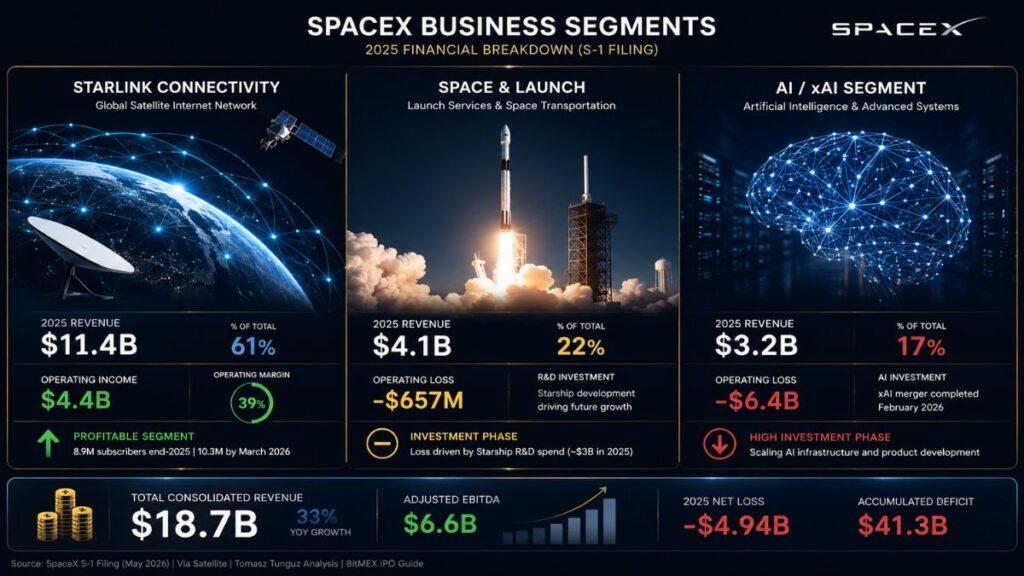
SpaceX operates three fundamentally different businesses. Starlink is the only profitable engine at 39% operating margin. The AI segment burned $6.4 billion in 2025 – funded entirely by Starlink’s success. Source: SpaceX S-1 Filing, May 2026 / Via Satellite / Tomasz Tunguz Analysis.
| Segment | 2025 Revenue | Share of Total | Operating Result | Key Detail |
|---|---|---|---|---|
| Starlink Connectivity | $11.4 billion | 61% | +$4.4B profit | 39% operating margin; 8.9M subscribers end-2025 |
| Space & Launch Services | $4.1 billion | 22% | -$657M loss | Loss driven by ~$3B Starship R&D spend |
| AI Segment (xAI/Grok/X) | $3.2 billion | 17% | -$6.4B loss | xAI merger completed February 2026 |
| Total Consolidated | $18.7 billion | 100% | -$4.94B net loss | 33% YoY growth; Adjusted EBITDA +$6.6B |
Source: SpaceX S-1 SEC Filing, May 2026, as reported by Via Satellite and multiple financial publications.
Several things stand out from this data.
Starlink is the only profitable segment, generating $4.4 billion in operating income at a 39% margin. Without Starlink, SpaceX’s consolidated financials would look considerably more stressed. The AI segment – which includes xAI, Grok, and the X platform following a February 2026 merger – consumed $6.4 billion in operating losses in 2025 alone. That division is currently funded entirely by Starlink’s profits.
The Space segment, which includes Falcon 9 launches and government contracts, operates at a deliberate loss primarily because SpaceX is spending approximately $3 billion annually on Starship development.
Despite $6.6 billion in adjusted EBITDA, SpaceX reported a GAAP net loss of $4.94 billion for full-year 2025. In the first quarter of 2026 alone, the net loss reached $4.28 billion – meaning losses are accelerating, not moderating. The accumulated deficit now stands at approximately $41.3 billion.
Investors should be clear on what this means: they are buying a company that is currently unprofitable on a standard accounting basis, where one division funds the losses of two others, and where the largest single expense item is an AI business that has not yet demonstrated a clear path to profitability.
The Allocation Reality Most Retail Investors Are Not Prepared For
SpaceX reserved approximately 30% of the offering for retail investors – around $22.5 billion worth of shares. That is notably generous by industry standards, where retail typically receives 5% to 10% of a large listing.
Despite that generosity, retail demand alone reportedly exceeded $100 billion. Total demand from all investor categories combined surged past $250 billion, making the offering approximately 3.5 to 4 times oversubscribed overall. On the retail tranche specifically, demand was more than four times the available supply.
The arithmetic produces an uncomfortable outcome. Even investors who qualified through their broker, submitted a valid order, and received a confirmation notice may have ended up with a single share or nothing at all.
SpaceX named five brokerages as designated retail channels in its prospectus: Fidelity, Charles Schwab, Robinhood, SoFi, and E*TRADE. Each has its own allocation methodology and its own rules for what happens after you receive shares:
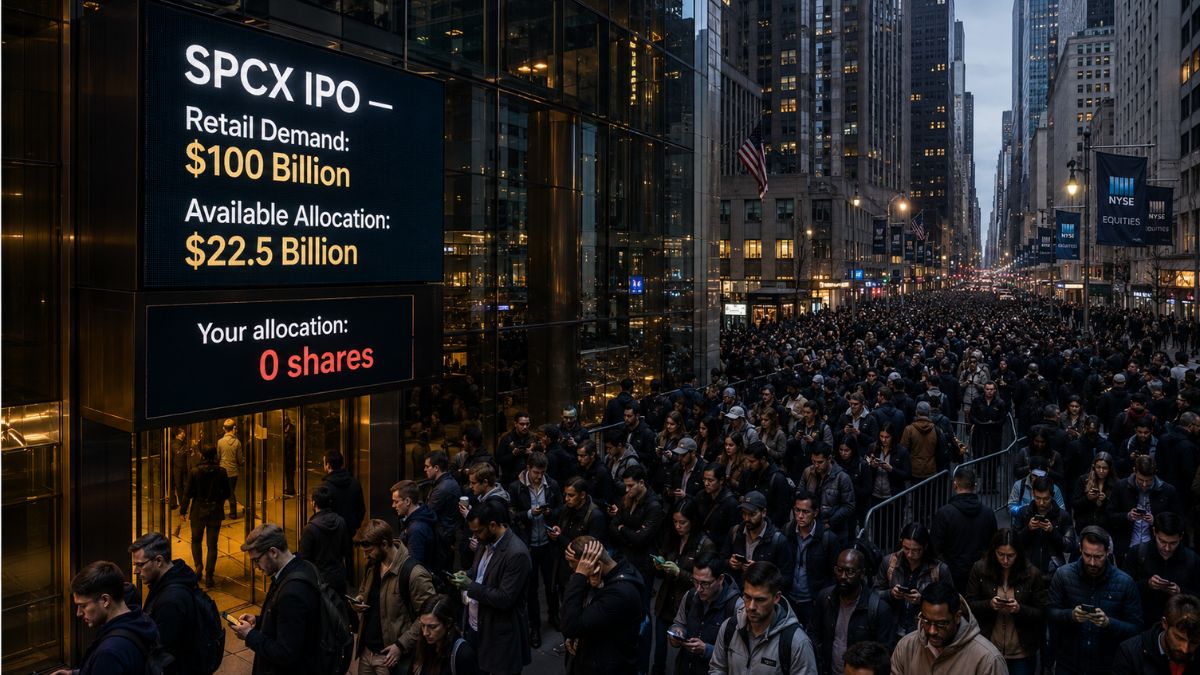
The math is brutal: $100 billion in retail demand chasing $22.5 billion in available allocation means most investors who applied received little or nothing. SpaceX’s 30% retail tranche – triple the industry standard – still could not accommodate the demand. Source: IBTimes UK, June 12, 2026.
| Broker | Minimum to Qualify | Restriction Period | Penalty for Early Sale |
|---|---|---|---|
| Fidelity | $2,000 | 15 calendar days | 6-month IPO ban; repeat offense = permanent (SSN-tied) |
| E*TRADE | Funded account only | 30 days | Future IPO participation restricted |
| Robinhood | Standard account | 30 days | Similar restrictions apply |
| SoFi | Standard account | 30 days | Similar restrictions apply |
| Charles Schwab | Standard account | No stated policy | No anti-flipping rule disclosed |
Source: Brokerage disclosures as reported by IBTimes UK, June 12, 2026.
The Lock-In Problem Nobody Is Discussing
There is a consequence of receiving an IPO allocation that many retail investors discover only after the fact.
Those who do receive shares at $135 are restricted from selling them for 15 to 30 days depending on their broker. This lock-in period coincides precisely with the most volatile stretch of any new listing – the days and weeks when price discovery is most unpredictable and when a relatively thin public float can produce sharp moves in either direction.
According to brokerage disclosures, the free float at launch represented approximately 4% of shares outstanding. A thin float combined with large institutional demand creates conditions for significant volatility in both directions – and retail investors, by design, are the least able to respond to that volatility during the lock-in window.
Three Risks That Deserve More Careful Consideration
Risk 1: Starship Has Not Yet Proven Commercial Viability
A significant portion of SpaceX’s long-term valuation case depends on Starship – the fully reusable heavy-lift rocket system intended to dramatically reduce the cost of access to space. The Space segment spent approximately $3 billion on Starship development in 2025 alone, contributing directly to that segment’s operating loss.
As of mid-2026, Starship has not completed a full operational commercial mission. Investors who are pricing Starship’s eventual success into their valuation are, by definition, making a bet on a program that has not yet delivered its central promise. That may prove to be a wise bet. It is not yet a validated one.
Risk 2: AI Losses Are Large and Growing
The xAI segment posted operating losses of $6.4 billion in 2025 and consumed an additional $2.5 billion in the first quarter of 2026 alone. The Colossus data center – a 220,000-GPU facility built in 120 days – secured a reported contract with Anthropic worth $1.25 billion per month through May 2029, which may eventually improve this segment’s economics. Whether that contract, and others like it, are sufficient to bring the AI division toward profitability at scale remains to be seen.
Risk 3: Starlink’s Growth Economics Are Shifting
Starlink subscriber counts have grown rapidly – from 2.3 million in 2023 to 8.9 million by end-2025 and 10.3 million by March 2026. However, average revenue per user has declined approximately 18% to around $81 per month as SpaceX has expanded into lower-income markets and introduced more competitive pricing tiers.
Competition is also increasing. Amazon’s Project Kuiper launched its first commercial satellites in 2024 and has significant capital resources behind its expansion. If Starlink’s subscriber growth slows or average revenue per user continues declining, the earnings case for the overall $1.77 trillion valuation weakens considerably – since Starlink is the only profitable segment currently supporting the entire enterprise.
The AI business is becoming an increasingly important part of the SpaceX investment story. For additional context on how artificial intelligence infrastructure could influence the company’s future economics, see The SpaceX-Google Compute Deal: An Infrastructure Shift Investors Are Underestimating.
A Practical Framework Before You Decide
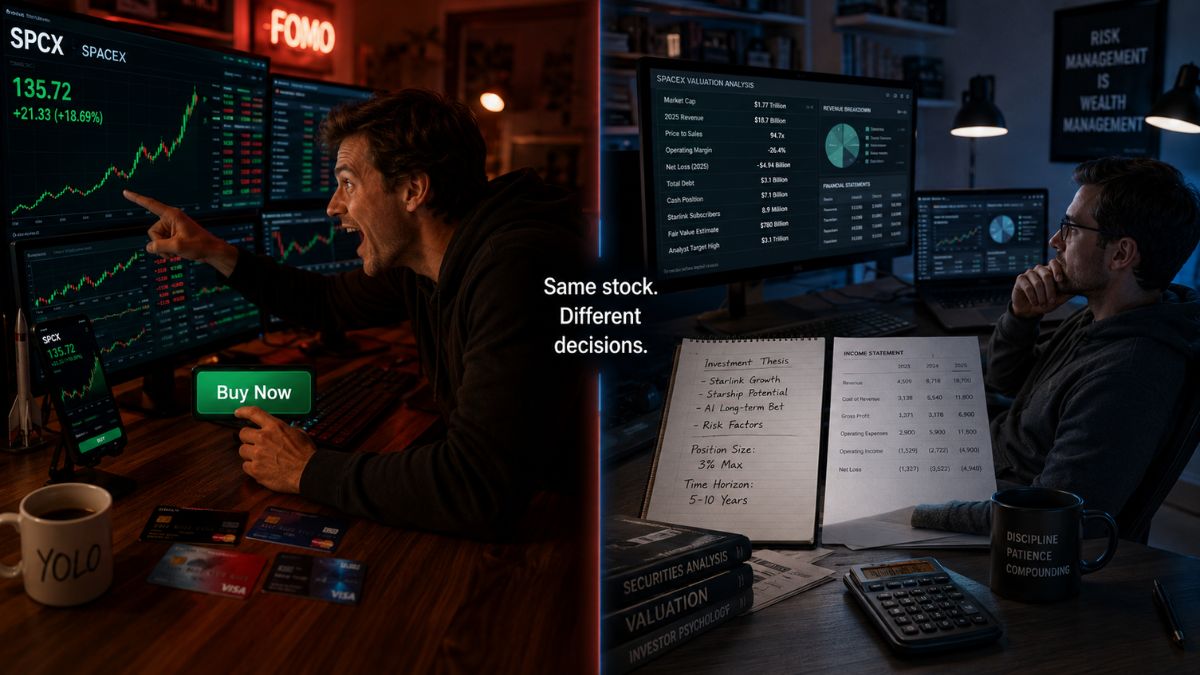
Same stock. Fundamentally different approaches. The left side represents the $100 billion in retail demand driven by excitement. The right side represents the framework every investor should apply before committing capital: position size, time horizon, valuation reality, and drawdown tolerance.
Before placing any order – whether at the IPO price or in the open market – these questions are worth answering honestly:
What is your time horizon? The valuation math at $1.77 trillion requires years, possibly a decade or more, of strong execution across multiple business lines. Investors expecting meaningful returns within 12 to 24 months are speculating on price momentum, not investing on fundamentals.
What percentage of your portfolio does this represent? Standard risk management practice suggests limiting any single speculative position to no more than 3 to 5 percent of investable assets, regardless of confidence level. The notebook visible on the right side of the image above – “Position Size: 3% Max” – reflects exactly this principle.
Do you understand what the valuation is pricing in? At $1.77 trillion against $18.7 billion in 2025 revenue, the price-to-sales ratio is approximately 94.7 times. That multiple requires Starship commercialization, sustained Starlink dominance, a path to AI profitability, and continued revenue growth — simultaneously and over an extended period.
Can you hold through a significant drawdown? High-valuation growth companies routinely experience corrections of 40% to 60% or more, even when their underlying businesses remain operationally intact. Rivian fell more than 80% from its IPO price within 12 months despite being a real company with real products and real backing. If a major decline would prompt you to sell, your position size is already larger than your actual risk tolerance supports.
The Bottom Line
SpaceX is, by almost any measure, one of the most operationally impressive companies ever built. Its engineering achievements are real. Starlink is a genuinely profitable and growing business. The long-term opportunities – if Starship succeeds, if AI generates returns, if Starlink maintains its competitive position – are potentially enormous.
None of that means buying at $135 per share, at a $1.77 trillion implied valuation, is the right decision for every investor or for every portfolio.
The best investment decisions are rarely the most exciting ones at the moment they are made. They are usually the ones where the price paid leaves enough room for execution to disappoint modestly and still produce a reasonable return over time.
At the current valuation, SpaceX needs execution to exceed expectations, not simply meet them. For investors who understand that distinction and are comfortable with the risk it implies, a carefully sized, long-term position may be worth considering. For everyone else, watching the first few quarters of public financial reporting before committing capital may prove to be the more prudent approach.
The rocket is impressive. So is the price tag.
Frequently Asked Questions
What is the SpaceX IPO price and valuation?
SpaceX priced its IPO at $135 per share on June 11, 2026, raising approximately $75 billion at an implied market capitalization of $1.77 trillion. It began trading on Nasdaq under the ticker SPCX on June 12, 2026.
Is SpaceX profitable?
On a GAAP basis, no. SpaceX reported a net loss of $4.94 billion in 2025 despite $18.7 billion in revenue. Starlink is profitable with a 39% operating margin. The AI segment posted a $6.4 billion operating loss in 2025, which offsets Starlink’s profitability at the consolidated level.
Can retail investors buy SpaceX stock at the IPO price?
Retail investors could apply through five designated brokerages – Fidelity, Schwab, Robinhood, SoFi, and E*TRADE – but receiving an allocation was not guaranteed. With over $100 billion in retail demand against $22.5 billion in available retail allocation, many investors received reduced or zero allocations.
What are the main risks of investing in SpaceX at IPO?
The primary risks are valuation risk (paying 94.7x price-to-sales for future expectations), AI segment losses ($6.4 billion in 2025), Starship’s unproven commercial viability, increasing competition in satellite internet, and key-person concentration risk.
What do analysts say about SpaceX’s fair value?
Analyst opinions differ significantly. Morningstar has estimated fair value near $780 billion, suggesting the IPO price is substantially above intrinsic value. ARK Invest has projected a potential valuation of up to $3.1 trillion by 2030 under a bull-case scenario. These estimates are not investment advice and reflect differing assumptions about long-term growth.
Sources & Methodology
This analysis is based on publicly available information, regulatory filings, and financial research reports available at the time of publication.
Primary Sources
- SEC EDGAR Database – SpaceX S-1 Registration Statement (May 2026)
- CNBC – “SpaceX targets $135 IPO price at valuation of $1.77 trillion” (June 3, 2026)
- Reuters – “Musk’s SpaceX prices record $75 billion IPO at $135 a share” (June 11, 2026)
- International Business Times UK – “SpaceX IPO Retail Allocation…” (June 12, 2026)
- Via Satellite – “SpaceX’s IPO Filing Gives First Look Into Company’s Financials” (May 2026)
Research & Analysis Sources
- Tomasz Tunguz – SpaceX S-1 Financial Analysis (June 2026)
- Morningstar Research – SpaceX Fair Value Assessment (June 2026)
- ARK Invest Research – Long-Term SpaceX Valuation Projections (June 2026)
Editorial Note The data compiled for this analysis represents information as of June 12, 2026. While every effort has been made to ensure accuracy based on available reports, market figures are subject to rapid change. This article is intended for educational and informational purposes only.
⚠️ Important Disclaimer
This article is written for educational and informational purposes only. Nothing in this article constitutes personalized investment advice, a recommendation to buy or sell any security, or a solicitation of any investment. Investing in stocks, including IPOs, involves significant risk including the possible loss of your entire investment.
All financial figures cited in this article – including revenue, valuation, loss figures, and analyst estimates – are based on publicly available sources including SpaceX’s S-1 SEC filing, published news reports, and analyst research available as of June 12, 2026. These figures may change as new information becomes available.
Past IPO performance referenced in this article is historical and does not guarantee or predict future results for SpaceX or any other investment.
VeritaLogic is an independent publication. The author holds no position in SpaceX (SPCX) stock and receives no compensation from any party related to this offering. This article does not represent the views of any brokerage, financial institution, or investment firm.
Always conduct your own independent research and consult a qualified, licensed financial professional before making any investment decision. Investment suitability depends on your individual financial situation, risk tolerance, investment horizon, and financial goals.