
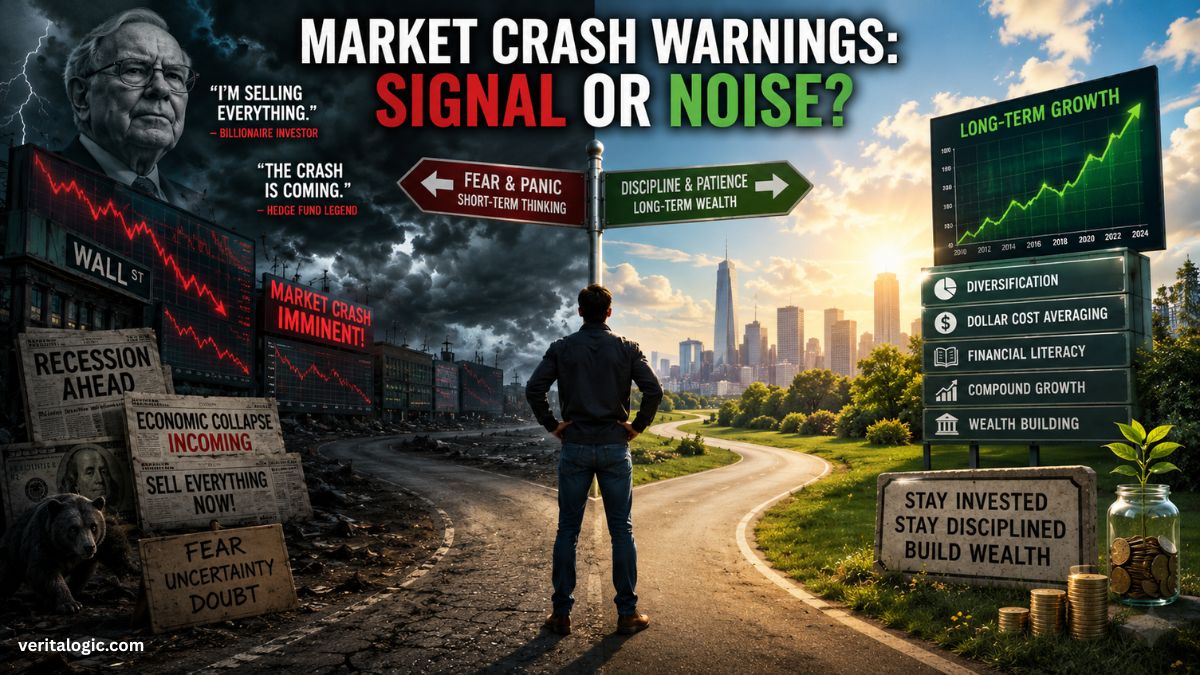
Every few months, a familiar headline captures investors’ attention:
“A billionaire investor warns of an imminent crash.”
“The market is in a bubble.”
“Sell everything before it’s too late.”
These warnings spread quickly because fear is one of the most powerful forces in finance. A prediction of disaster attracts far more attention than a prediction of steady growth.
Yet many retail investors have started asking a reasonable question: If markets have continued climbing despite years of crash predictions, are these Market Crash Warnings valuable signals or simply financial noise?
The answer is more nuanced than either side admits.
Some warnings have saved investors from devastating losses. Others have caused people to sit on the sidelines while markets rallied to record highs. Understanding the difference is critical for anyone trying to build long-term wealth.
Why Billionaire Market Crash Warnings Get So Much Attention
When a billionaire speaks about the economy, people listen.
After all, these individuals often have decades of experience, access to elite research teams, and a track record of navigating multiple economic cycles.
But there is an important distinction between identifying risks and accurately predicting timing.
Many respected investors correctly identify economic vulnerabilities years before a downturn actually occurs.
This creates a problem for ordinary investors.
An investor who exits the market too early may miss years of gains before a correction finally arrives.
One community member summarized the issue perfectly:
“The first and most fundamental rule of the market is: nobody knows the future.”
While that statement may sound simplistic, market history repeatedly supports it.
No investor, economist, central banker, or hedge fund manager has consistently predicted every major market move.
History Shows That Timing the Market Is Extremely Difficult
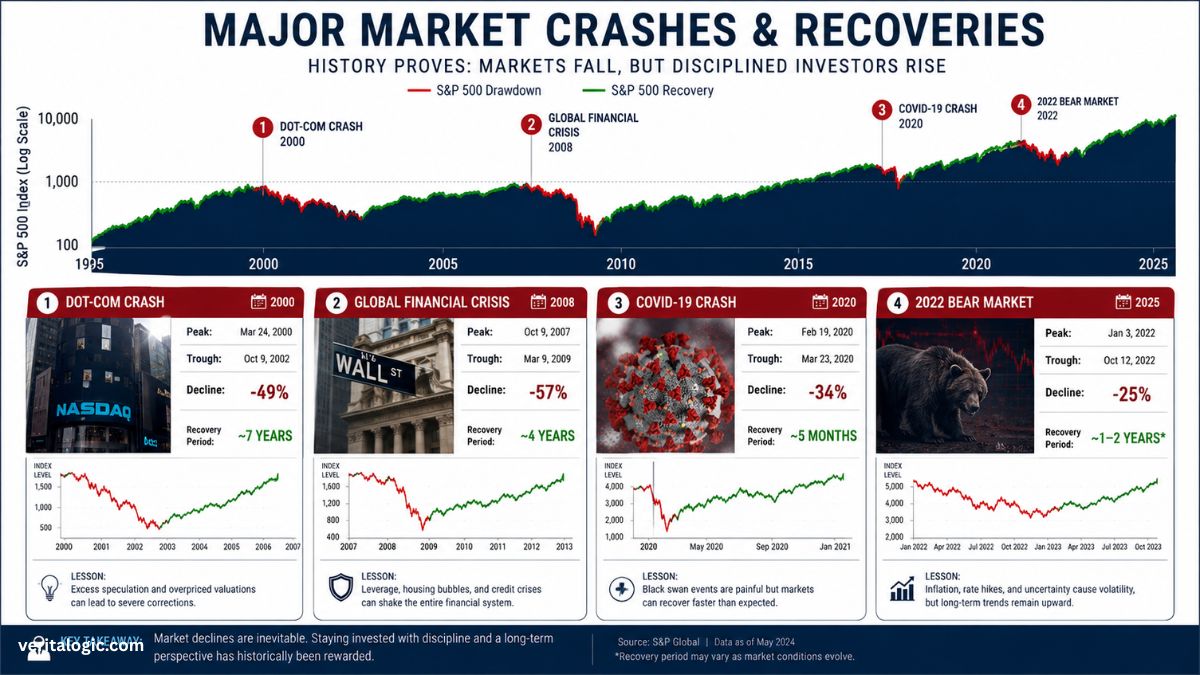
Major market crashes have historically been followed by recoveries that rewarded patient investors.
Throughout modern financial history, markets have endured countless crises:
| Event | Market Decline | Approximate Recovery Period |
|---|---|---|
| Dot-Com Crash (2000) | -49% | About 7 years |
| Global Financial Crisis (2008) | -57% | About 4 years |
| COVID-19 Crash (2020) | -34% | About 5 months |
| 2022 Bear Market | -25% | Around 1–2 years |
Despite these declines, markets eventually recovered and moved to new highs.
This does not mean crashes should be ignored.
It means investors should understand that downturns are a normal part of the investing journey.
A warning about risk is useful.
A prediction that investors should permanently abandon markets is rarely supported by history.
Video Source: The Diary Of A CEO, “Billionaire’s WARNING: I’m SELLING Everything.” YouTube.
Why Many Retail Investors Distrust Crash Predictions
One recurring theme among investor communities is skepticism toward wealthy market commentators.
Many retail investors believe that fear-based narratives disproportionately affect ordinary people.
As one commenter observed:
“It’s always rich people who try and scare us little people at the bottom.”
Whether or not this claim is entirely fair, it highlights an important psychological reality.
Retail investors have watched:
- Recession warnings come and go.
- Housing collapse predictions fail to materialize.
- Technology bubble fears persist for years.
- Markets repeatedly recover after major downturns.
Over time, many have become less responsive to dramatic headlines.
They have learned that acting on fear often produces worse outcomes than following a disciplined investment plan.
The Psychology of Fear: Why Bad News Feels More Convincing
Human beings are naturally wired to focus on threats.
Psychologists call this negativity bias.
In investing, this bias causes people to:
- Overestimate risks.
- Underestimate long-term opportunities.
- React emotionally during volatility.
- Sell at precisely the wrong time.
Financial media often amplifies this tendency because alarming headlines generate clicks.
A headline predicting a 50% market crash is far more likely to attract attention than a headline predicting average annual returns.
This is why investors must learn to separate emotional reactions from rational decision-making.
The goal is not to ignore risks.
The goal is to evaluate risks objectively.
Dollar Cost Averaging: The Antidote to Market Crash Warnings
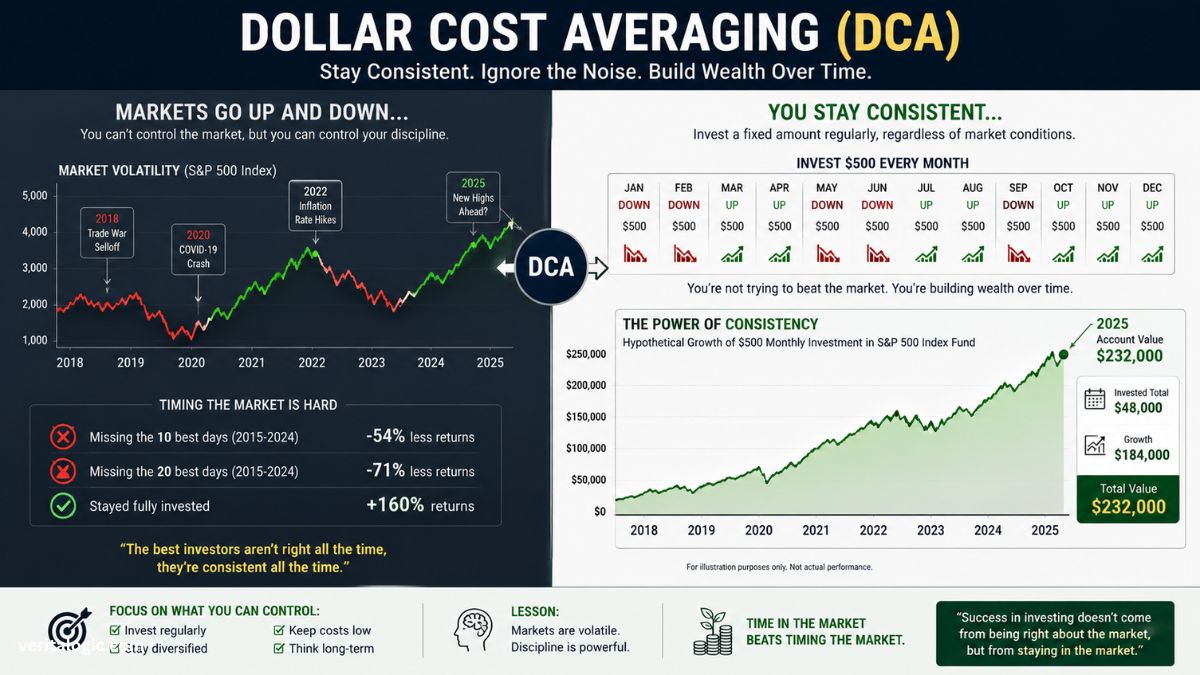
Consistent investing through Dollar Cost Averaging helps investors avoid emotional market timing decisions.
One of the most effective responses to constant Market Crash Warnings is Dollar Cost Averaging (DCA).
DCA involves investing a fixed amount of money at regular intervals regardless of market conditions.
This approach offers several advantages:
It Removes Emotion
Investors continue buying whether markets rise or fall.
It Reduces Timing Risk
There is no need to predict tops or bottoms.
It Turns Volatility Into Opportunity
Market declines allow investors to purchase more shares at lower prices.
This philosophy is reflected in one of the most practical community comments:
“Never time the market. Buy the dip, and DCA.”
While no strategy eliminates risk, DCA helps investors avoid one of the most damaging mistakes: letting emotions dictate investment decisions.
Financial Literacy Matters More Than Market Predictions
Perhaps the most important observation from the community discussion was the repeated call for financial education.
Several commenters emphasized:
- Financial literacy
- Critical thinking
- Economic history
- Personal responsibility
They are absolutely right.
The average investor does not need to predict the next recession.
They need to understand:
- Diversification
- Asset allocation
- Risk management
- Compounding
- Inflation
- Long-term investing
These skills create a foundation that remains valuable regardless of market conditions.
As legendary investor Warren Buffett famously suggested, successful investing often involves controlling emotions rather than predicting the future.
Knowledge creates confidence.
Confidence creates discipline.
Discipline creates results.
The Hidden Danger: Excessive Leverage
One particularly insightful comment stated:
“If you don’t have leverage then you won’t go to zero if invested in large index funds.”
This observation deserves attention.
Many investment disasters are caused not by market declines themselves but by excessive borrowing.
Leverage amplifies both gains and losses.
When markets fall sharply, leveraged investors may face:
- Margin calls
- Forced selling
- Permanent capital losses
Meanwhile, investors who avoid excessive leverage often retain the flexibility to wait for recovery.
For long-term investors, survival is more important than maximizing returns during every market cycle.
Building a Portfolio That Can Survive Mistakes
One of the most mature perspectives in the community came from an investor who noted:
“The hardest part of investing isn’t finding opportunities. It’s building a portfolio that can handle inevitable mistakes.”
This is an important lesson.
Every investor makes mistakes.
Even professional fund managers experience periods of underperformance.
The objective is not perfection.
The objective is resilience.
A resilient portfolio typically includes:
- Broad diversification
- Multiple asset classes
- Emergency savings
- Reasonable risk exposure
- Long-term thinking
Successful investing is often less about finding the next winning stock and more about avoiding catastrophic mistakes.
When Do Market Crash Warnings Become Noise?
Not all warnings are equal.
Some provide valuable insight into emerging risks.
Others become repetitive predictions that never materialize.
A useful warning encourages investors to:
- Review their portfolio.
- Assess risk exposure.
- Improve diversification.
- Strengthen cash reserves.
An unhelpful warning encourages:
- Panic selling.
- Emotional decision-making.
- All-or-nothing investing.
The best investors understand that uncertainty is permanent.
Instead of trying to eliminate uncertainty, they build strategies designed to function despite it.
A Practical Checklist Before Reacting to Market Crash Warnings
Before making any major investment decision, ask yourself:
✔ Do I have an emergency fund?
✔ Is my portfolio diversified?
✔ Am I investing with borrowed money?
✔ Has my long-term investment thesis changed?
✔ Am I reacting to data or emotions?
✔ Would I make the same decision if headlines disappeared tomorrow?
If you cannot answer these questions confidently, the issue may not be the market—it may be your investment process.
FAQ
What are Market Crash Warnings?
Market Crash Warnings are predictions or concerns that financial markets may experience significant declines due to economic, valuation, geopolitical, or structural risks.
Should I sell all my investments during a crash warning?
For most investors, selling everything is rarely advisable. Decisions should align with personal goals, risk tolerance, and investment time horizon.
Does Dollar Cost Averaging work during market downturns?
Yes. DCA allows investors to purchase assets at lower prices during declines, potentially improving long-term returns when markets recover.
How can I protect my portfolio from a market crash?
Diversification, proper asset allocation, emergency savings, and avoiding excessive leverage are among the most effective risk-management tools.
Has the stock market always recovered from major crashes?
Historically, major market indexes have recovered from significant downturns, though recovery timelines vary and future results are never guaranteed.
The Real Lesson for Retail Investors
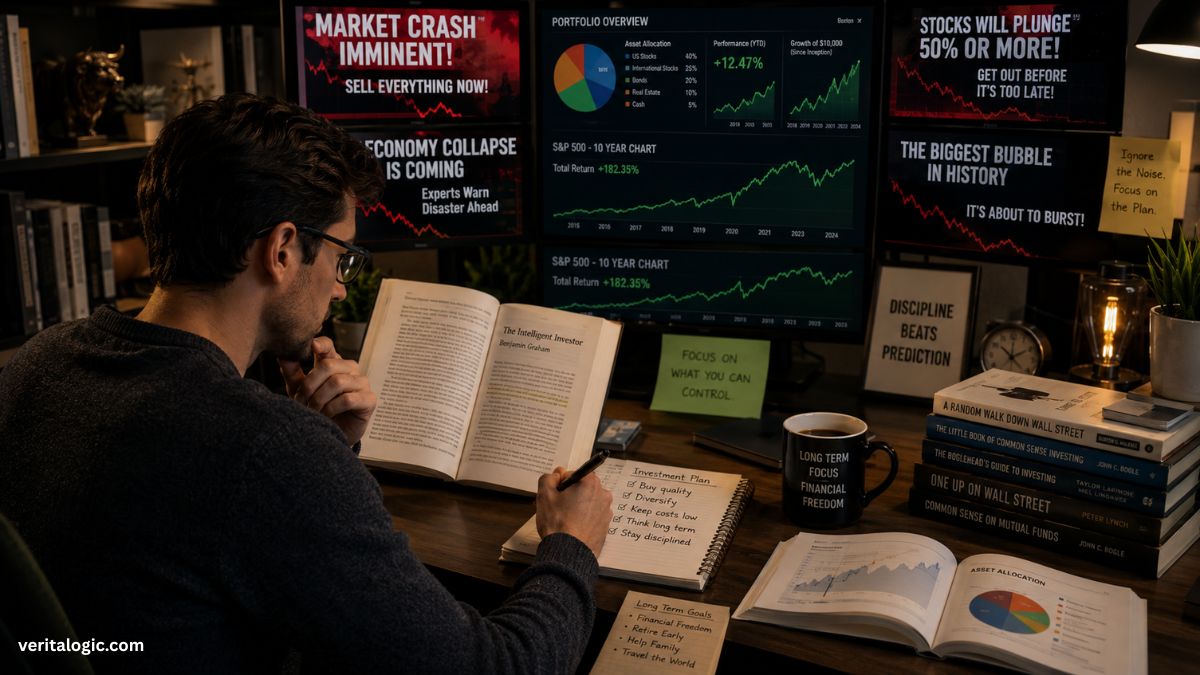
Financial literacy, critical thinking, and diversification often matter more than predicting the next market crash.
The debate surrounding Market Crash Warnings will never disappear.
Every economic cycle produces new predictions, new fears, and new headlines.
Some warnings will prove accurate.
Many will not.
What ultimately separates successful investors from unsuccessful ones is rarely their ability to predict the next crash.
It is their ability to remain disciplined when uncertainty arrives.
Markets will rise.
Markets will fall.
Headlines will change.
Fear will come and go.
But investors who prioritize financial literacy, diversification, risk management, and long-term thinking are often better positioned than those who spend their time chasing the next prediction.
Further Reading to Strengthen Your Financial Strategy
To build a resilient portfolio and make better financial decisions in 2026, consider these essential resources:
- Is an Online College Business Degree Worth It in 2026?
- Learn how to evaluate the real ROI of business education in today’s rapidly changing professional landscape.
- Gold vs. Silver in 2026: A Market Story Few Investors Expected
- Discover how precious metals can act as a buffer against market volatility and billionaire crash warnings.
- Asset Allocation Strategy for Investors: A Guide to Balancing Risk
- Master the art of asset allocation to ensure your investments remain secure, regardless of market sentiment.
Disclaimer
This article is for informational and educational purposes only and should not be considered financial, investment, legal, or tax advice. The views and opinions discussed are based on publicly available information, market history, and investor commentary. Financial markets involve risk, and past performance does not guarantee future results. Readers should conduct their own research and consult a qualified financial advisor before making any investment decisions. The author and publisher are not responsible for any financial losses resulting from actions taken based on this content.
Editorial Note: This article was curated from community insights and expert analysis to provide a balanced view on market volatility. All external media referenced remains the property of their respective owners.