
For most of the last decade, investors treated gold vs silver as part of the same trade.
When inflation fears rose, both metals tended to rally. When central banks printed aggressively, both benefited. When geopolitical tensions increased, investors often bought both without thinking twice.
That relationship is beginning to change.
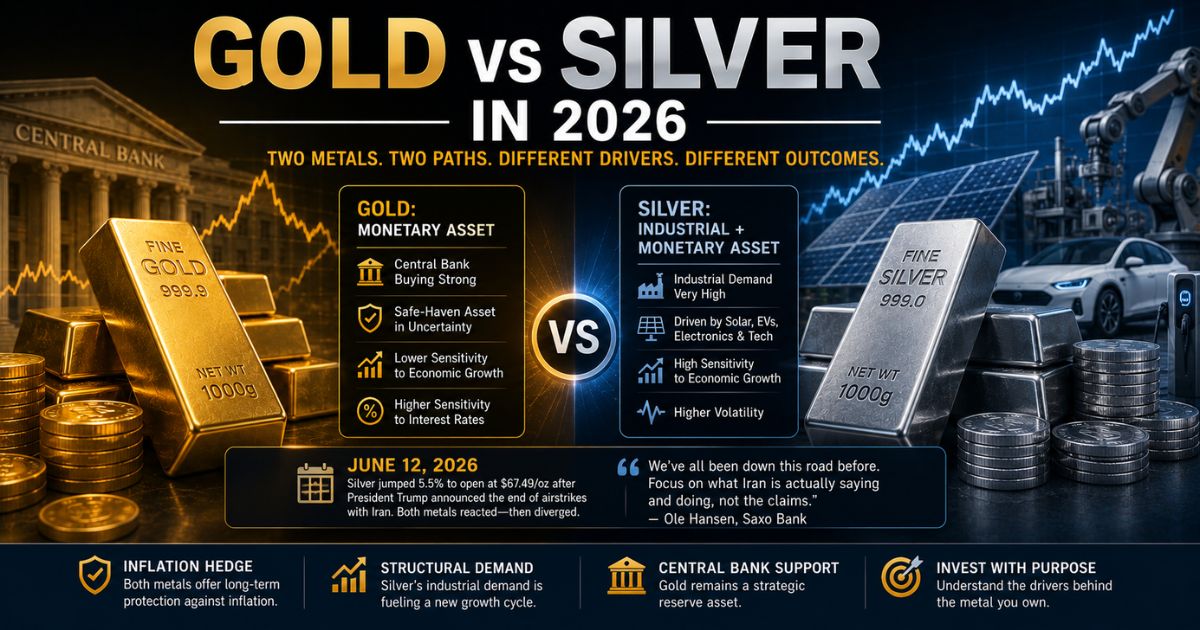
The divergence between gold and silver in 2026 is no longer a short-term anomaly. It reflects a deeper shift in how markets value each metal. Gold continues to function primarily as a monetary asset and store of value. Silver is increasingly being valued as both a precious metal and a strategic industrial resource.
Understanding that distinction may be more important today than watching the next price target from Wall Street.
Why Gold Is Facing Resistance Despite Strong Long-Term Fundamentals
Gold remains one of the most closely watched assets in global markets.
Central banks continue accumulating reserves, government debt levels remain elevated, and long-term concerns surrounding currency stability have not disappeared.
Yet gold has experienced periods of weakness throughout 2026.
Part of the explanation comes from investor behavior.
When markets become optimistic about economic growth, capital tends to rotate into higher-risk assets such as technology stocks, artificial intelligence companies, and growth sectors. During those periods, gold often becomes a funding source rather than a destination.
Interest rates also matter.
Gold generates no yield. When Treasury securities and cash-equivalent instruments offer attractive returns, the opportunity cost of holding gold increases. That creates temporary headwinds even when the long-term case remains intact.
When markets become optimistic about economic growth, capital tends to rotate into higher-risk assets such as technology stocks, artificial intelligence companies, and growth sectors. During those periods, gold often becomes a funding source rather than a destination. (If you want to understand how massive tech trends siphon capital from defensive assets, see our deep dive on the SpaceX IPO: What the $1.77 Trillion Valuation Actually Means for Retail Investors).
The Central Bank Demand Story Most Retail Investors Overlook
Retail investors often focus on daily price movements.
Institutional buyers operate differently.
Central banks are not attempting to predict where gold will trade next month. They are building long-term reserves designed to reduce reliance on foreign currencies and financial systems.
Gold offers something few assets can provide:
- No counterparty risk
- No dependence on corporate earnings
- No exposure to sovereign default
- Long-term purchasing power preservation
That strategic demand continues regardless of short-term market volatility.

Central bank gold reserves and bullion holdings in 2026
Silver Is Playing a Different Game
Silver is no longer moving solely on investment demand.
Today, it sits at the center of multiple industrial trends that are reshaping the global economy.
While investors still buy silver as a precious metal, manufacturers increasingly view it as an essential industrial input.
That distinction has become one of the defining stories of 2026.
Why Industrial Demand Is Becoming Silver’s Secret Weapon
Several major industries depend heavily on silver.
Solar Energy Expansion
Solar panel manufacturing remains one of the largest sources of silver demand worldwide.
As countries continue investing in renewable energy infrastructure, silver consumption continues rising.
Electrification and Power Infrastructure
Silver’s conductivity makes it difficult to replace in advanced electrical systems.
Grid upgrades, industrial automation, and energy transmission projects all contribute to growing demand.
Electric Vehicles
Modern electric vehicles require substantial amounts of silver across sensors, electronics, power management systems, and charging technologies.
Advanced Technology Manufacturing
Semiconductors, telecommunications equipment, and next-generation electronics continue creating demand for high-performance conductive materials.
Silver sits directly in the middle of these trends.
Related Analysis: Silver in 2026: A Strategic Hedge or an Industrial Necessity for US Investors?
A detailed look at the structural shifts in the silver market.
The June 12 Shock: When Silver Stopped Trading Like Gold
The morning of June 12, 2026 offered a perfect illustration of why investors can no longer assume gold and silver belong to the same trade.
Before U.S. markets fully settled into the day, President Donald Trump announced that American airstrikes had been halted and that the military confrontation with Iran was effectively over. The statement immediately rippled through commodity markets.
Silver July futures opened at $67.49 per ounce, surging 5.5% in a single session. Gold also moved higher as investors processed the implications of a potentially calmer Middle East.
At first glance, the reaction looked familiar.
A geopolitical headline arrives. Precious metals move higher. Traders rush to reposition.
But the similarity ended there.
Ole Hansen, Head of Commodity Strategy at Saxo Bank, urged caution, warning investors not to build positions based solely on political statements.
According to Hansen, investors should pay closer attention to what Iran was actually saying and doing rather than relying entirely on declarations coming from Washington.
That warning proved important.
Although both metals reacted to the same geopolitical event, silver’s broader performance was already being driven by a much larger story.
By June 12, silver had delivered an impressive 88.7% year-over-year gain, after reaching a remarkable 173.3% annual increase on May 14.
Those numbers suggest that silver’s rally cannot be explained by safe-haven demand alone.
Industrial consumption continues to provide a second source of support that gold simply does not enjoy.
The June 12 trading session demonstrated something investors may need to understand moving forward:
Headlines can move prices for a day.
Structural demand can move them for years.
Related Market Analysis: Why Gold & Silver Faced Recent Pressure
Watch this deep-dive precious metals analysis by Jeffrey Christian of CPM Group exploring the recent price action and what lies ahead for commodities.
Gold vs Silver: Different Drivers, Different Outcomes
| Factor | Gold | Silver |
| Primary Role | Monetary Asset | Monetary + Industrial Asset |
| Central Bank Demand | Strong | Limited |
| Industrial Demand | Moderate | Very High |
| Interest Rate Sensitivity | High | Medium |
| Economic Growth Sensitivity | Lower | Higher |
| Volatility | Lower | Higher |
The table highlights why treating gold and silver as identical investments may no longer make sense.
Their demand drivers are increasingly different.
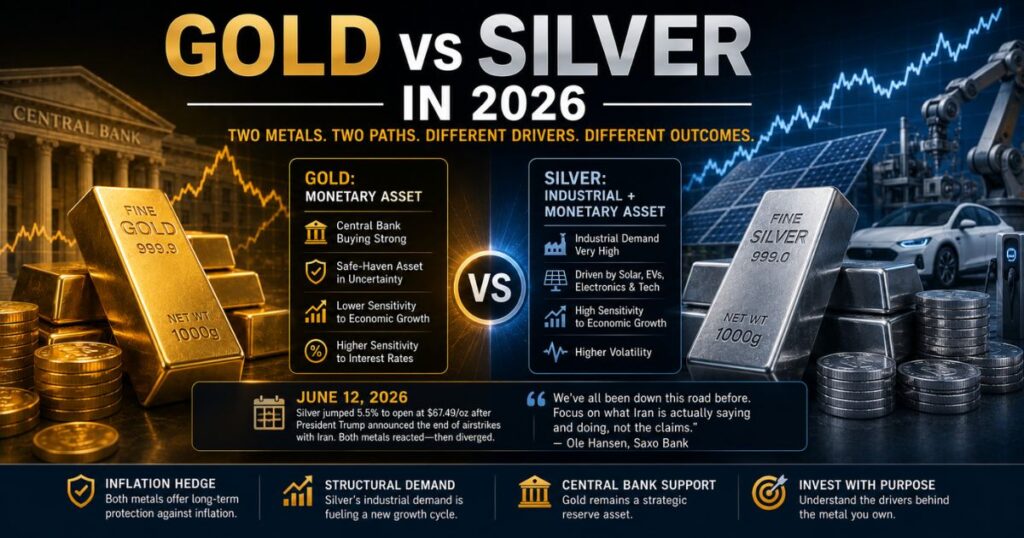
Gold vs Silver performance comparison chart 2026
What This Means for Investors
The most important question is not whether gold or silver will outperform next month.
The more important question is why you own either asset in the first place.
Investors focused on wealth preservation often gravitate toward gold because of its monetary characteristics.
Investors seeking exposure to industrial growth trends alongside precious metals may find silver attractive for different reasons.
Neither approach is inherently correct or incorrect.
What matters is understanding the fundamental thesis behind the position.
Could the Divergence Continue Through the Rest of 2026?
No market trend lasts forever.
However, the forces currently influencing both metals remain intact.
Gold continues benefiting from:
- Central bank accumulation
- Fiscal deficits
- Currency diversification
- Long-term monetary uncertainty
Silver continues benefiting from:
- Solar deployment
- Electrification
- Industrial modernization
- Technology manufacturing
Unless those drivers change significantly, the divergence may persist longer than many investors expect.
The Bottom Line
The relationship between gold and silver is evolving.
Gold remains a monetary asset closely tied to central bank demand, interest rates, and investor confidence.
Silver increasingly reflects the realities of an electrified and technology-driven economy.
Investors who continue treating the two metals as interchangeable may be missing one of the most important commodity stories of 2026.
The question is no longer whether gold and silver move together.
The question is whether your portfolio reflects the fact that they may not.
Sources
- Yahoo Finance
- Saxo Bank Commodity Research
- Silver Institute
- World Gold Council
- Reuters
- CNBC
Disclaimer
This article is for educational and informational purposes only and should not be considered financial, investment, or tax advice. Investors should conduct independent research and consult qualified financial professionals before making investment decisions.