
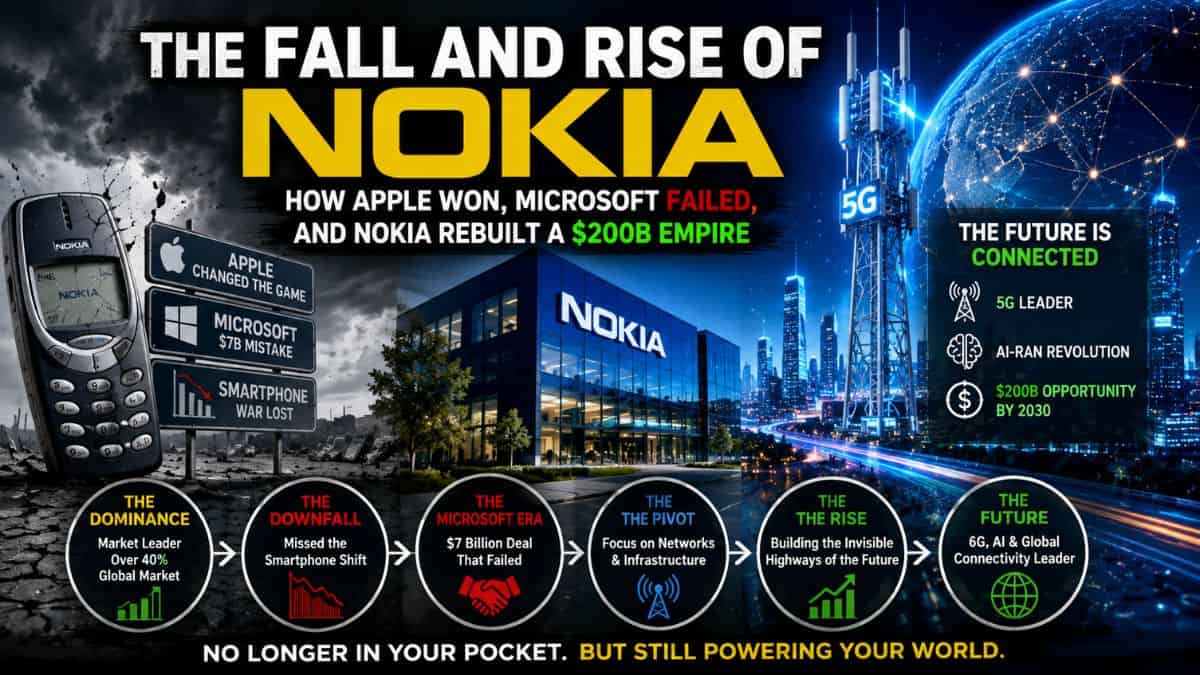

Nokia Didn’t Disappear: How the Former Phone Giant Quietly Rebuilt Itself for the AI and 6G Era
For millions of people around the world, Nokia is still remembered as the company that once dominated the mobile phone industry.
If you owned a phone in the late 1990s or early 2000s, there’s a good chance it had a Nokia logo on it. The brand became famous for reliability, long battery life, and nearly indestructible hardware. At one point, Nokia was so dominant that competitors struggled to keep up.
Then smartphones changed everything.
Apple’s iPhone transformed the way consumers interacted with technology, Android rapidly expanded across the global market, and Nokia’s position slowly collapsed in front of the entire industry.
Most people assumed the company simply faded away.
But that’s only part of the story.
What happened behind the scenes is actually one of the most fascinating corporate pivots in modern tech history.
Instead of disappearing completely, Nokia quietly rebuilt itself around the global telecom infrastructure powering today’s connected world.
When Nokia Started Losing Control of the Smartphone Market
Before the smartphone revolution, mobile phones were mainly judged by practical features:
- battery life
- durability
- signal quality
- physical keyboards
That environment perfectly suited Nokia.
The company became the undisputed leader of the global mobile phone market, building devices that were simple, dependable, and massively popular across both developed and emerging economies.
Then Apple introduced the iPhone in 2007.
The industry shifted almost overnight from hardware-focused phones to software-driven ecosystems built around apps, touchscreens, and internet services.
Nokia struggled to react quickly enough.
Its Symbian operating system increasingly felt outdated compared to Apple’s iOS and Google’s Android platform. Internal restructuring and slower decision-making reportedly made adaptation even harder during one of the fastest-moving periods in technology history.
By the time Nokia fully recognized how dramatically consumer behavior had changed, Apple and Android manufacturers had already taken control of the smartphone market.
(At its peak, Nokia controlled over 40% of the global mobile phone market — a level of dominance no single manufacturer has consistently maintained since.)
The Microsoft Partnership That Became a Business School Case Study
In 2011, Nokia made one of the most important decisions in the company’s history.
The company entered an exclusive partnership with Microsoft and adopted Windows Phone as its primary mobile operating system.
On paper, the strategy seemed reasonable.
Microsoft needed a strong hardware partner to compete against Apple and Android, while Nokia desperately needed a modern software ecosystem capable of keeping pace with the rapidly changing smartphone industry.
But the partnership never gained meaningful traction with consumers.
App developers focused mainly on iOS and Android, leaving Windows Phone with a much smaller ecosystem. Buyers also struggled to see a compelling reason to switch away from platforms that already dominated the market.
In 2013, Microsoft purchased Nokia’s phone division in a deal worth more than $7 billion.
The acquisition ultimately became one of the most disappointing deals in modern tech history.
Windows Phone failed to gain significant market share, Microsoft eventually wrote off much of the investment, and Nokia-branded smartphones slowly disappeared from mainstream relevance.
For most companies, that level of collapse could have been fatal.
For Nokia, surprisingly, it became the beginning of a completely different strategy.
The Billion-Dollar Business Most Consumers Never Notice
While the public focused heavily on smartphones, Nokia had already spent years investing in telecom infrastructure and network technology.
That side of the business survived.
Today, Nokia earns billions through:
- telecom infrastructure
- wireless networking equipment
- 5G systems
- software-driven telecom services
- cellular patents and licensing agreements
Most consumers no longer buy Nokia phones, but telecom operators around the world still rely on Nokia technology behind the scenes.
The company also owns an enormous portfolio of wireless communication patents tied to modern mobile standards.
That means many global smartphone manufacturers still pay licensing fees connected to Nokia-developed technology.
Ironically, companies that once helped push Nokia out of the smartphone market now operate within systems partially built on Nokia’s telecom innovations.
Why Nokia Could Become Even More Important in the AI and 6G Era
The next major opportunity for Nokia may come from AI-driven telecom infrastructure and future 6G network development.
Modern cellular systems are becoming increasingly software-based, automated, and dependent on AI-assisted network management. Telecom companies are investing heavily in smarter infrastructure capable of handling massive amounts of connected devices and data traffic.
Nokia wants to position itself directly inside that transformation.
Instead of competing in the consumer smartphone market again, the company is focusing on becoming part of the infrastructure layer powering future communication networks.
According to telecom analyst firm Omdia, the upcoming AI-driven network expansion and AI-RAN market could represent a massive $200 billion opportunity by 2030, potentially placing Nokia in a strong long-term financial position if the company successfully executes its strategy.
A Growing Frustration With Modern Smartphones
Interestingly, Nokia’s name still generates strong discussion inside online tech communities for another reason entirely.
Many consumers have become increasingly frustrated with modern smartphones.
Devices have become more expensive, more difficult to repair, and heavily dependent on software ecosystems controlled by large corporations. Privacy concerns have also grown significantly as tech companies collect increasing amounts of user data.
Because of this, some consumers are now looking toward simpler alternatives focused on:
- repairability
- sustainability
- longer device lifespan
- reduced tracking
- user privacy
Across forums and independent tech communities, there’s growing interest in whether trusted legacy brands like Nokia could eventually return with simpler, more repairable, Linux-based devices designed for privacy-conscious users.
Whether that happens remains uncertain, but the demand clearly exists.
The Bigger Picture
Nokia clearly lost the global smartphone war.
Apple reshaped consumer expectations, Android dominated worldwide, and Microsoft’s partnership failed to reverse Nokia’s decline.
But the more interesting story is what happened after the collapse.
Instead of disappearing, Nokia quietly transformed itself into one of the companies helping power the invisible infrastructure behind modern connectivity.
Today, most people no longer carry Nokia phones in their pockets.
Yet every time someone sends a message, streams a video, or connects to a mobile network, there’s a strong chance Nokia technology is still involved somewhere behind the scenes.
And as AI-driven telecom systems and future 6G infrastructure continue expanding, Nokia may once again become one of the most important companies in global communications — even if most consumers never directly notice it.
This article is inspired by corporate reporting, telecom market analysis, and business insights discussed in CNBC’s “Built for Billions” documentary feature “Inside Nokia’s New Money Machine,” alongside industry forecasts from telecom research firm Omdia and broader technology market commentary.