
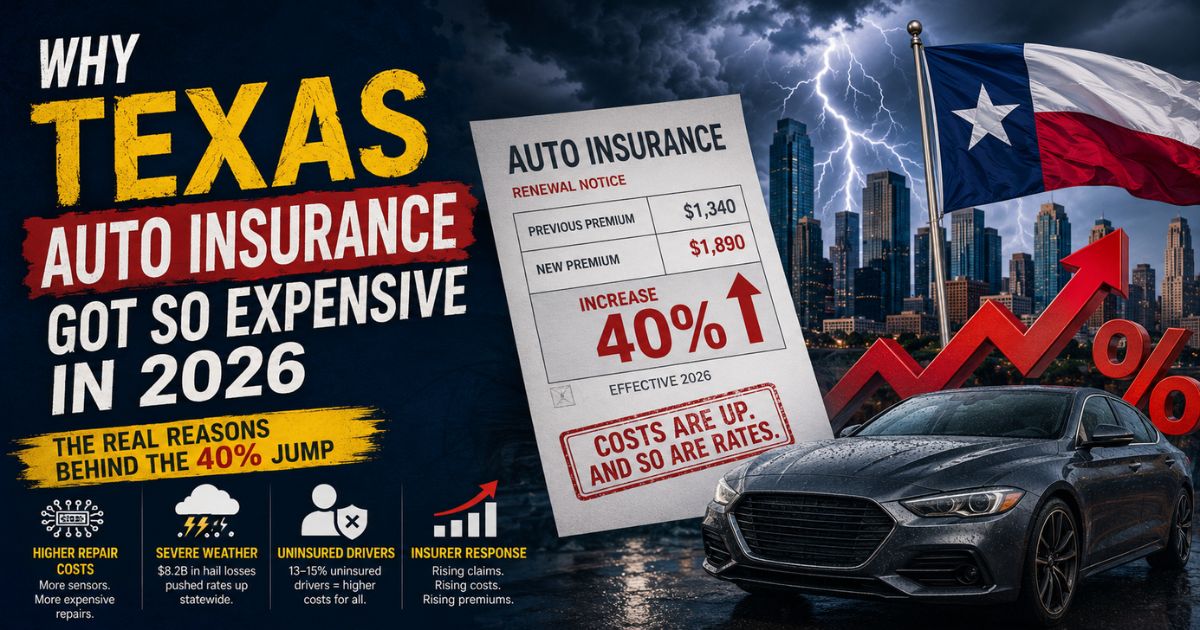
Across Texas, many major auto insurers implemented significant rate increases in 2026, with some drivers reporting premium jumps of 30% to 40% or more depending on carrier, location, and coverage profile.
Not scattered increases. Not regional variations. Simultaneous price hikes across GEICO, State Farm, Progressive, and Allstate. The uniformity suggests something broader shifted in the insurance industry’s cost structure-though explaining what requires wading through sensor repair logs, hail damage claims, and the financial calculus behind uninsured drivers.
When I opened my renewal notice, the increase was stark: $1,340 to $1,890 annually. Clean driving record. No claims. No traffic violations. The insurance company’s explanation-“rate adjustments based on local market conditions”-told me nothing about why my risk profile had supposedly changed.
It turns out my risk hadn’t changed. The industry’s definition of what damages cost.
While luxury tech drives repair costs, the broader market is also shifting. For drivers looking for value and efficiency, options like the New Nissan Leaf 2026: Budget EV USA show that the EV transition is reaching different price points, which will eventually reshape insurance risk models.
The Repair Cost Revolution Nobody Saw Coming
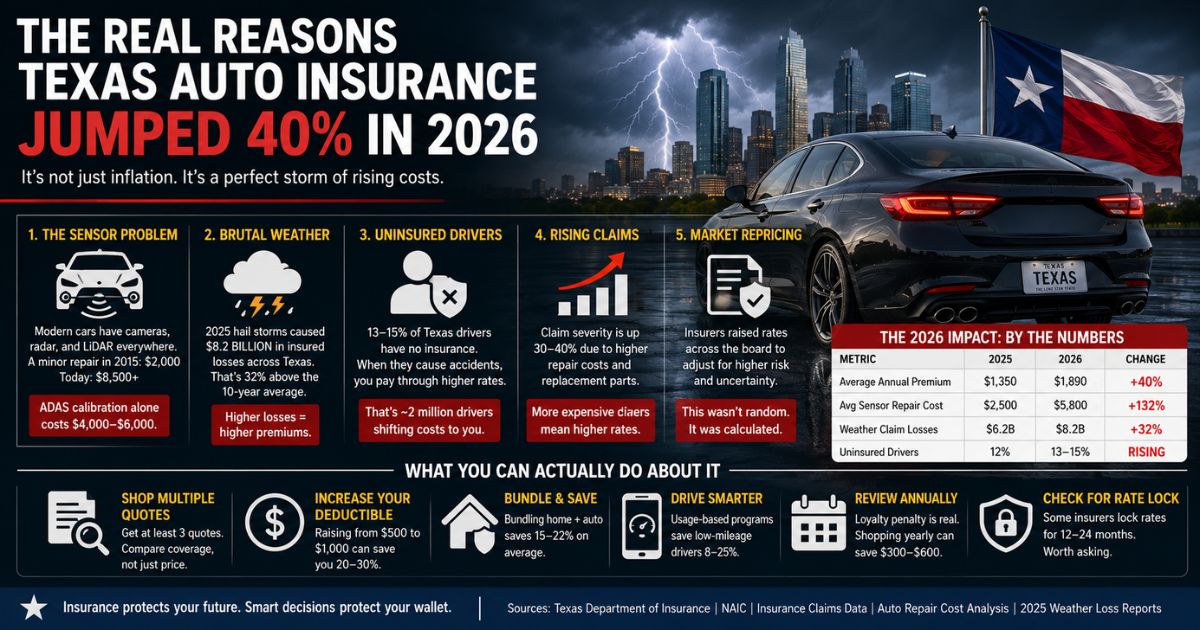
Texas auto insurance rates are driven by a perfect storm of rising repair costs, severe weather, and an increase in uninsured drivers in 2026.
Industry repair-cost analyses suggest that repairs involving modern sensor-equipped vehicles can cost several times more than comparable repairs a decade ago.
That gap doesn’t reflect inflation. It reflects engineering. Modern vehicles carry roughly 150 sensors. Some monitor tire pressure or fluid levels. Others detect lane drift, measure distance to obstacles, or coordinate with nearby vehicle systems. A single luxury sedan might contain 40 distinct electronic control units.
When there’s a collision, that bumper isn’t just a bumper anymore. It’s a structural element housing a radar sensor (replacement cost: $3,200). The windshield has embedded cameras for lane-keeping assistance ($1,500). The hood integrates pedestrian detection sensors.
A competent body shop can install new bumper components in hours. But recalibrating the radar sensor relative to the vehicle frame, validating camera alignment, and confirming that the entire advanced driver assistance system functions properly takes days. Parts of the repair involve proprietary diagnostic equipment that only certain shops possess.
The bill for that calibration work: $4,000 to $6,000.
Insurance companies don’t absorb cost increases. They distribute them. Higher claim severity means higher premiums for the next policy cycle. What changed wasn’t insurer behavior. What changed was the actual cost of returning a damaged vehicle to roadworthy condition.
Modern vehicle engineering is evolving rapidly. For example, when you look at high-end, sensor-heavy electric vehicles like the Ferrari Luce 2026: The Brand’s First Electric Car, it becomes clear why repair costs are reaching record highs compared to traditional cars.
The Hail Losses Nobody Predicted (Until They Happened)
Texas experienced severe hail in late summer and fall 2025. The events weren’t unusual in isolation-Texas gets hail regularly. But the concentration of damaging storms, combined with more populated areas in their path, created losses that exceeded historical averages.
The Insurance Information Institute estimated insured losses at $8.2 billion. That figure matters not because it’s large but because it reveals how insurance economics work. An insurer that paid out $8 billion in claims in 2025 doesn’t absorb that cost in 2025. It recovers that cost in 2026 by raising rates on the entire customer base.
A driver who never files a hail claim still sees a rate increase, because insurance operates on pooled risk. The storm didn’t hit your neighborhood. But your premium reflects the aggregate losses from storms that hit others.
This is often framed as a fairness problem-why should you pay for someone else’s hail damage? But it’s actually how insurance works. The moment you accept coverage, you become part of the pool. The pool’s losses become your financial obligation in the form of higher premiums.
The Uninsured Driver Expense Hidden in Your Bill
Roughly 13 to 15 percent of Texas drivers operate with inadequate insurance, according to the Texas Department of Insurance. That’s approximately 2 million drivers.
When an uninsured driver causes a collision, the insured driver’s coverage pays for damages. Insurance companies can pursue the uninsured driver for recovery, but the practical outcome is clear: a driver earning $25,000 annually won’t satisfy a $15,000 collision judgment.
The insurance company absorbs the loss. It then recovers that loss the only way available: by raising premiums on customers who do maintain coverage.
Every insured driver effectively subsidizes uninsured drivers through higher premiums. The percentage varies by geography-neighborhoods with higher concentrations of uninsured motorists see larger increases-but the cost is real. It’s a hidden tax embedded in every policy.
What Insurance Analysts Are Watching in 2026

Average insurance premium increases across major Texas metropolitan areas show a consistent upward trend for 2026.
Industry analysts and regulators are paying attention to three long-term trends that may continue influencing Texas auto insurance premiums beyond 2026.
First, advanced driver-assistance systems (ADAS) are becoming standard across new vehicles. While these technologies can reduce accident frequency, they often increase repair costs when collisions occur because sensors, cameras, and calibration systems are expensive to replace.
Second, weather-related claims remain a growing concern. Texas continues to experience severe hailstorms, flooding events, and extreme weather patterns that place pressure on insurer loss ratios and reserve requirements.
Third, insurers are increasingly relying on granular risk modeling. Pricing is becoming more individualized, with factors such as driving behavior, vehicle technology, location-specific claims data, and repair-cost trends playing a larger role than they did a decade ago.
For drivers, the practical takeaway is simple: future premiums will likely depend less on broad statewide averages and more on individual risk characteristics.
Video Credit: The SUV Geek. This video explains how modern vehicle technology directly impacts Texas auto insurance premiums.
How the Same Driver Gets Different Quotes
Two drivers in the same ZIP code, operating identical vehicles with identical driving records, can receive quotes differing by 30 to 40 percent. This puzzles most consumers. It shouldn’t.
Insurance companies evaluate at least 40 variables when pricing. Most are invisible to the consumer. Consider: not your ZIP code, but your specific street. Not the average accident rate in your area, but the accident history on your particular road. Not whether you commute, but the time of day you commute and the distance.
Insurance companies analyze your specific model’s claim history down to the detail. This is why comparing popular, reliable SUVs like the RAV4 vs CR-V vs CX-5 2026: Best SUV can lead to vastly different insurance premiums, as each model carries a different risk and repair-cost profile.
A driver on a major highway corridor faces different risk than a driver three blocks over. A driver parking on the street faces a different risk than a driver with a garage. A driver working nights and driving during off-peak hours faces different risk than a driver with a reverse commute during rush hour.
Add to this the vehicle’s repair economics. Newer cars with expensive sensors cost more to repair. Some vehicles have cheap, available parts; others require specialized dealers. Some models accumulate claims faster than others. These factors get baked into the rate, invisible to the consumer but precise in calculation.
Insurance companies have decades of actuarial data showing exactly which streets, at which times, with which vehicles, generate the most claims. Your rate reflects that data.
The False Efficiency of Quote Comparison
Every financial article recommends comparing insurance quotes. The advice is sound but incomplete.
Three quotes from different carriers rarely represent equivalent products. Compare the typical quotes:
A regional carrier quotes $1,200 annually. Coverage: $100,000 bodily injury liability, $100,000 property damage, $500 deductible. No accident forgiveness. No new car replacement coverage.
A national carrier quotes $1,650 annually for the same vehicle. Coverage: $250,000 bodily injury, $250,000 property damage, $500 deductible. Accident forgiveness included. New car replacement coverage for two years.
The second option costs 37 percent more. But the liability coverage is 2.5 times higher. The accident forgiveness removes the rating penalty for a single mistake. The new car replacement covers the gap between insurance payout and actual vehicle replacement cost if the car is totaled within two years.
Most drivers compare price, not value. They select the cheaper option and later discover inadequate coverage. The cheaper policy was cheaper precisely because it covered less.
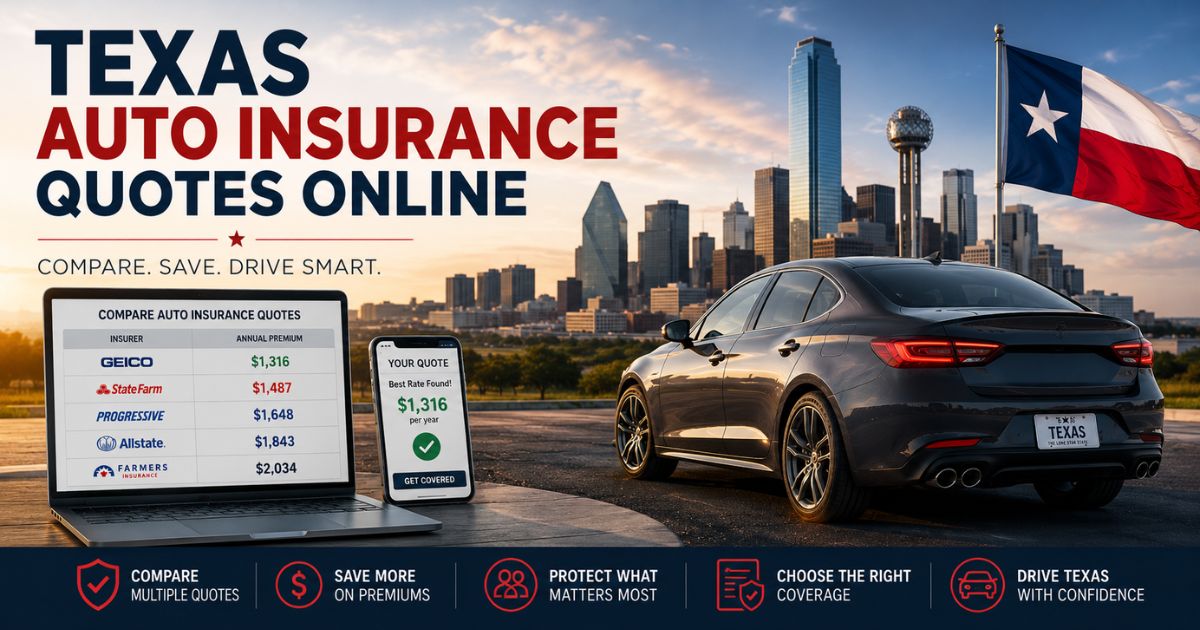
Comparing multiple insurance quotes remains the most effective strategy for Texas drivers to balance cost and coverage.
What Actually Works to Lower Your Rate
Most “money-saving” insurance tips don’t work. Some work partially. A few actually reduce your premium materially.
Bundling home and auto insurance with the same carrier typically saves 15 to 22 percent. For a driver paying $1,890, that’s roughly $280 to $415 annually. But carriers often don’t auto-apply the discount. You must request it explicitly.
A good driver discount-three years without at-fault claims-usually amounts to 10 to 15 percent, or $130 to $225 annually. Again, you typically need to ask.
Increasing your deductible from $500 to $1,000 saves 20 to 30 percent, roughly $240 to $450 annually. The tradeoff: you need $1,000 available immediately if you cause an accident. If you don’t have emergency reserves, this creates risk.
Usage-based insurance programs track your actual driving. Low-mileage or conscientious drivers can save 8 to 25 percent-potentially $500 annually for remote workers. The cost: surrendering some privacy by installing an app.
These represent the actual levers. Everything else-good credit, defensive driving courses, safety features-produces smaller savings or no savings at all.
Finally, if higher insurance premiums have become a recurring burden on your monthly budget, it’s worth reviewing your overall financial health. If you are struggling with high-interest debt, exploring a Balance Transfer Strategy for Debt could free up the cash flow needed to handle these rising essential costs.
Why Your Insurer Expects You to Stay
Insurance companies understand basic consumer behavior: people dislike switching providers.
Shopping for new insurance requires time. Setting up new auto-pay takes effort. Canceling your existing policy involves a phone call. The psychological resistance to change is real, measurable, and relied upon by insurers.
When an insurance company raises rates 40 percent, it doesn’t expect to retain 100 percent of customers. It expects to lose roughly 5 to 10 percent. The remaining 90 to 95 percent, despite complaining, will renew. The additional revenue from the rate increase on that larger group exceeds the lost profit from the departed customers.
It’s optimization, not extraction. But it operates on the assumption that customers won’t shop.
Drivers who actually obtain competing quotes restore negotiating power. An insurer that knows you’ve shopped alternatives might offer a retention discount. That discount nearly never appears without the friction of competitive shopping.
What Comes Next
Insurance pricing in Texas will remain volatile. Severe weather patterns show no sign of moderating. Vehicle repair costs will stay elevated as automotive technology becomes more complex, not simpler. The percentage of uninsured drivers is unlikely to decline.
These aren’t temporary conditions. They’re structural features of the insurance market.
For consumers, the practical implication is clear: annual shopping for insurance coverage isn’t optional. It’s the only mechanism available to offset rate increases driven by factors entirely outside individual control. The driver with the clean record faces the same rate increase as the driver with accidents, because rate increases reflect pool-level losses, not individual performance.
Your insurer’s business model depends on your inertia. The customers who maintain reasonable insurance costs are the ones who refuse to accept it.
The reality is that most Texas drivers cannot control hailstorms, repair costs, or the number of uninsured motorists on the road. What they can control is how often they review coverage, compare quotes, and evaluate whether their policy still delivers value.
Insurance is ultimately a tool for managing financial risk. In 2026, understanding that risk may be more important than finding the lowest price.
VeritaLogic publishes analysis of personal finance and insurance markets based on publicly available data. This article reflects analysis of regulatory filings and industry reports. Insurance rates, coverage, and terms vary by carrier and individual circumstances. Consult licensed insurance professionals regarding decisions specific to your situation.
Sources:
- Texas Department of Insurance (TDI) regulatory filings (2025-2026)
- National Association of Insurance Commissioners (NAIC) data
- Insurance Information Institute (III) weather loss reports
- Automotive Service Association (ASA) repair cost analyses
- SAE International – Vehicle technology and ADAS standards
Further Reading:
- Understand the factors behind premiums: Insurance Pricing Analysis
- Economic shifts impacting your wallet: Market & Economy Trends
- Why insurance companies price risk the way they do: Behavioral Economics Insights
- How to manage your finances amid rising costs: Strategic Mindset & Planning