
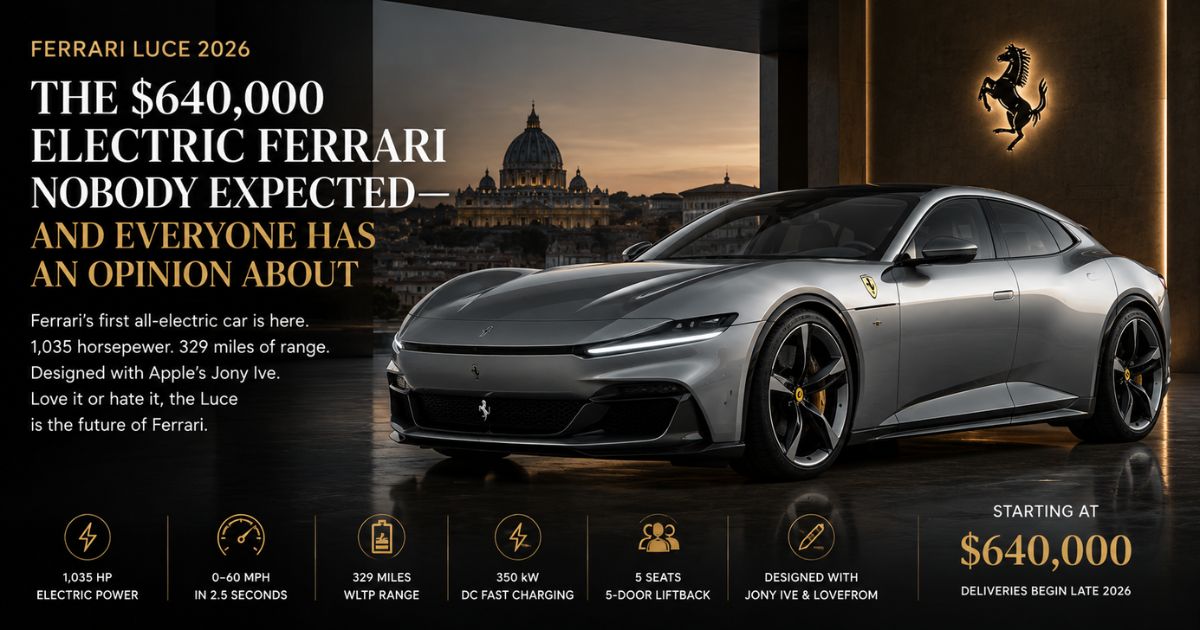
May 25, 2026. Rome, Italy. Two hundred journalists gathered under the lights as Ferrari unveiled something it had spent decades swearing it would never build.
An electric car.
Not just any electric car. A $640,000, four-door, five-seat, 1,050-horsepower machine called the Luce – Italian for “light” – with an interior designed by the man who gave the world the iPhone.
Within hours, Ferrari’s stock had dropped nearly 8%, wiping out more than $5 billion in market value before partially recovering. Italy’s deputy prime minister posted on X asking what Enzo Ferrari would think. Ferrari’s own former chairman Luca di Montezemolo told Italian media the company should “at least take the prancing horse off.” Car forums erupted. Half the internet called it a masterpiece. The other half said it looked like a Honda Accord.
And just like that, the Ferrari Luce became the most talked-about car of 2026.
Key Specifications at a Glance
Before diving into the controversy, the politics, and the billion-dollar questions – here is what the Ferrari Luce actually is, based on confirmed manufacturer data:
| Specification | Detail |
| Price | €550,000 (~$640,000 USD in Europe) |
| Power output | 1,050 horsepower (772 kW) |
| Motors | 4 × permanent-magnet synchronous, one per wheel |
| Battery | 122 kWh, 800-volt architecture (SK On) |
| Range | ~530 km / ~330 miles (WLTP) |
| 0–60 mph | Approximately 2.5 seconds |
| Top speed | Above 310 kph / 190 mph |
| Fast charging | 350 kW DC |
| Seating | 5 passengers |
| Body style | Four-door liftback with rear coach doors |
| Weight | Approximately 2,260 kg |
| Interior design | LoveFrom (Jony Ive & Marc Newson) |
| European deliveries | Q4 2026 (October target) |
| US deliveries | Expected 2027 (pricing not yet confirmed) |
Source: Ferrari official statements, CNN Business, Electrek, Electrive. US pricing reflects analyst estimates of $500,000–$650,000; Ferrari has not yet confirmed a US figure.
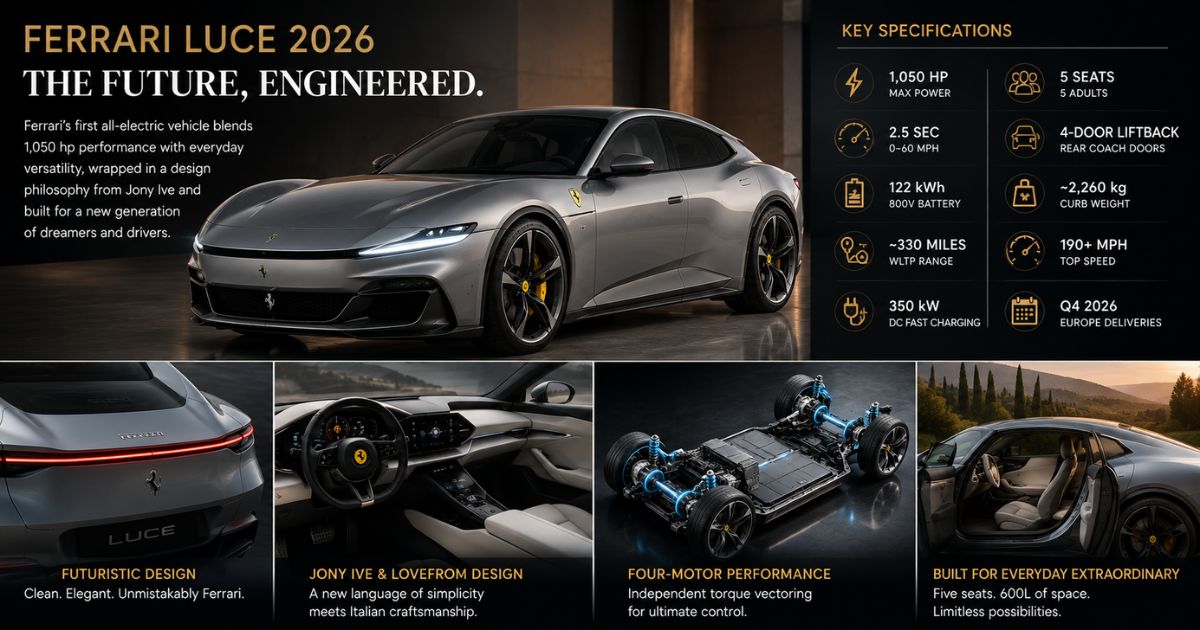
Ferrari Luce 2026: 1,050 hp, four motors, 122 kWh battery on an 800-volt architecture, ~330 miles of WLTP range, and an interior created by Jony Ive and LoveFrom. European deliveries begin Q4 2026. Source: Ferrari official specifications / Electrive / Electrek.
What Is the Ferrari Luce – And Why Does It Matter So Much?
The Luce is not simply Ferrari’s first electric vehicle. It is a statement about where one of the world’s most iconic brands believes the future of luxury is going – and it is a bet that is either visionary or reckless, depending on who you ask.
Ferrari CEO Benedetto Vigna stood in front of more than 200 reporters in Rome and said: “It’s the result of five years of work.” Five years of engineering, designing, debating, and ultimately deciding that a company built entirely on the drama of combustion engines was ready to go somewhere completely different. CarBuzz
As Vigna has been clear to explain, this is an addition to the lineup, not a transition. The Luce will coexist with internal combustion and hybrid models. Ferrari’s stated strategy for 2030 calls for 20% electric vehicles, 40% hybrids, and 40% internal combustion vehicles – a deliberate balance that distinguishes Ferrari from several competitors who announced all-electric futures and have since quietly reversed course.
Whether this particular chapter begins brilliantly or misses the mark is the question the entire automotive world is currently debating.
The Numbers: What $640,000 Actually Buys You
The Ferrari Luce combines four permanent-magnet synchronous motors – one per wheel – producing 1,050 horsepower from an 800-volt, 122 kWh battery supplied by SK On. Claimed WLTP range is approximately 530 kilometres, or around 330 miles. The car supports up to 350 kW DC fast charging. CARFOOLY Media
According to Electrek, citing Ferrari’s technical briefings, the motors are derived from technology developed for the F80 hypercar, featuring independent torque vectoring, active suspension with no anti-roll bars, rear-wheel steering, and a centre of gravity 95 mm lower than the Purosangue. For a production electric vehicle, that is an extraordinary technical foundation.
Zero to 60 mph takes approximately 2.5 seconds. Top speed exceeds 190 mph. yahoo
The body is a five-door liftback, featuring coach doors at the rear – only the second Ferrari after the Purosangue to offer four doors. It weighs approximately 2,260 kg, heavy by Ferrari’s historic standards but lighter than you might expect for a car carrying a 122 kWh battery and seating five adults.
Ferrari aimed this squarely at families with deep pockets, according to reporting from CarBuzz. offering comfortable seating for five, high-end technology throughout, and a 600-litre boot. A family car. From Ferrari. Starting at $640,000.
That takes a moment to absorb.
While Ferrari is redefining the limits of high-performance EVs at the $640,000 mark, the broader electric vehicle market continues to evolve at the entry level. If you are interested in how current EV technology is being packaged for the mass market, take a look at our analysis of the new Nissan Leaf 2026 budget EV options currently arriving in the US.
The Jony Ive Question – Apple DNA Inside a Ferrari
If the powertrain got engineers talking, the interior got everyone else talking.
The cabin, interface, and overall user experience of the Ferrari Luce were developed in close collaboration with LoveFrom – the creative collective founded by Sir Jony Ive alongside designer Marc Newson. Ferrari says the partnership has been in place for five years, with LoveFrom involved across every dimension of the car’s design.
Jony Ive is the man responsible for the iMac, the iPod, the iPhone, the MacBook Air – arguably the most influential product designer of the last three decades. His philosophy is relentlessly minimal. No unnecessary details, no visual noise, nothing that does not serve a purpose. When you apply that philosophy to a Ferrari interior, you get something that feels genuinely unlike anything that has ever come out of Maranello.
The screens feature Apple Watch-like crowns, the infotainment panel has an iPad-like quality, and the use of Gorilla Glass echoes Apple’s hardware approach throughout. The steering wheel is a clean three-spoke design. Physical, CNC-machined controls replace the touchscreen-dominated dashboards that have become standard – and widely mocked – in many luxury EVs. Research And Markets
Ferrari’s chief commercial officer Enrico Galliera described the ambition clearly: “We want to bring something that we consider as a game changer, really talk in a different language.” Miss Auto
The question is whether Ferrari’s existing clients wanted a different language – or whether the Luce is speaking to someone else entirely.
The Backlash: $5 Billion Gone in One Day
Ferrari shares dropped about 8% after the Luce debut, wiping out more than $5 billion in market value – though shares have since partially recovered, gaining back more than 3% in the days that followed. THE SHOP
The criticism came from multiple directions at once, and it went further than the usual social media noise.
Within hours of the unveiling, criticism spread across social media, owner forums, and into Italian politics. Matteo Salvini, Italy’s deputy prime minister and transport minister, posted on X: “It looks nothing like a Ferrari. Is this supposed to be ‘innovation’? Who knows what Enzo Ferrari would say.” Mycarrollcountynews
Then came the remark that arguably stung more than any politician’s opinion. Luca di Montezemolo – former Ferrari chairman who held senior leadership positions at the company for decades – told Italian media that Ferrari should “at least take the prancing horse off.” When the man who helped define Ferrari’s modern identity publicly questions whether a new model deserves the badge, that is not a social media pile-on. That is a different category of criticism altogether.
The design community was divided. Some praised the clean lines and the courage to break from Ferrari’s muscular, aggressive aesthetic. Others were less kind. Comparisons to a Honda Accord and a Tesla Model 3 appeared within minutes of the reveal images going online.
Analysts also noted the broader context: rival Lamborghini recently cancelled its upcoming EV citing insufficient demand, while Bentley has delayed its first electric vehicle on multiple occasions. Ferrari is entering the ultra-luxury EV space at precisely the moment several of its competitors have decided to leave it. The Luxury Journal
Why Ferrari May Not Care – And Why History Suggests They’re Right
Here is the thing about Ferrari backlash: it has happened before, and Ferrari has often proven critics wrong in the past.
Analysts at RBC Capital Markets noted investor concerns that the Luce’s design “could weigh on residual values” – but they also pointed out that investors voiced similar concerns when the Purosangue was unveiled in 2022. Since then, the Purosangue has become one of Ferrari’s bestsellers, with demand consistently exceeding supply. gulfnews
The Purosangue was supposed to be the car that betrayed Ferrari’s soul. A four-door SUV from a company that had spent decades insisting it would never build one. The internet hated it. Ferrari sold every single one they could make, and a waiting list formed almost immediately.
Bernstein analyst Stephen Reitman summarised the dynamic simply: “If Ferrari builds the car, the clients will come. That has been the Ferrari Way.” Hypebeast
Ferrari does not have a volume problem. It has a deliberate supply problem – because limiting production is how the company maintains the exclusivity and pricing power that competitors cannot replicate. The Luce will be no different in that respect.
Video Credit: The new Ferrari Luce: My HONEST take… – Carwow (Embedded from YouTube for reference and analysis purposes.)
Watch Carwow’s full first-impression review of the Ferrari Luce before continuing with the market and investor analysis below.
Who Is Ferrari Actually Building the Luce For?
Analysts say Ferrari is looking beyond its traditional customer base and toward a new generation of buyers, particularly in technology circles. The pricing, the design collaboration with Ive, and the car’s overall aesthetic sensibility all point toward this direction. Go-Electra
Think carefully about who buys a $640,000 car with Jony Ive’s fingerprints throughout the interior. It is not primarily the 65-year-old Ferrari collector who has owned ten V12s and attends Concours d’Elegance events. It is the tech founder in San Francisco, Singapore, or Shenzhen who admires Apple products, thinks about sustainability differently than the previous generation of luxury buyers, and wants something that signals refined taste rather than aggressive performance. Someone who can write a six-figure check without reviewing their balance, and who wants something that needs explaining – because that is precisely the point.
Ferrari is also hoping the Luce will accelerate its presence in markets like China, where EVs are widespread and large petrol cars are heavily taxed. CarBuzz
That is a fundamentally different buyer. That is also a vast and growing one. The Luce is not Ferrari trying to keep its existing customers happy. It is Ferrari trying to identify the next generation of Ferrari customers before someone else does.
Think carefully about who buys a $640,000 car with Jony Ive’s fingerprints throughout the interior. It is not primarily the 65-year-old Ferrari collector who has owned ten V12s… It is the tech founder… who wants something that signals refined taste rather than aggressive performance. Understanding this shift requires looking at how luxury brands influence consumers, as the desire for exclusivity often overrides traditional price sensitivity. That is a fundamentally different buyer.
The Sound Problem – And Ferrari’s Approach
There is one thing every Ferrari buyer has always paid for that an electric motor cannot replicate: the sound.
A Ferrari V12 at full throttle is not noisy. It is an experience in an entirely different sensory category from any other production car on the road. It is the reason people stop on pavements and turn around. It is, by many accounts, the core product.
Ferrari’s solution is to amplify the natural vibration sounds generated by the electric powertrain to maintain a visceral character consistent with the brand’s identity. The Luce does not play synthesised engine sounds through speakers – an approach that has been universally mocked in other electric luxury cars. Instead, Ferrari has engineered the physical structure to resonate and transmit the genuine sounds the motors and drivetrain produce, amplifying them in a way that is intended to feel organic rather than artificial.
Whether it succeeds as an experience in its own right is something that will only be answered properly once journalists and owners spend real time in the car. Early reactions from the Rome event were cautiously positive – nobody called it a revelation, but nobody described it as an anonymous silence either.
The Investment Angle: What the Luce Tells Us About Ferrari’s Business
Ferrari is not a car company in the conventional sense. It is a luxury goods company that manufactures cars. The distinction shapes almost every decision the company makes.
The Luce, priced at €550,000 in Europe, sits above Ferrari’s hybrid SF90 Stradale. That positioning is deliberate. Ferrari is not discounting the electric vehicle market. It is doing what it always does when entering a new category: arriving at the very top of the price hierarchy first.
The 8% stock drop on debut day reflects short-term market anxiety, not a fundamental change in Ferrari’s business model. The company has a backlog measured in years, operating margins that almost no manufacturer in any industry can match, and a brand that has not once been permanently damaged by a bold product decision – even the ones that initially caused alarm.
The Purosangue precedent is instructive. So is the broader history. Ferrari does not make mistakes that damage the brand. It makes calculated bets that initially disturb its most conservative observers, then proves them wrong.
What Happens Next?
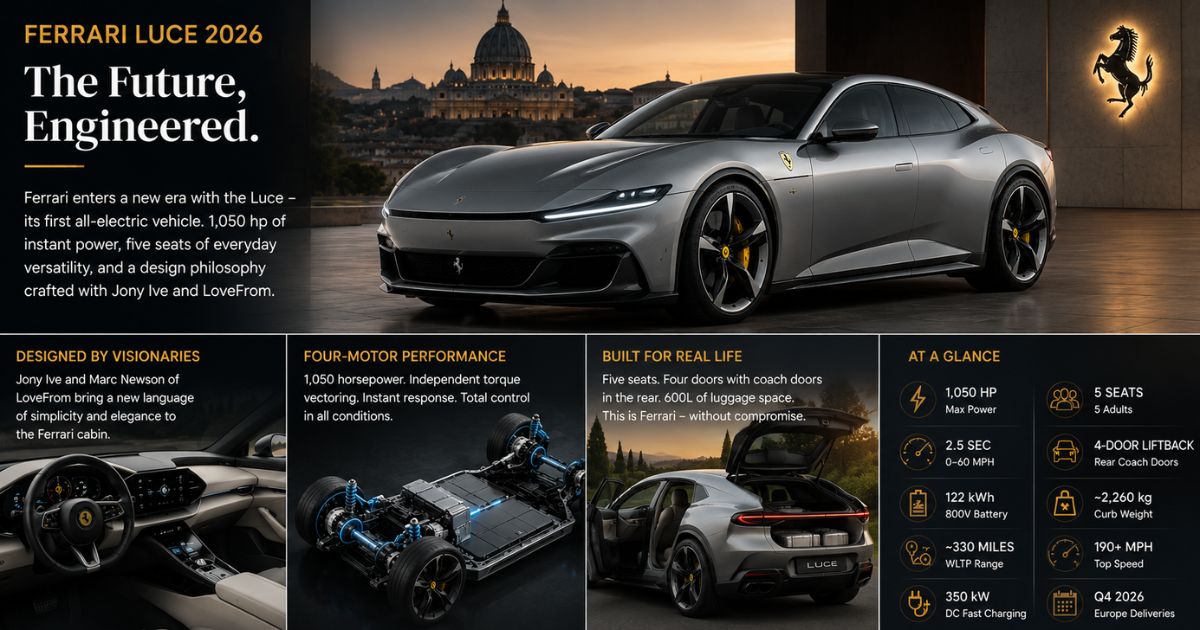
Ferrari Luce 2026 -“The Future, Engineered.” Orders are already booked into late 2027 according to CEO Benedetto Vigna, despite the design backlash that wiped out $5 billion in market value on debut day. European deliveries begin October 2026. The US waits until 2027.
This is where the story gets genuinely interesting – because the backlash and the order book are telling completely opposite stories.
Ferrari CEO Benedetto Vigna confirmed to Bloomberg that the Luce is already receiving orders from both existing Ferrari owners and first-time buyers, with production slots extending toward the end of 2027. Deliveries are not due to begin until October 2026. That means Ferrari has sold out approximately 14 months of production before a single customer has taken delivery – during a period of vocal public criticism and an 8% stock drop.
The order book running into late 2027 suggests the customer base writing the actual cheques is considerably more receptive than the internet commentary would imply. It is worth noting, as some industry analysts have pointed out, that Ferrari’s allocation system means loyal buyers often purchase new models to strengthen their relationship with the company – which can inflate early order numbers. Whether the Luce sustains that demand through its production run remains the real test.
For European buyers, the first cars arrive in October 2026. For American buyers, the wait extends into 2027, with US pricing not yet officially confirmed – though analysts expect figures in the $500,000 to $650,000 range depending on specification.
Vigna has been clear about Ferrari’s broader intention: “We have internal combustion, we have hybrid, and we have electric. Then the client can pick whatever they want.” That framing – the Luce as an option rather than a replacement – is Ferrari’s most important message to its traditional customer base. Whether those customers ultimately accept it, or whether they feel the brand’s identity is being diluted regardless of the philosophical positioning, will become clearer once real-world deliveries begin and the first independent road tests appear. Motor1.com
The most pointed early reaction came not from journalists or social media, but from within Ferrari’s own extended family. Former chairman Montezemolo’s public scepticism cannot be dismissed as ignorance – this is a man who arguably did more than anyone alive to build Ferrari’s modern commercial identity. His criticism, and the company’s choice to proceed anyway, says something about how far Ferrari believes the world has moved from the era the Luce is designed to replace.
Ferrari has been right before when the world said it was wrong. It may be right again. The difference this time is that the engine noise is gone, and for Ferrari, that is not a small thing.
The Bottom Line
The Ferrari Luce is not a perfect car. The design is genuinely polarising by any honest reading. The weight is considerable for a Ferrari. The price is extraordinary even by this brand’s standards. And the question of whether it can deliver – in any meaningful sense – the emotional experience of a combustion-powered Ferrari from Maranello remains unanswered until real driving impressions arrive later this year.
But it is also one of the most consequential vehicles launched in years. Not simply because it is a Ferrari that runs on electricity, but because of what it tells us about where the luxury automotive market is heading, who the next generation of ultra-high-net-worth buyers actually are, and what they value when they spend half a million dollars on a car.
Galliera said it more plainly than most executives allow themselves to: “We want to test something completely different with different approaches.” Miss Auto
Ferrari is testing something unprecedented for the brand. History suggests the test usually goes Ferrari’s way.
European deliveries begin October 2026. The US gets its turn in 2027. By then, the conversation will have shifted from “does it look like a Ferrari” to something far more revealing: “can you actually get one – and what does it feel like to drive?”
Sources
- CNN Business – Ferrari unveils its first electric car and it comes with a $640,000 price tag – May 26, 2026 – cnn.com
- Electrek – Ferrari CEO says Luce EV is ‘clocking up orders’ despite design backlash – May 28, 2026 – electrek.co
- Yahoo Finance/Autos – Ferrari stock falls after unveiling of Luce / Ferrari Claims Luce Orders Extend Into Late-2027 – yahoo.com
- CNBC – Why Ferrari’s rocky EV launch may not be the disaster investors fear – May 28, 2026 – cnbc.com
- TechSpot – Ferrari bet its legacy on an EV designed by Jony Ive. The backlash wiped out $5 billion in a day – techspot.com
- Electrive – Ferrari’s first EV Luce to launch from €550,000 – May 26, 2026 – electrive.com
- Go-Electra – Electric Ferrari Luce: price, power, and everything we know go-electra.com
Disclaimer
This article is written for educational and informational purposes only. All specifications, prices, and market figures cited reflect publicly available information from named sources as of June 2026 and are subject to revision as Ferrari releases further official data. Ferrari has not yet confirmed US pricing for the Luce; figures cited reflect analyst estimates only.
Nothing in this article constitutes investment advice or a recommendation to buy or sell any security, including Ferrari S.p.A. (RACE). Stock performance data reflects reported figures and may have changed since publication.
VeritaLogic is an independent publication with no commercial relationship with Ferrari, LoveFrom, or any company mentioned herein.