
Looking for the best AI stocks to invest in 2026? As the AI infrastructure buildout hits a record-breaking $500 billion in capital expenditure, the market is shifting from hype to real cash flow. In this VeritaLogic deep-dive, we analyze the financial fundamentals of the top five AI leaders-Nvidia, Microsoft, Alphabet, Amazon, and Broadcom-to determine which companies are building defensible moats and which are merely burning cash in an expensive race for dominance.
Here’s a number that should stop you for a second: Microsoft just told investors it plans to spend $190 billion on capital expenditures this year. Not over five years. This year. Amazon is in the same neighborhood, at roughly $200 billion. Alphabet hasn’t published a final 2026 figure, but CFO Anat Ashkenazi has already warned that 2027 spending will “significantly increase” from wherever 2026 lands.
For context, that’s three companies committing close to half a trillion dollars combined to AI infrastructure in a single calendar year. Microsoft’s stock dropped 5% the day it announced its number – not because the business was struggling, but because Wall Street is genuinely unsure whether this spending will pay off on a reasonable timeline.
That tension is the whole story of AI investing in 2026. A year ago, the question was which companies had the best AI products. Now the question is which companies can actually convert all this spending into durable cash flow – and which ones are along for an expensive ride.
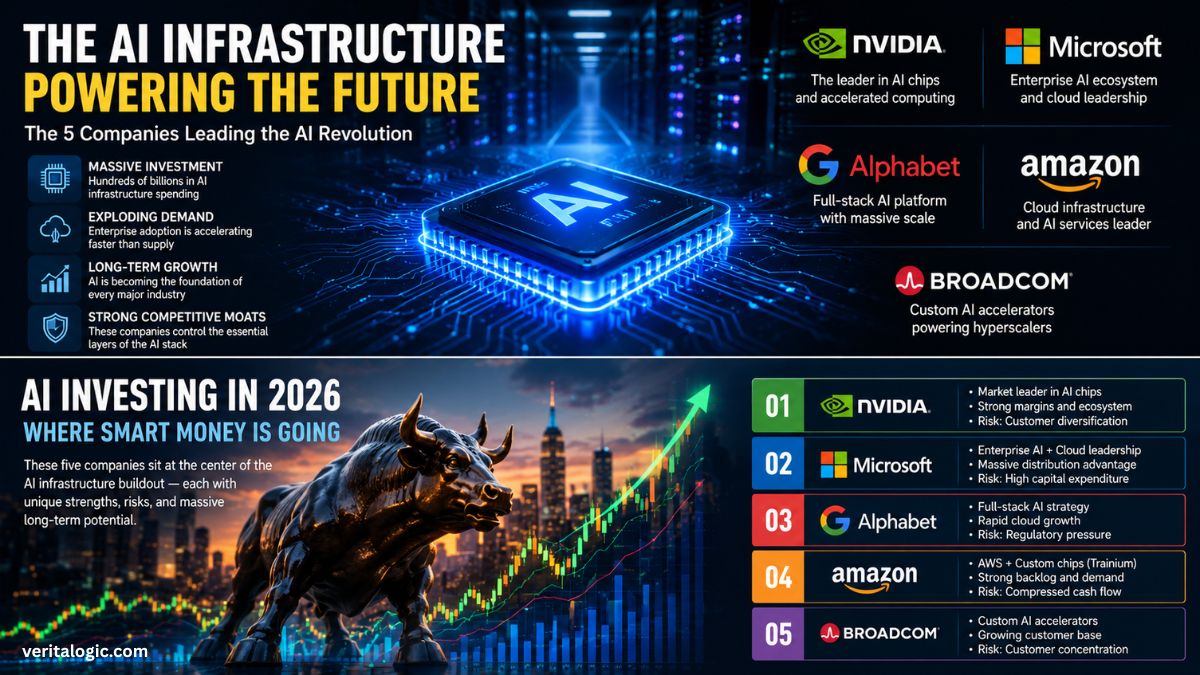
Five companies keep showing up at the center of that conversation: Nvidia, Microsoft, Alphabet, Amazon, and Broadcom. None of them are cheap. None of them are without real risk. But each occupies a different, defensible position in the AI infrastructure buildout, and understanding those positions matters more than chasing whichever stock had the best month.
Why AI Investing Looks Different in 2026
The easy trade is over. Buying “anything AI” worked reasonably well in 2023 and 2024, when the market was still figuring out who the winners might be. That phase has ended. Capital expenditure numbers are now public, quarterly, and enormous, which means investors can actually measure whether spending is translating into revenue growth – or just inflating depreciation schedules.
This is also the year cash flow started mattering again. Amazon’s trailing twelve-month free cash flow fell 95% year-over-year, compressed to just $1.2 billion, almost entirely because of AI-related capital spending. That’s not a red flag by itself – Andy Jassy has compared this directly to AWS’s early buildout years, when heavy upfront spending eventually funded a decade of compounding returns. But it does mean investors need to separate companies that are spending to build a moat from companies that are spending because they’re afraid of being left out.
Why Buying “AI Companies” Isn’t Enough Anymore
There’s a meaningful difference between owning the infrastructure AI runs on and owning a product that happens to use AI. A company can slap “AI-powered” on its marketing without having any structural advantage in compute, data, or distribution. That distinction is exactly why this list focuses on companies sitting at the foundation of the buildout rather than further up the stack, where competitive moats are thinner and easier to disrupt.
AI Infrastructure vs. AI Applications
Infrastructure companies sell the picks and shovels: chips, cloud capacity, networking, data centers. Application companies build the software people actually interact with – chatbots, copilots, image generators. Infrastructure tends to have longer sales cycles, higher capital requirements, and – when done right – much stickier customer relationships, because switching cloud providers or chip architectures is expensive and slow. All five companies below sit primarily on the infrastructure side, even though several also have growing application businesses layered on top.
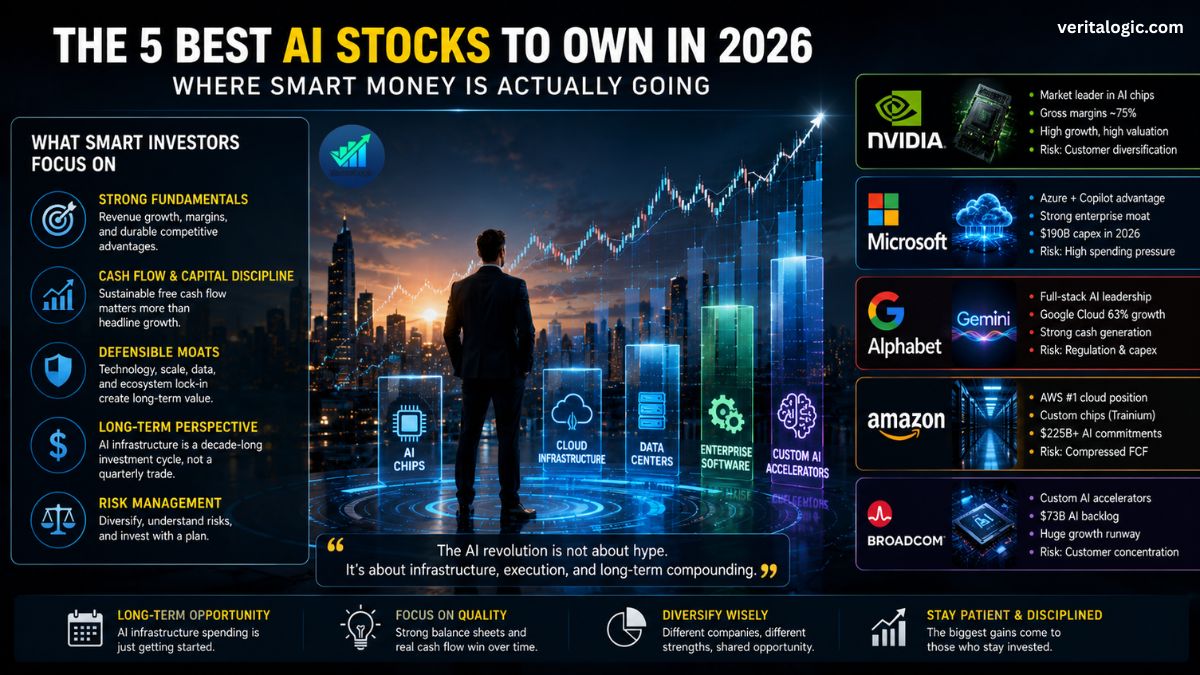
The AI revolution is not about hype. It’s about infrastructure, execution, and long-term compounding.” Five fundamentals separate durable AI investments from momentum trades – and each of these five companies carries a distinct risk profile worth understanding before buying.
1. Nvidia (NVDA)
Why it matters. Nvidia is still the default chip for training and running large AI models, and the company’s most recent quarter made that almost impossible to dispute. Revenue hit $81.6 billion in the quarter ended April 2026, up 85% year-over-year, with data center revenue alone reaching $75.2 billion – up 92%. Full fiscal year 2026 revenue came in at $215.9 billion, up 65% from the prior year.
Competitive advantage. CEO Jensen Huang put it plainly on the earnings call: “Nvidia is the only platform that runs every frontier AI model,” name-checking Anthropic, OpenAI, and others as customers. That’s the moat – not just raw chip performance, but a software and networking ecosystem (CUDA, NVLink, InfiniBand) that took over a decade to build and that competitors are still years from replicating at scale.
Revenue drivers. Roughly half of data center revenue now comes from hyperscalers – Microsoft, Amazon, Google, Meta – with the rest split across AI clouds, sovereign nations building their own AI infrastructure, and enterprise customers. That diversification matters. Nvidia isn’t dependent on any single customer the way some chip companies are.
AI strategy. Huang’s framing on the May 2026 call was telling: “Agentic AI has arrived,” he said, describing demand as having “gone parabolic.” Nvidia is betting that AI moves from answering questions to taking actions on a company’s behalf, which requires dramatically more compute per task than today’s chatbot use case.
Long-term thesis. Gross margins around 75% on a business growing this fast is a combination almost no semiconductor company has ever sustained. If AI infrastructure spending continues at anything close to current levels, Nvidia is positioned to capture a disproportionate share of it.
Biggest risk. Customer concentration cuts both ways. Microsoft, Amazon, Google, and Meta are all building their own custom AI chips specifically to reduce their dependence on Nvidia. None of them can replace Nvidia entirely in the near term, but every dollar that shifts to in-house silicon is a dollar that doesn’t show up in Nvidia’s data center revenue. Valuation is also demanding enough that any growth deceleration – even from 92% to, say, 40% – could hit the stock hard regardless of the underlying business health.
2. Microsoft (MSFT)
Why it matters. Microsoft is the only company on this list with a credible claim to leadership in both AI infrastructure and AI applications simultaneously. Azure cloud revenue grew 40% in constant currency last quarter, and Microsoft Cloud overall crossed $54.5 billion in quarterly revenue, up 29% year-over-year.
Competitive advantage. Distribution. Microsoft 365 Copilot already has more than 20 million paid enterprise seats, embedded into software that hundreds of millions of corporate employees already use every day. That’s a fundamentally easier sale than convincing a company to adopt a brand-new AI tool from scratch.
Revenue drivers. Microsoft’s AI business now has an annual revenue run rate of $37 billion, up 123% year-over-year – a figure CFO Amy Hood highlighted specifically on the April 2026 earnings call. Azure remains capacity-constrained, which is a strange problem to have: demand is outrunning the company’s ability to build data centers fast enough to serve it.
AI strategy. Microsoft’s bet is breadth – Azure for infrastructure, Copilot for productivity software, and a deep (if occasionally tense) partnership with OpenAI that gives it privileged access to frontier models. CEO Satya Nadella has consistently framed AI as something that gets embedded into every Microsoft product rather than sold as a standalone category.
Long-term thesis. Few companies have Microsoft’s combination of enterprise relationships, balance sheet strength, and product distribution. If enterprise AI adoption continues moving from pilot programs into actual production deployment – which the data increasingly suggests it is – Microsoft is positioned to monetize that shift across multiple product lines simultaneously.
Biggest risk. That $190 billion calendar-2026 capital expenditure plan came in well above the $147 billion Wall Street had penciled in, and the stock dropped 5% on the news despite Microsoft beating earnings estimates on every major line. Free cash flow came in at $15.8 billion for the quarter – solid, but visibly pressured by the spending. Investors are not yet convinced the return on this capital will show up fast enough to justify the outlay, and that skepticism isn’t unreasonable.
3. Alphabet (GOOGL)
Why it matters. Alphabet had what might be the most underrated quarter of the bunch. Google Cloud revenue grew 63% to just over $20 billion – faster growth than either Azure or AWS posted in their most recent quarters – and the cloud backlog nearly doubled sequentially to more than $460 billion.
Competitive advantage. Alphabet is the only company among the major hyperscalers that designs its own AI chips (TPUs) at real scale and has been doing so since 2014, giving it a cost structure advantage that’s difficult for competitors to match without years of equivalent investment. Google’s TPU hardware is now beginning to ship to select customers’ own data centers, extending that advantage beyond Alphabet’s internal use.
Revenue drivers. Net income jumped 81% year-over-year to $62.6 billion, helped partly by gains on investments, but the underlying operating business was genuinely strong. Search revenue grew 19%, Gemini’s consumer app has surpassed 750 million monthly active users, and the company’s models now process more than 16 billion tokens per minute through direct API use – up from 10 billion the prior quarter.
AI strategy. CEO Sundar Pichai has described Alphabet’s approach as a “full-stack” strategy: owning the chips, the models, the cloud infrastructure, and the consumer-facing products all at once. Few competitors can credibly make that claim across all four layers simultaneously.
Long-term thesis. Alphabet is explicitly capacity-constrained right now, meaning cloud revenue would already be higher if the company had more data center capacity to sell. That’s a good problem – it suggests demand isn’t the issue, supply is, and supply can eventually catch up.
Biggest risk. The stock dipped after-hours following the Q1 2026 report specifically because of capex commentary, not the earnings beat itself. Investors are pricing in a multi-year compression of free cash flow as Alphabet builds out data centers and TPU clusters, and the bear case here is straightforward: if AI compute commoditizes faster than these massive contracts pay back, returns on this spending disappoint. Regulatory risk around Google’s core search and advertising business also remains a background concern that doesn’t show up in quarterly earnings but could matter over a longer horizon.
4. Amazon (AMZN)
Why it matters. AWS generated $37.6 billion in revenue last quarter, growing 28% year-over-year – the fastest growth rate the segment has posted in fifteen quarters, at a $150 billion annualized run rate. Sustaining acceleration at that scale is genuinely unusual; most cloud businesses see growth rates compress as the revenue base gets larger, not expand.
Competitive advantage. Amazon’s custom chip portfolio – Trainium for AI training and inference, Graviton for general compute, Nitro for networking – has crossed a $20 billion annualized revenue run rate and is growing at triple-digit rates. Trainium specifically has more than $225 billion in revenue commitments already on the books, and management says it can save tens of billions of dollars in capital expenditures annually compared to relying entirely on third-party chips.
Revenue drivers. Total Q1 2026 revenue reached $181.5 billion, up 17% year-over-year, with advertising also contributing $17.2 billion, up 24%. AWS’s total backlog stood at $364 billion, not even counting a separate Anthropic deal that CEO Andy Jassy said was worth more than $100 billion on its own.
AI strategy. Amazon’s pitch to enterprise customers is choice and cost control – Bedrock gives companies access to multiple AI models rather than locking them into one provider, while Trainium gives Amazon a lower-cost alternative to Nvidia GPUs for specific workloads. Meta signed on for Graviton5 processors during the quarter specifically because its own AI compute demand outstripped available infrastructure elsewhere.
Long-term thesis. Jassy has drawn a direct parallel to AWS’s original buildout years ago: heavy upfront spending that looked aggressive at the time eventually built the capacity that funded a decade of compounding returns. If that pattern repeats, today’s spending looks less like risk and more like an entry fee for the next growth phase.
Biggest risk. The numbers here require some unpacking. Amazon’s headline net income was inflated by a $16.8 billion paper gain tied to its investment in Anthropic – a real position, but not operating cash flow. Strip that out and free cash flow has compressed to just $1.2 billion on a trailing twelve-month basis, down 95% year-over-year, almost entirely because of $43-44 billion in quarterly capital expenditure. The operating business is performing well. The accounting picture is more complicated than the headline suggests, and investors need to look past net income to actual cash generation.
5. Broadcom (AVGO)
Why does it matters. Broadcom is the least familiar name on this list to retail investors, and arguably the most interesting. The company doesn’t sell AI chips directly to consumers or compete head-on with Nvidia’s general-purpose GPUs. Instead, it designs custom AI accelerators – XPUs – specifically for individual hyperscale customers who want chips tailored to their exact workloads.
Competitive advantage. Broadcom has six confirmed major XPU customers: Google, its longest-standing partner with seven generations of co-designed TPUs dating back to 2014; Meta, for its MTIA accelerator program; OpenAI, a new 2027 deployment; Anthropic, scaling from 1 gigawatt to 3 gigawatts of capacity; and two unnamed customers that industry analysts widely believe are Apple and ByteDance. That customer list reads like a who’s-who of companies trying to reduce their dependence on Nvidia.
Revenue drivers. Q1 fiscal 2026 AI revenue hit $8.4 billion, up 106% year-over-year, with Q2 guidance of $10.7 billion – a 140% increase. CEO Hock Tan has stated Broadcom has “line of sight” to AI chip revenue exceeding $100 billion in 2027, backed by a disclosed $73 billion backlog of committed customer orders.
AI strategy. Broadcom isn’t trying to out-compute Nvidia. Custom XPUs typically offer 30-50% lower total cost of ownership for specific, narrow AI workloads, in exchange for less general-purpose flexibility. For a hyperscaler running the same type of inference job billions of times a day, that tradeoff often makes economic sense.
Long-term thesis. Total corporate backlog sits near $162 billion, with AI now representing close to half of that future revenue book. Some analysts believe Tan’s $100 billion 2027 target may actually be conservative – Bank of America estimates roughly $20 billion in chip revenue per gigawatt of committed capacity, which would put the implied total well above $100 billion given current customer commitments.
Biggest risk. Broadcom trades at a demanding valuation – a GAAP price-to-earnings ratio above 80 and a price-to-sales ratio near 29 – which leaves little room for disappointment. Customer concentration is a genuine concern: if two of the top three XPU customers slow their deployment timelines simultaneously, the growth targets become much harder to hit. The company’s June 2026 earnings call was widely viewed as the key test of whether this thesis holds up under scrutiny.
The verified numbers behind the hype: Nvidia’s data center revenue hit $75.2B (+92% YoY), Microsoft’s AI run rate reached $37B (+123%), Alphabet’s cloud revenue topped $20B (+63%), Amazon’s AWS grew to $37.6B (+28%), and Broadcom’s AI revenue surged to $8.4B (+106%). Source: Company Q1 2026 earnings reports.
| Company | Primary AI Strength | Biggest Risk | Best For |
| Nvidia | AI chips and infrastructure | Customer chip diversification | Growth-focused investors |
| Microsoft | Enterprise AI ecosystem | Massive capital spending | Long-term compounders |
| Alphabet | Full-stack AI platform | Regulatory pressure | Value-oriented growth investors |
| Amazon | Cloud infrastructure and AI services | Compressed free cash flow | Patient long-term investors |
| Broadcom | Custom AI accelerators | Customer concentration | Higher-risk growth investors |
What Most Investors Get Wrong About AI Stocks
Chasing the headline, not the cash flow. It’s easy to get excited about a 92% revenue growth number and forget to ask what it costs to generate that growth. Several of these companies are spending tens of billions of dollars to produce that growth, and the return on that spending won’t be fully visible for years.
Treating valuation as irrelevant. “This company is going to dominate AI” doesn’t automatically mean the current stock price reflects a good entry point. Broadcom’s price-to-sales ratio near 29 means a lot of future success is already baked into the price. Paying too much for a great company is still a mistake.
Underestimating concentration risk. Several of these five companies are, in some way, each other’s customers and competitors simultaneously. Microsoft, Amazon, and Google are all major Nvidia customers while also building chips designed to reduce that dependence. That web of relationships makes single-company risk harder to isolate than it looks on the surface.
Ignoring free cash flow entirely. Net income can be misleading right now. Amazon’s most recent quarter is a clear example – a multibillion-dollar paper gain on an investment inflated the headline number while actual free cash flow collapsed. Anyone evaluating these companies needs to look past net income to what’s actually happening with cash.
Confusing a great product with a great investment. A genuinely impressive AI product doesn’t guarantee shareholder returns if the company has to spend enormous sums to build and defend it, or if competitors can replicate the advantage within a few years. The best AI investment isn’t necessarily the company with the flashiest demo.
For more context on the AI sector, check out our analysis on which strategies are actually paying off. here
Should You Buy Individual Stocks or an AI ETF?
There’s no universally correct answer here, but there is a useful question to ask yourself: do you have the time and interest to track quarterly capital expenditure commentary, customer concentration, and competitive dynamics across five or more companies? If yes, individual stock selection lets you weight your portfolio toward the specific companies whose risk profile you understand and are comfortable with.
If not, a diversified AI-focused ETF spreads that single-company risk across dozens of holdings, at the cost of diluting your exposure to any one company’s specific upside. Given how interconnected these five companies already are – customers of each other, competitors of each other, sometimes both at once – diversification within the sector isn’t just a hedge against picking the wrong individual stock. It’s a hedge against being wrong about the AI infrastructure buildout as a whole, on a timeline you didn’t anticipate.
Looking for income outside of tech? Here are the best high-yield ideas we’re tracking for 2026.
What I’m Watching Over the Next Five Years
Capital expenditure trends matter more than quarterly earnings beats right now. Microsoft, Amazon, and likely Alphabet are each on pace to spend close to $200 billion or more in a single year on AI infrastructure. Watching whether that spending growth decelerates – or keeps accelerating – will tell you more about the sustainability of this cycle than any single earnings call.
Enterprise AI adoption is the variable that determines whether all this infrastructure spending gets justified. Pilot programs converting into actual production deployments, at scale, across large enterprises, is the signal to track. Microsoft’s 20 million Copilot seats and Google Cloud’s 800% year-over-year growth in enterprise AI products are early signs this is happening, not proof it will continue at the same pace.
Cloud demand and semiconductor demand are now deeply linked. AWS’s 28% growth at a $150 billion run rate, Azure’s 40% growth, and Google Cloud’s 63% growth all draw on the same finite pool of chips, power, and data center capacity. Watching where bottlenecks emerge – and which companies solve them fastest – matters more than watching which company has the best headline growth number in any given quarter.
Regulation is the wildcard nobody can model precisely. Antitrust scrutiny of the major cloud and search businesses, potential restrictions on AI chip exports, and evolving rules around AI deployment in regulated industries could all reshape the competitive landscape in ways that are difficult to price in today.
Capital expenditure as a share of revenue is worth tracking company by company. At some point, these companies need to demonstrate that this spending converts into durable, growing free cash flow – not just impressive revenue growth funded by ever-larger capital outlays.
What Could Go Wrong?
No investment trend moves in a straight line, and AI won’t be the exception.
The biggest risk isn’t that artificial intelligence disappears. It’s that expectations continue rising faster than profits. Many of the companies leading today’s AI race are spending extraordinary amounts on data centers, custom chips, and cloud infrastructure. If enterprise demand grows more slowly than expected, investors could face several years of lower returns even if the businesses themselves remain fundamentally healthy.
Regulation is another uncertainty. Governments in the U.S., Europe, and Asia are still deciding how AI models should be governed, particularly around copyright, privacy, and national security. New rules could increase compliance costs or slow deployment in highly regulated industries.
There’s also the competitive landscape. Nvidia’s largest customers are simultaneously building their own AI chips. Microsoft, Amazon, Alphabet, and Broadcom are all competing while also relying on one another. That balance may not remain stable forever.
Finally, valuations matter. Even outstanding companies can become poor investments if investors pay too much for future growth. History has shown that technological revolutions often create long-term winners while still producing painful corrections along the way.
For long-term investors, the challenge isn’t predicting every twist. It’s owning businesses that can still create value even if the AI story unfolds more slowly than the market expects.
A Realistic Way to Think About This
None of these five companies are sure things. Nvidia’s customers are actively trying to reduce their dependence on it. Microsoft and Alphabet are spending more than Wall Street expected and getting punished for it in the short term, even while their underlying businesses post genuinely strong numbers. Amazon’s cash flow picture is more complicated than its headline earnings suggest. Broadcom’s growth depends heavily on a small number of customer relationships continuing to scale on schedule.
What connects all five is that each sits at a different, defensible layer of an infrastructure buildout that is still in its early-to-middle innings, regardless of how mature the AI conversation already feels. The spending happening right now – hundreds of billions of dollars across just these few companies – is either going to look like one of the great infrastructure investments of this generation, or like a cautionary tale about capital discipline. The data available through mid-2026 doesn’t fully answer that question yet. It does, at least, tell you exactly where to keep watching.
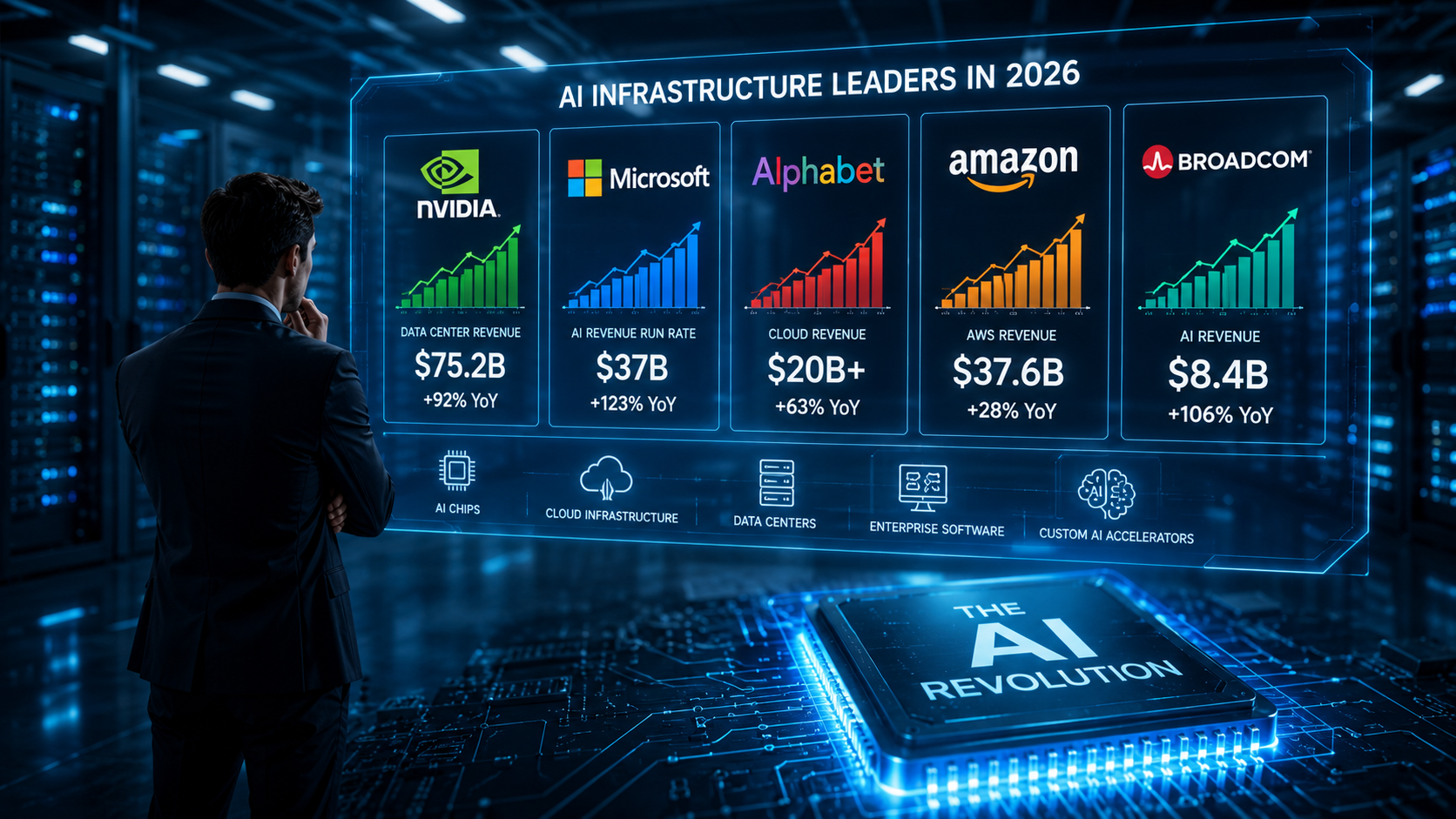
Five companies, five different bets on the same infrastructure buildout. None are without risk – but together they represent where institutional capital is actually flowing in 2026, not just where the headlines point.
Gold vs. Silver: Hedge your portfolio against market volatility-here’s why gold and silver are gaining traction in 2026.
Frequently Asked Questions
Is Nvidia still the best AI stock in 2026?
Nvidia remains the market leader in AI hardware, but investors should also consider valuation, customer concentration, and long-term competition before investing.
Which AI stock has the lowest risk?
Microsoft is generally viewed as one of the more balanced AI investments because its AI business is supported by mature businesses like Microsoft 365, Azure, Windows, and enterprise software.
Should beginners buy individual AI stocks or an ETF?
Investors who don’t have time to follow quarterly earnings or industry developments may prefer an AI-focused ETF for broader diversification. Those willing to research individual businesses may choose selected stocks instead.
Could AI stocks experience another major correction?
Yes. Rapid earnings growth doesn’t eliminate valuation risk. If AI infrastructure spending slows or investor expectations become too optimistic, significant price corrections are possible.
Is AI still a long-term investment theme?
Most analysts believe AI remains a long-term structural trend, but that doesn’t mean every AI-related company will become a successful investment. Business fundamentals still matter more than headlines.
Sources & Further Reading
This article is based on publicly available information from company earnings reports, investor presentations, regulatory filings, and financial publications, including:
- Nvidia Investor Relations
- Microsoft Investor Relations
- Alphabet Investor Relations
- Amazon Investor Relations
- Broadcom Investor Relations
- U.S. SEC Filings (10-K, 10-Q)
- Bloomberg
- CNBC
- Morningstar
- Barron’s
- Yahoo Finance
- The Motley Fool
- Seeking Alpha
Readers are encouraged to review original company filings before making investment decisions.
This article is for informational and educational purposes only and does not constitute investment advice. Stock prices, revenue figures, and forward-looking guidance referenced above are based on publicly available company filings and earnings calls as of June 2026 and are subject to change. Past performance does not guarantee future results. Consult a licensed financial advisor before making investment decisions.