

Last spring, a financial advisor in Ohio told me about a phone call he still thinks about. A client in her late sixties had just opened her annuity statement, seen the guaranteed income figure printed at the bottom, and called him in a slight panic with a question nobody had ever really answered for her: “If the insurance company goes out of business, do I lose all of this?”
He didn’t have a quick answer. Most advisors don’t, not because the information is secret, but because almost nobody asks. People spend weeks comparing interest rates, surrender periods, and rider fees before buying an annuity. Very few spend even ten minutes looking into whether the company standing behind that contract is actually built to keep its promises three decades from now.
That question matters more in 2026 than it has in years. Annuities just had their fourth consecutive year of record sales, with Americans pouring $461.3 billion into these products in 2025 alone, according to LIMRA’s year-end survey. A lot of that money is moving without anyone checking the one factor that determines whether a “guaranteed” income stream is actually guaranteed.
Why Annuities Came Roaring Back
There’s a demographic story behind these numbers that’s worth understanding before anything else. The insurance industry calls it “Peak 65” – the period running through the late 2020s when more Americans turn 65 each year than at any point in U.S. history, north of 4 million annually. A meaningful share of them are reaching retirement without a pension, and many are uneasy about turning a lump sum of savings into income that lasts as long as they do.
Annuities are essentially the only retail financial product built specifically to solve that problem. LIMRA’s research head, Bryan Hodgens, put it plainly in the organization’s year-end release: total annuity sales hit $461.3 billion in 2025, up 6% from the previous year, marking the ninth straight quarter above $100 billion. Registered index-linked annuities – a newer hybrid product – grew 20% to $79.6 billion, while fixed indexed annuities reached $128.2 billion. Interest rates that stayed historically elevated even as the Fed began cutting helped, too. As Athene co-president Mike Downing noted in the company’s 2026 outlook, annuities have been offering close to 2 percentage points more yield than CDs or money market accounts.
None of that growth tells you whether any specific annuity, from any specific company, is actually a sound decision for your retirement. It just explains why so many people are asking the question in the first place.
What an Annuity Actually Is, Without the Sales Pitch
Strip away the marketing language and an annuity is a contract. You give an insurance company a sum of money – sometimes all at once, sometimes over time – and in exchange, the company promises to pay you back, usually as a stream of income, sometimes for the rest of your life no matter how long that turns out to be.
That last part is the entire point. Social Security does this. Old-fashioned pensions used to do this. An annuity is one of the few remaining tools that can replicate that kind of longevity protection for someone who doesn’t have a pension waiting for them.
The trade-off is that you’re handing your money to a private company and trusting its promise over a horizon that might run twenty or thirty years. That’s a very different kind of trust than handing money to a federally insured bank, and the rest of this article is largely about that distinction.
Fixed, Fixed Indexed, and Variable – The Difference That Actually Matters
People often use “annuity” as if it describes one product. It describes a family of products with meaningfully different risk profiles.
A fixed annuity is the simplest version. You deposit money, the insurer credits a guaranteed interest rate for a set period, and your principal doesn’t move with the market. It behaves a lot like a CD, except it’s backed by an insurance company’s claims-paying ability rather than the FDIC. Fixed-rate deferred annuity sales reached $165.3 billion in 2025 according to LIMRA’s final figures – still the largest single category, even after a strong year for stocks pulled some buyers elsewhere.
A fixed indexed annuity links your returns to the performance of a market index, like the S&P 500, but with both a floor and a ceiling. You won’t lose principal if the market drops, but your upside is usually capped through a participation rate or a cap rate set by the insurer. This category just posted its fifth straight year of growth.
A variable annuity puts your money directly into investment subaccounts that function much like mutual funds. Your account value can genuinely go up or down with the market, and unlike the other two types, you can lose principal. Traditional variable annuity sales rose 7% to $65.2 billion in 2025.
Here’s the detail that surprises people: only the fixed and fixed indexed types offer real downside protection on principal. A variable annuity’s market-based gains are not backed by the insurance company’s general account the way a fixed annuity’s guarantees are – which becomes critical the moment you start asking what happens if the insurer itself runs into trouble.
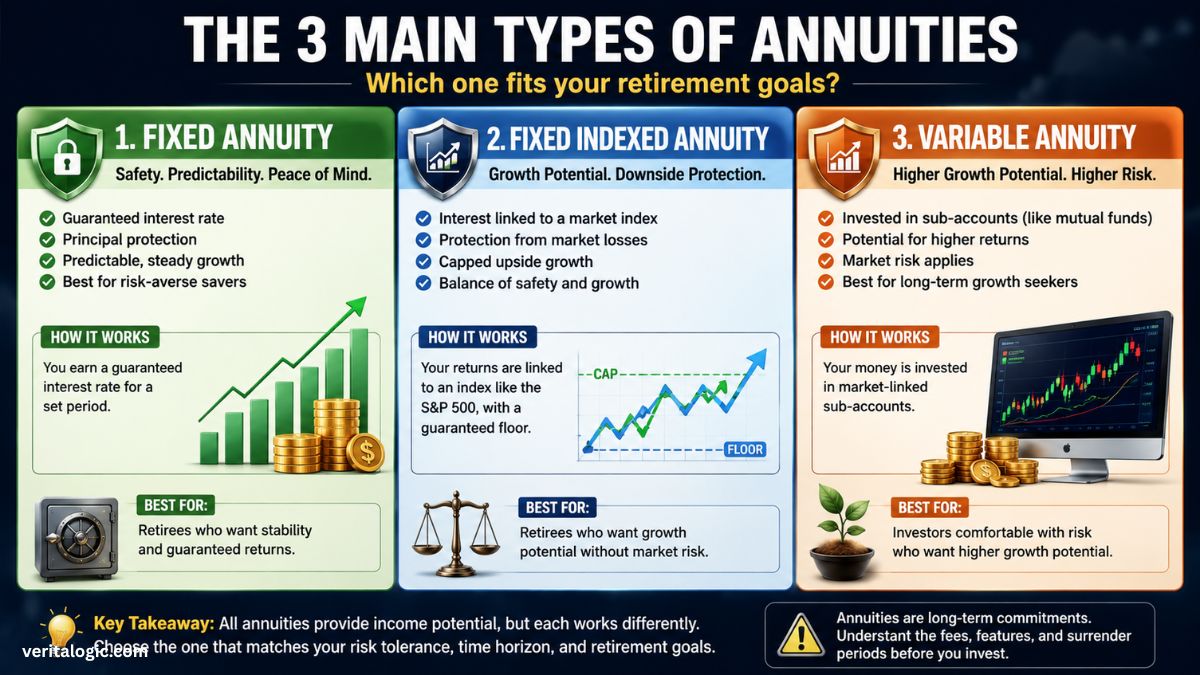
Only fixed and fixed indexed annuities offer real downside protection on principal – a distinction that matters enormously once you start asking what happens if the insurer itself runs into trouble.
Why the Company’s Rating Should Matter More Than the Rate It’s Advertising
This is the part that gets skipped most often, and it shouldn’t be.
An annuity’s guarantee is only as strong as the company making it. Every promise printed in that contract -the income for life, the death benefit, the guaranteed minimum return – depends entirely on the insurer remaining financially able to pay it, potentially decades into the future. That’s why independent credit rating agencies exist, and why a handful of letters and numbers on a one-page summary can matter more than the headline interest rate on the brochure.
Four organizations dominate this space, and each one is judging something slightly different.
AM Best is the agency built specifically around insurance companies, and it’s the one most insurance professionals reference first. Its scale runs from A++ (Superior) down through a series of letter grades into vulnerable territory, and it’s rating the company’s ability to meet ongoing insurance obligations specifically.
S&P Global Ratings, Moody’s, and Fitch Ratings all also rate insurers, using their own letter-grade systems (AAA down through D at S&P and Fitch, Aaa down through C at Moody’s), but their core business is rating debt and creditworthiness more broadly across every industry, not just insurance. When all four agencies rate the same company similarly, that consistency carries weight. When they diverge, it’s worth understanding why before signing anything.
A retiree comparing two annuities offering nearly identical rates should treat the underlying ratings as the tiebreaker, not an afterthought. A company rated A+ by AM Best with a stable outlook and one rated B++ with a negative outlook are not interchangeable, even if their current product brochures look nearly identical.
What Actually Happens If an Insurance Company Fails
This is the scenario nobody wants to think about, and it’s also the one most people misunderstand most completely.
Unlike bank deposits, annuities are not protected by the federal government. There is no FDIC equivalent at the federal level for insurance products. Instead, every state – along with D.C. and Puerto Rico – runs its own state guaranty association, a nonprofit safety net funded entirely by assessments on other insurance companies operating in that state, not by taxpayers.
If an insurer becomes insolvent, the state first attempts rehabilitation. If that fails, a court orders liquidation, and the guaranty association steps in, either transferring the contract to a healthy insurer or continuing payments directly, up to a statutory limit.
That limit is where things get genuinely important to understand. Under the NAIC’s model act, the floor is $250,000 in present value of annuity benefits per person, per company. But coverage isn’t uniform nationwide – roughly 19 states and jurisdictions have raised that limit to $500,000, according to the National Organization of Life and Health Insurance Guaranty Associations, while the rest fall somewhere in between. Many states also apply a separate aggregate cap, often around $300,000, across all policies you might hold with the same failed insurer.
The practical implication is straightforward but rarely discussed by the agent selling you the annuity: if you’re placing $400,000 or $500,000 with a single insurance company, and your state’s limit sits at $250,000, a portion of that money would sit outside guaranty association protection in a true insolvency. One advisor I came across described his standard practice for higher-balance clients as spreading money across three to six different carriers specifically to keep each contract under the relevant state threshold – which is a far more conservative approach than the typical annuity sale takes.
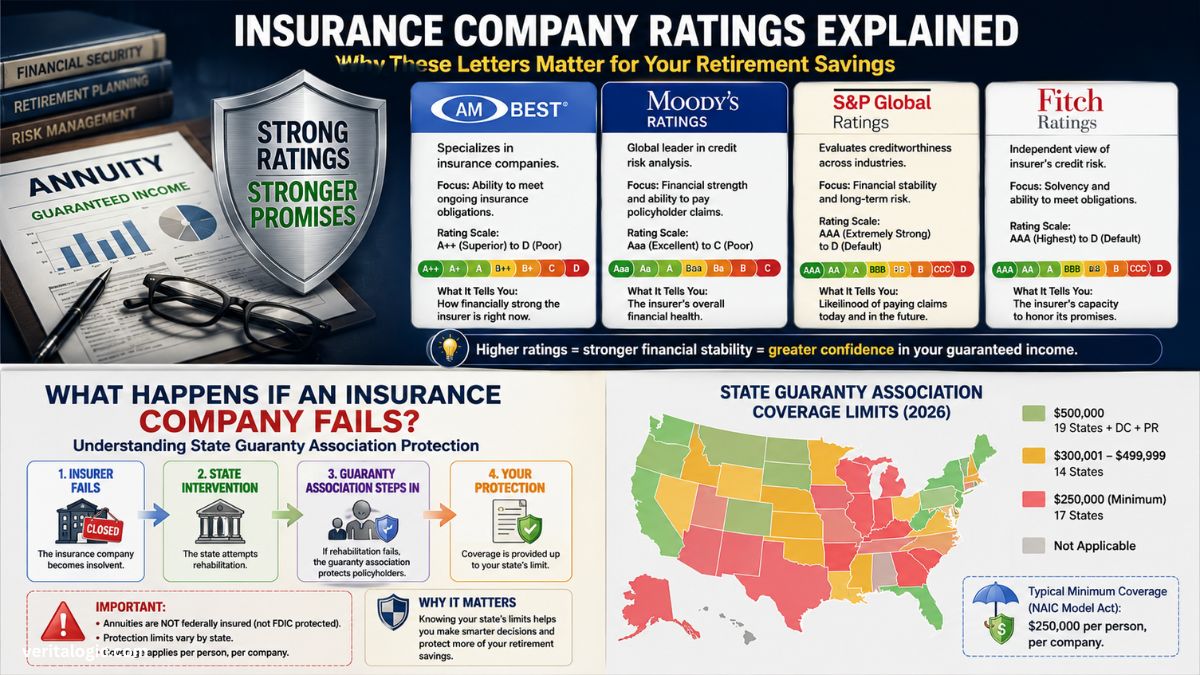
Annuities are not FDIC insured. Protection comes from your state’s guaranty association, with limits ranging from $250,000 in 17 states to $500,000 or more in 19 states plus DC and Puerto Rico. Source: NOLHGA, NAIC Model Act.
It’s also worth knowing that the NAIC’s model act has historically discouraged insurers and agents from using the existence of guaranty coverage as a sales tool, on the theory that it shouldn’t be marketed as a substitute for choosing a financially strong company in the first place. That’s a meaningful signal in itself: the safety net exists, but it isn’t designed to be the reason you buy.
Insurance company failures involving annuities are genuinely rare in the United States – nothing like the scale of bank failures during a financial crisis – but “rare” is not “never,” and the guaranty system exists precisely because regulators have seen it happen.
While annuities offer safety, many investors are simultaneously hunting for growth to beat inflation in 2026. If you’re looking for opportunities beyond fixed contracts, explore our latest research: 5 Best High-Yield Investment Ideas for 2026.
Common Myths Worth Retiring
A surprising number of people believe their annuity works exactly like a bank account, just with an insurance company’s name on it. It doesn’t. There’s no FDIC, no federal backstop, and no $250,000 blanket guarantee that applies automatically and identically everywhere.
Another common misconception: that a high advertised rate signals a strong, safe company. It signals a competitive product. Some of the more aggressive rates in the market have historically come from newer or thinly capitalized carriers trying to build market share quickly. Rate and financial strength are two separate questions, and a high number on page one doesn’t answer the second one.
A third myth, often pushed in the opposite direction by annuity skeptics: that all annuities are bad investments loaded with hidden fees. Some are poorly structured. Plenty of straightforward fixed annuities are not – they’re simple contracts that do exactly one thing reasonably well, which is convert a lump sum into predictable income or steady, protected growth.
When an Annuity Genuinely Makes Sense
The clearest case is a retiree without a pension who is worried specifically about outliving their money. LIMRA’s research has found that more than half of Americans between 61 and 65 hold less than $100,000 in total assets – a population for whom the risk of running out of savings is not theoretical. Converting a portion of savings into a guaranteed income floor, alongside Social Security, can meaningfully reduce that specific risk.
A fixed annuity can also make sense as a conservative alternative to a CD or money market fund for money you’re confident you won’t need for several years, particularly when crediting rates run ahead of comparable bank products, which they frequently have in this rate environment.
Annuities are just one piece of the puzzle. To build a resilient portfolio, you must balance these guarantees with your broader goals. For a comprehensive guide on building a balanced portfolio, see our expert breakdown: Asset Allocation Strategy for Investors.
When It’s Probably the Wrong Tool
If you might need the money within the next few years, most annuities come with surrender periods of six to ten years, and early withdrawals can trigger steep penalties on top of any IRS early-withdrawal tax. That alone disqualifies a lot of situations.
If an advisor is recommending you move a large share of your liquid retirement savings into a single annuity contract with one company, that’s worth real scrutiny – both for concentration risk against guaranty limits and for the simple principle that no single product should usually hold your entire financial life.
And if the explanation of how the product actually works takes longer than the explanation of how great the returns could be, that imbalance is itself a signal.
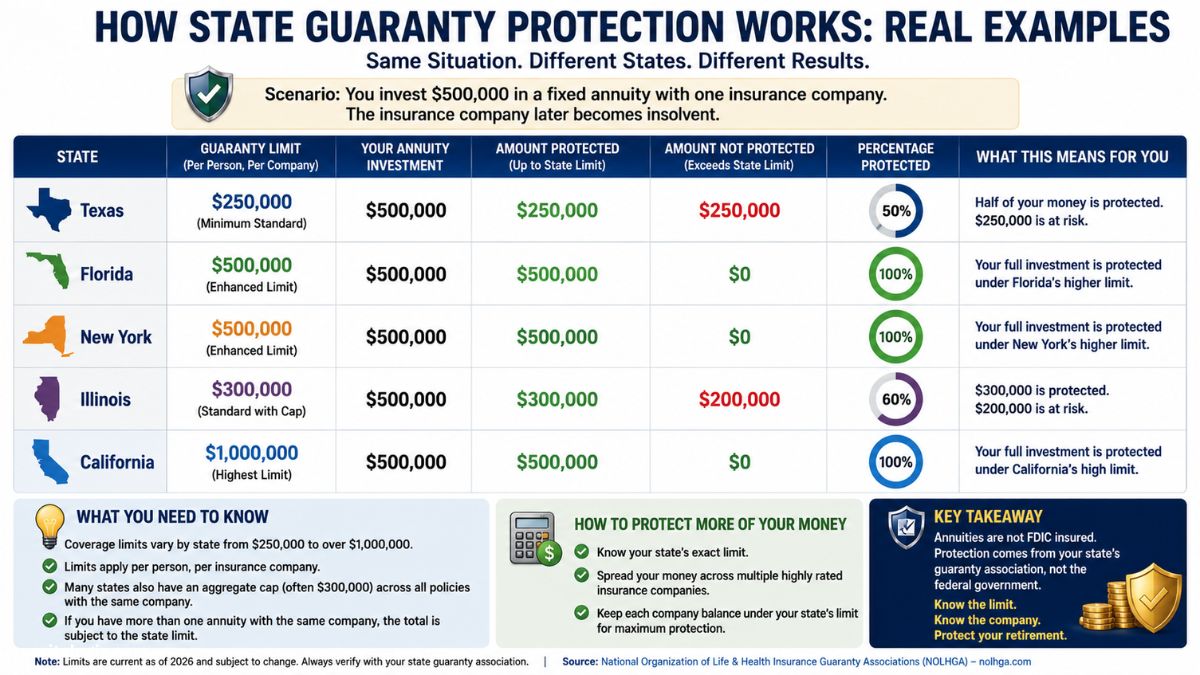
Same $500,000 annuity, five different states, five different outcomes. In Texas, only 50% would be protected. In Florida, New York, and California, the full amount is covered. Knowing your specific state’s limit before you buy is not optional. Source: NOLHGA, 2026.
Questions Worth Asking Before You Sign Anything
What is this specific company’s current rating from AM Best, and has that rating moved up or down in the last two years? What is the surrender period, and what are the penalties if you need the money early? What does the contract actually guarantee, separate from any optional rider, and what do those riders cost annually? What is your state’s specific guaranty association coverage limit for annuities, and does your total balance with this insurer fall under it? And finally – would this same advisor recommend this same product to their own parent, and why?
Red Flags That Deserve a Second Opinion
Watch for pressure to decide quickly, “bonus” rates that look unusually generous relative to the rest of the market, surrender periods that stretch well beyond ten years, and any reluctance to clearly separate the guaranteed portion of a contract from the parts that depend on index performance or company discretion. An advisor unwilling to discuss the insurer’s credit rating, or unfamiliar with how your specific state’s guaranty association works, is a reasonable signal to seek a second opinion before committing.
What Independent Planners Generally Recommend
Fee-only fiduciary advisors – the ones with no commission riding on which product you choose – tend to land in a similar place. Annuities are a tool for a specific job: converting savings into guaranteed lifetime income or protecting principal you can’t afford to lose. They’re rarely recommended as the entire retirement plan. As Transamerica’s Liza Tyler put it in the company’s 2026 outlook, the more useful framing isn’t “annuities versus the stock market” – it’s how a modest, well-chosen guarantee fits alongside growth assets, an emergency reserve, and Social Security to build something that can hold up through both market downturns and a long life.
The practical version of that advice: check the rating before the rate, understand your state’s guaranty limit before you sign, keep any single insurer’s exposure under that threshold if your balance allows it, and read the surrender schedule as carefully as the income projection.
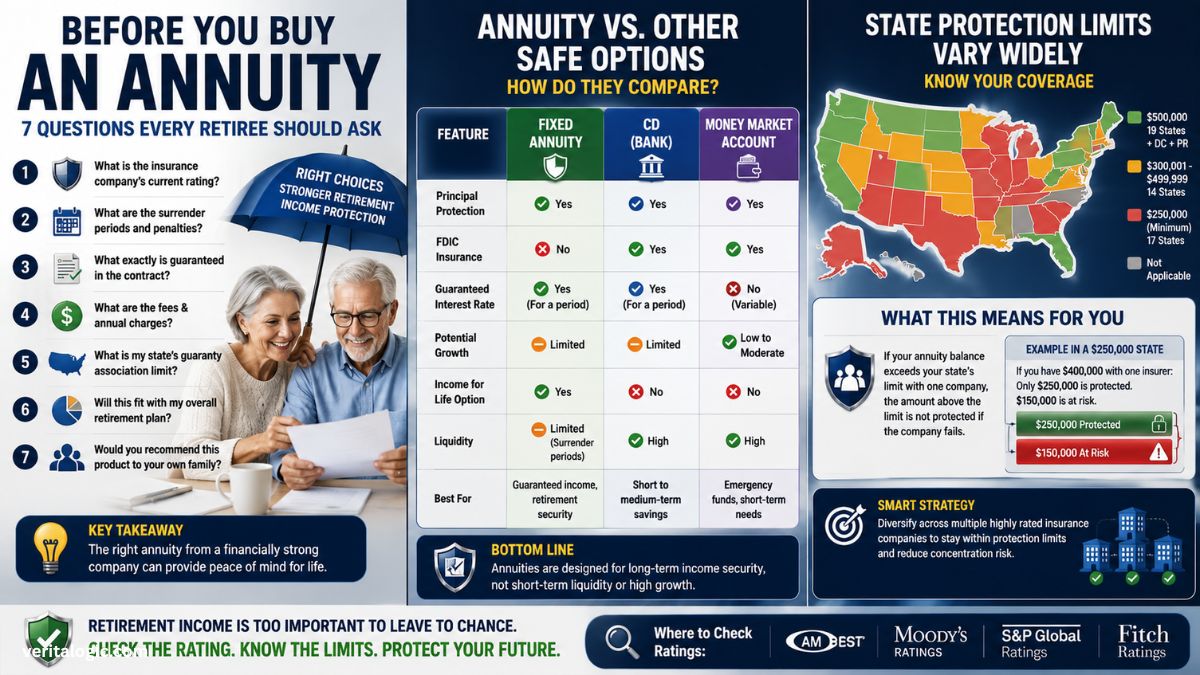
Retirement income is too important to leave to chance. Check the rating, know your state’s limit, and understand exactly what’s guaranteed before signing anything – the right annuity from a financially strong company can provide real peace of mind.
If your portfolio has room for growth assets alongside your income-generating annuities, consider the sectors currently reshaping the global economy. Discover our top picks here: Best AI Stocks for Investors to Own in 2026.
A Final Thought
The advisor in Ohio eventually gave his client a real answer. Her annuity was with a company carrying a strong, stable rating, her balance sat comfortably under her state’s guaranty limit, and the contract itself was a fairly simple fixed product without layers of riders she didn’t understand. She wasn’t fully at risk. But he was honest that the answer could easily have gone the other way with a different company and a different balance, and that nobody at the point of sale had ever walked her through how to check.
That’s really the quiet lesson sitting underneath all the record sales numbers. The annuity industry is larger and more competitive than it has ever been, and that competition has genuinely produced better products in places. But a guarantee is still only as good as the institution behind it, and the institution behind it is something anyone can verify in about the same time it takes to compare two interest rates. Most retirees just never think to look.
Managing your total cost of living is part of a successful retirement plan. Rising insurance premiums impact everyone, regardless of their investment strategy. Learn more about the current insurance landscape in our recent update: Texas Auto Insurance 2026: Why It’s So Expensive.
Editorial Disclaimer
This article is provided for educational and informational purposes only. It is not financial, tax, legal, or investment advice, and it should not be relied upon as a substitute for personalized guidance from a qualified professional. Annuity products, state guaranty association rules, and insurance company ratings can change, and coverage limits vary significantly by state. Before purchasing any annuity or making any retirement income decision, consult a licensed, fee-only financial advisor, and verify current details directly with your state’s guaranty association and the relevant rating agencies.
Sources & References
- LIMRA – Final U.S. Retail Annuity Sales Set New Sales High, Totaling $464.1 Billion in 2025 https://www.limra.com/en/newsroom/news-releases/2026/limra-final-u.s.-retail-annuity-sales-set-new-sales-high-totaling-$464.1-billion-in-2025/
- LIMRA – U.S. Retail Annuity Sales Top $460 Billion in 2025, Marking Fourth Year of Record Sales https://www.limra.com/en/newsroom/news-releases/2026/limra-u.s.-retail-annuity-sales-top-$460-billion-in-2025-marking-fourth-year-of-record-sales/
- LIMRA – The 2026 Annuity Sales Outlook Remains Strong https://www.limra.com/en/newsroom/industry-trends/2026/the-2026-annuity-sales-outlook-remains-strong/
- InvestmentNews – Annuity sales notch fourth straight yearly record amid demand for protection https://www.investmentnews.com/retirement-planning/annuity-sales-notch-fourth-straight-yearly-record-amid-demand-for-protection/265260
- PLANADVISER – LIMRA Predicts Continued Annuity Growth This Year 0https://www.planadviser.com/limra-predicts-continued-annuity-growth-this-year/
- Annuity.org – State Guaranty Associations and Annuity Protection Limits –https://www.annuity.org/annuities/regulations/state-guaranty-associations/
- National Organization of Life and Health Insurance Guaranty Associations (NOLHGA) – FAQs: Product Coverage – https://nolhga.com/policyholders/faqs-product-coverage/
- American Council of Life Insurers (ACLI) – Guaranty Associations – https://www.acli.com/about-the-industry/guaranty-associations
- Federal Reserve Bank of Chicago – Insurance on Insurers: How State Insurance Guaranty Funds Protect Policyholders – https://www.chicagofed.org/publications/economic-perspectives/2024/3
- LegalClarity – Annuity Guaranty Association Coverage: Insolvency Protection https://legalclarity.org/annuity-guaranty-association-coverage-insolvency-protection/
- AM Best – https://www.ambest.com
- S&P Global Ratings – https://www.spglobal.com/ratings
- Moody’s Ratings – https://ratings.moodys.com
- Fitch Ratings – https://www.fitchratings.com
- National Association of Insurance Commissioners (NAIC) – https://content.naic.org