
Over the last several years, I’ve spent time studying consumer behavior, luxury markets, and premium-brand economics.
One of them spent nearly twenty minutes moving between testers, asking the sales associate careful questions, and eventually purchased a bottle priced at $420. The other looked at the same price tag, laughed, and said exactly what most people in that airport were probably thinking: “Who pays that much for perfume?”
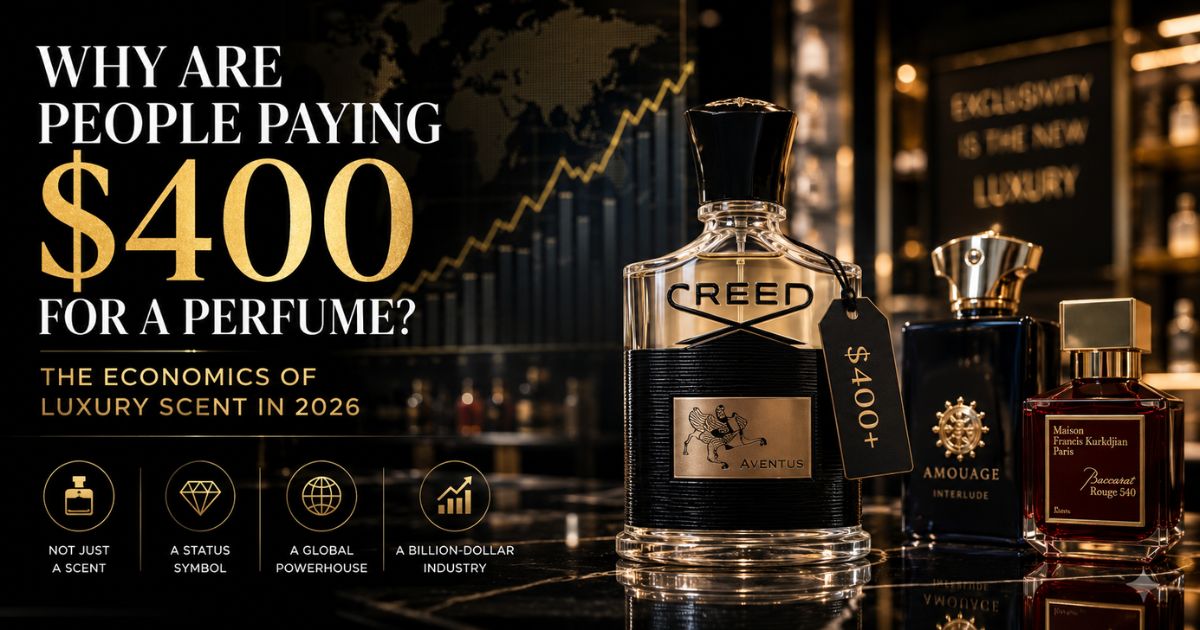
It is a legitimate question. Nobody needs a $400 fragrance to survive. It is not food or housing or healthcare. And yet the global luxury fragrance market – valued at approximately $13.2 billion in 2024 and projected by Grand View Research to exceed $20 billion by 2030 – keeps expanding while consumers in the same breath complain about inflation, grocery bills, and mortgage payments they can barely manage.
That contradiction is worth taking seriously. Because when you actually examine what is driving it, you stop seeing an irrational market and start seeing something more revealing about human behavior than almost any other consumer category currently offers.
They’re Not Selling Scent. They’re Selling a Story About You.
Walk through any serious Luxury Perfume Market or fragrance store – Creed, Maison Francis Kurkdjian, Amouage – and pay attention to what the advertising actually communicates. There is almost no discussion of ingredients. Nobody is breaking down the chemistry or explaining why a particular raw material costs what it does.
Every campaign, without exception, is selling a version of someone you might want to become.
Adventure. Quiet confidence. Old money. Artistic independence. The kind of success that does not need to announce itself.
The fragrance becomes a symbol before it becomes a scent. Consumers understand this, even if they would not describe it in those terms. When someone pays $420 for a bottle of Creed Aventus, they are not simply buying the liquid. They are purchasing the statement that comes with owning that bottle – the recognition it earns from people who know what it represents, and the experience of wearing something most people around them cannot afford.
Economists have a name for goods that become more desirable as their prices rise rather than less: Veblen goods. Luxury fragrances fit this framework precisely. A $45 mass-market fragrance competes on scent alone. A $450 niche fragrance competes on exclusivity – and the price itself is a core part of what makes it exclusive.
That is not irrational consumer behavior. It is a different kind of rationale entirely, and understanding the distinction matters for anyone trying to make sense of where the luxury perfume industry is heading.
The Middle East Quietly Became the Industry’s Most Important Market
If you follow luxury spending patterns, one development over the past decade has received far less mainstream attention than it deserves: the Gulf Cooperation Council has become one of the most commercially critical fragrance markets on earth.
Saudi Arabia, the UAE, Qatar, and Kuwait have longstanding cultural traditions around scent that are structurally different from what most Western consumers experience. Fragrance in the Gulf is not an occasional accessory. It is layered throughout the day, applied before leaving the house, used throughout home spaces, and considered a meaningful expression of hospitality and personal identity. Oud – a dense, woody resin derived from agarwood trees – can sell for thousands of dollars per kilogram and remains foundational to regional perfumery in ways that have no direct Western equivalent.
Global luxury houses noticed. Many now release Gulf-exclusive editions, build collections specifically around regional scent preferences, and open flagship stores in Riyadh and Dubai alongside their Paris and New York locations. For fragrance executives looking at growth projections, the Gulf market is no longer a regional consideration. It has become a strategic priority.
The business logic is straightforward: Middle Eastern fragrance consumers spend significantly more per transaction than their Western counterparts, show strong repeat purchase behavior, and represent a growing affluent class with purchasing power that is still expanding. That combination – high spend, high loyalty, high growth – is precisely what luxury companies seek.
Why Niche Fragrance Houses Are Winning Against Fashion Giants
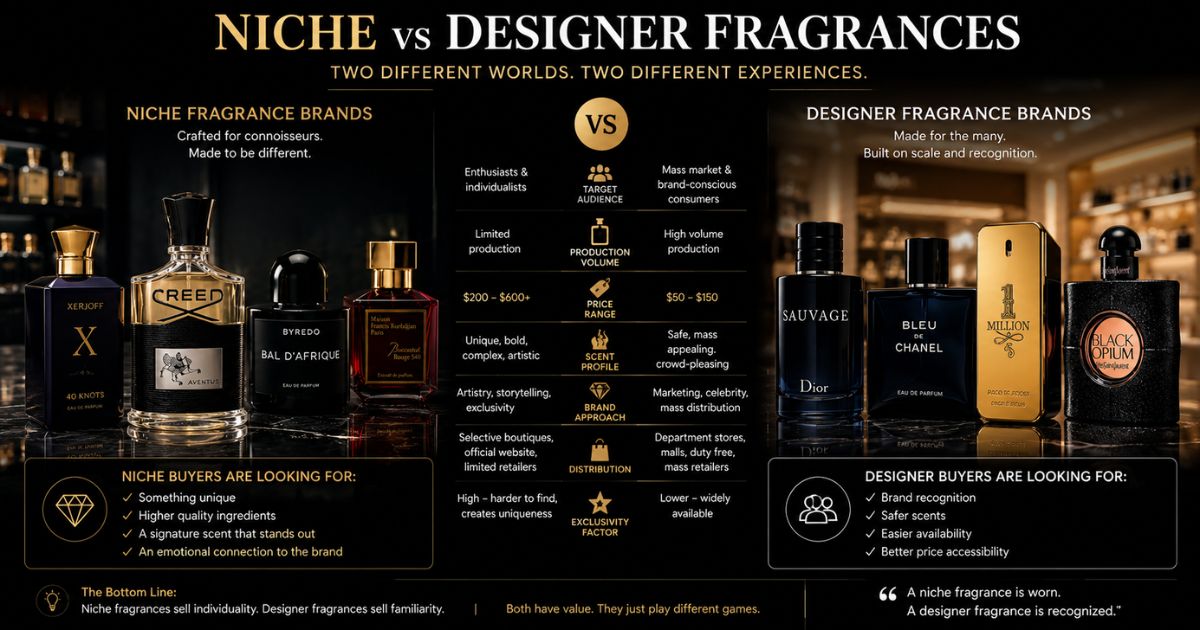
Ten years ago, most fragrance purchases came through recognizable fashion brands. Dior, Chanel, Tom Ford, Giorgio Armani – names built primarily on clothing and leather goods that extended naturally into fragrance through licensing arrangements and mass distribution.
That landscape is changing faster than most legacy players anticipated.
A growing and commercially significant segment of luxury fragrance consumers – particularly younger buyers with disposable income and strong trend awareness – is moving deliberately away from fashion house names and toward independent niche perfumers. Brands like Byredo, Xerjoff, Parfums de Marly, and Roja Parfums have built loyal followings by doing the opposite of what the majors do: producing in smaller volumes, pricing above the market ceiling, and cultivating communities of enthusiasts rather than pursuing mass awareness.
The underlying logic is simple. Once a fragrance becomes widely distributed and widely worn, it loses the exclusivity signal that made it compelling to a status-conscious buyer. When your signature scent becomes something your colleague also wears, it no longer communicates what you intended it to communicate.
Niche houses solve this problem by design. Their customers are not buying a famous name. They are buying differentiation – the confidence that what they are wearing is something most people around them have not encountered and cannot easily find.
Social Media Turned Fragrance Into a Global Conversation
No analysis of the premium fragrance market in 2026 is complete without addressing the role that content communities have played in reshaping it.
YouTube fragrance reviewers with subscriber counts in the millions. TikTok collection tours reaching tens of millions of views. Instagram accounts driving global awareness of niche releases that, twenty years ago, would have been discovered only by walking into a specific boutique in Paris or London.
This content ecosystem transformed fragrance from a private, tactile experience into a social, participatory one. Consumers now research fragrances extensively before purchasing – comparing reviews across multiple creators, studying blind test results, building wish lists from houses they have never encountered in a physical store. The audience for luxury fragrance is better informed than it has ever been, and more demanding as a result.
For independent niche brands, this is a structural advantage that capital alone cannot replicate. A house with limited retail distribution that would previously have taken decades to build a following can now reach a passionate global audience through a handful of influential creators. For legacy brands, the same dynamic creates pressure: reformulation missteps and tone-deaf campaigns now travel as fast as positive reviews.
Luxury Fragrance Market Outlook: What the Numbers Actually Show
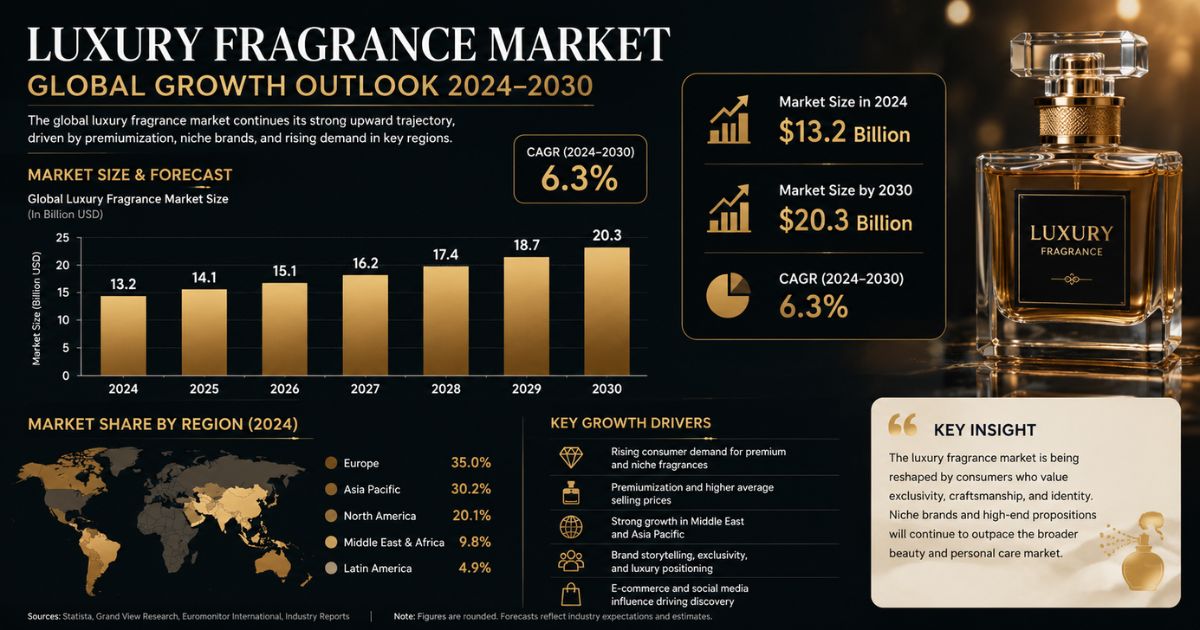
The global luxury fragrance industry does not behave like most consumer categories. It is not particularly sensitive to short-term economic noise. It does not respond to quarterly sentiment surveys the way apparel or electronics do. And in 2026, it continues expanding at a pace that has surprised analysts who expected pandemic-era growth rates to normalize more aggressively.
Industry research firms including Euromonitor and Grand View Research have consistently tracked the premium fragrance segment growing at a compounded annual rate between 6% and 8% through the mid-2020s – outpacing broader personal care and most luxury accessories categories. The driver is not volume. Consumers are not buying more bottles. They are paying considerably more per bottle and are increasingly comfortable doing so.
This is what the industry calls premiumization, and it is reshaping the competitive landscape in ways that were not fully anticipated even five years ago.
The Niche Segment Is a Structural Shift, Not a Trend.
Legacy fashion houses built their fragrance businesses on distribution scale – department stores, duty-free corridors, airport boutiques, mass-market licensing. That model generated enormous revenue, but it created a fundamental tension: the wider the distribution, the more diluted the exclusivity signal.
Independent niche houses understood this tension before the major conglomerates did. Bain and Company’s annual luxury study has repeatedly noted that the most resilient luxury segment caters to consumers who prioritize differentiation over brand recognition. That consumer – growing in both number and purchasing power – is the natural customer for a niche fragrance house. They are not buying something everyone knows. They are buying something most people in the room have never encountered.
Geography Is Rewriting the Industry’s Growth Map.
Asia represents a significant runway for premium fragrance brands willing to invest in education and brand-building rather than immediate conversion. China’s luxury fragrance market remains meaningfully underpenetrated relative to its luxury spending in other categories – a gap that industry analysts at multiple consulting firms have described as one of the more compelling medium-term growth opportunities in the sector.
Affluent Western consumers, meanwhile, are exhibiting what researchers describe as a quiet move away from conspicuous consumption – away from highly visible logos toward what the industry has begun calling stealth wealth signaling. A $500 fragrance from a house that requires explanation is, for this consumer, more interesting than a widely recognized designer name. That behavioral shift benefits niche fragrance brands directly and creates incremental pressure on legacy houses to move their portfolios upmarket.
For a deeper look at how precious metals are sending similar consumer confidence signals in 2026, see our analysis: Gold vs Silver in 2026: A Market Story Few Investors Expected
What Investors Can Learn From Luxury Fragrance Spending
Luxury discretionary spending has a well-established role in investor analysis, though it is frequently oversimplified. The usual framing – that luxury is resilient because the wealthy are insulated from economic pressure – is partially true and mostly incomplete.
The more useful framing is this: the composition of luxury spending tells you something about affluent consumer psychology that aggregate economic data consistently misses.
Fragrance as a Confidence Barometer.
Fragrance occupies an interesting position in the luxury hierarchy. It is accessible enough that a first-time luxury buyer can participate – a $150 bottle from a recognized house is an attainable luxury for a professional with disposable income. It is exclusive enough at the upper end that a $600 niche fragrance communicates genuine financial confidence. And unlike a handbag or a watch, it is consumed. It runs out. The repeat purchase rate creates a recurring revenue dynamic that is relatively rare in luxury goods.
When fragrance sales remain strong or accelerate during periods of broader economic uncertainty, it typically indicates one of two things. Either affluent consumers feel sufficiently insulated from macro pressures to maintain discretionary spending. Or they are trading down from larger luxury purchases – cars, fine jewelry, international travel – into smaller but still meaningful ones. Both readings are analytically useful. Neither is straightforwardly bullish.
The Limitations Analysts Should Not Overlook.
Luxury fragrance data is not uniformly reliable as a leading indicator. The category can be distorted by gifting cycles, travel retail dynamics, and product launch calendars in ways that make quarterly comparisons misleading. A strong fragrance quarter at LVMH’s Parfums Christian Dior division may reflect a successful new launch rather than genuine underlying demand strength.
There is also a bifurcation risk in the data. Ultra-high-net-worth consumers buying $800 limited editions are behaving differently from mass-affluent consumers buying $150 designer fragrances. Aggregating both into a single luxury fragrance growth figure obscures dynamics that matter for anyone trying to draw investment conclusions from the category.
The category is a useful signal. It is not a reliable one when read in isolation.
This behavioral shift isn’t unique to fragrance. We have previously analyzed the broader mechanisms of how luxury brands influence consumer psychology, proving that the desire for exclusivity often overrides traditional price sensitivity.
Industry Research and Expert Perspective
The most instructive read on the luxury fragrance industry does not come from fragrance specialists. It comes from the earnings calls and investor presentations of the conglomerates that hold the largest fragrance portfolios.
LVMH’s Perfumes and Cosmetics division has consistently ranked among the group’s higher-margin segments. Management commentary in recent periods has emphasized deliberate premiumization of the portfolio – reducing the weight of entry-level products and accelerating investment in ultra-premium positioning. That is a margin decision as much as a marketing one, and it signals where the company sees durable pricing power.
Estée Lauder Companies, which holds a significant luxury fragrance portfolio through acquisitions including Le Labo and Editions de Parfums Frédéric Malle, has discussed in investor communications the deliberate separation of its prestige fragrance strategy from its broader beauty business – treating niche fragrance as a distinct growth category requiring different retail, pricing, and community-building approaches.
Puig – the Spanish group controlling Carolina Herrera, Rabanne, and Jean Paul Gaultier fragrances, which completed a notable public listing in 2024 – has been explicit in investor materials about its view that the fragrance category is entering a multi-year premiumization cycle, with consumers willing to spend more per bottle provided the product and positioning justify the premium.
McKinsey’s luxury research has consistently highlighted what it describes as the experience economy dynamic – consumers increasingly valuing what a product communicates about them and the sensory experience it delivers, over its functional utility. Fragrance fits this framework more naturally than almost any other luxury category. Euromonitor has tracked the independent niche segment growing at roughly double the rate of the mass prestige segment in several key markets – a divergence that, if sustained, will eventually force major conglomerates to acquire niche brands, build them internally, or accept meaningful share loss in the fastest-growing part of their category.
Several of those acquisitions have already occurred. When large conglomerates begin buying independent niche brands at premium valuations, they are not expressing sentimentality about artisanal perfumery. They are following the consumer.
The Fragrance Investment Nobody Takes Seriously – Until They See the Resale Prices
Most people think of perfume as something you buy, use, and replace. A consumable with no residual value.
That framing misses a small but genuinely interesting secondary market. Discontinued fragrances from major houses routinely trade at meaningful premiums to their original retail prices. Limited edition releases – particularly numbered bottles or collaboration pieces produced in small quantities – sometimes appreciate substantially. Certain vintage bottles have sold at multiples of what they originally cost at retail.
This is not a reliable investment category and should not be treated as one. Most fragrances will not appreciate, and the storage, authentication, and liquidity challenges of building a fragrance collection for investment purposes are considerable. But the existence of this secondary market reveals something worth noting: when genuine scarcity meets a passionate collector base, pricing can detach from production costs in ways that look familiar to anyone who has watched vintage wine, rare sneakers, or limited-edition watches.
Scarcity creates secondary markets. It is a pattern that repeats across almost every category where supply is genuinely constrained and desire is genuinely strong. Luxury fragrance, in this respect, is simply a more fragrant version of a very old economic story.
Sources and Research References
Market size, growth forecasts, and luxury fragrance industry outlook are based on data from Grand View Research luxury perfume market reports and industry analysis.
Key Data References:
- Grand View Research – Luxury Perfume Market Size & Trends Report (2025–2030)
- Grand View Research – Luxury Perfume Market Growth & Industry Outlook
- Grand View Research – Global Flavors & Fragrances Market Forecast
Industry commentary, consumer behavior observations, and market analysis presented in this article reflect the author’s independent interpretation of publicly available research, industry reports, and company investor communications. Readers are encouraged to review the original research sources for the latest market figures and methodology details.
Disclaimer
This article is written for educational and informational purposes only. It reflects independent analysis of publicly observable luxury market dynamics, industry research, and publicly available company communications. Nothing in this article constitutes financial, investment, purchasing, or commercial advice of any kind.
Market size figures cited are drawn from publicly available industry research reports and should be verified independently. References to LVMH, Estée Lauder Companies, Puig, Bain and Company, McKinsey, Euromonitor, and Grand View Research reflect publicly available information and do not imply any affiliation, endorsement, or commercial relationship with VeritaLogic.
VeritaLogic is an independent publication. The author holds no position in any company mentioned in this article and received no compensation from any fragrance brand, retailer, conglomerate, or related commercial entity in connection with this article.
All observations and analysis are those of the author based on publicly available information as of June 2026. Reader discretion is advised. Consult qualified professionals before making any financial or commercial decisions.